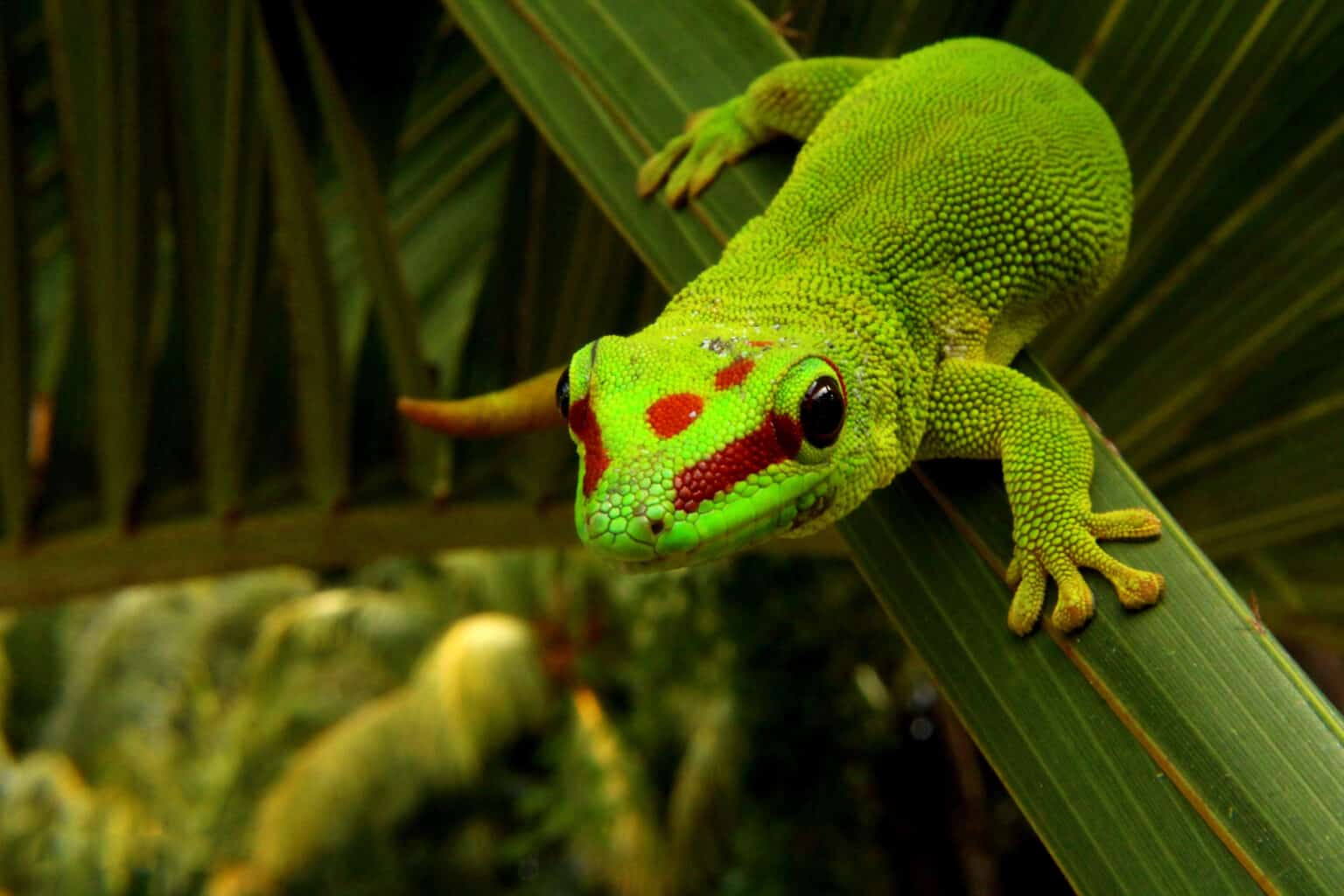
5 Incredible Gecko Facts!
Besides their infamous appearance on a series of car insurance commercials, you may not know that much about geckos! They are amazing creatures and use their toes to help them stick to any surface besides Teflon.
Contrary to popular belief, geckos don’t necessarily have “sticky” toes that stick like glue. They cling to surfaces with ease thanks to what is known to nanoscale hairs known as setae. If you can imagine, 6.5 million setae on a single gecko can support enough force to hold the weight of two people.
Geckos’ eyes are at least 350 times more sensitive to light than the human eye.
Geckos are standouts among the reptile class in a number of respects:
- These reptiles can climb practically every vertical surface effortlessly thanks to the tensile suction created by hundreds of thousands of tiny hairs on their toes.
- Geckos are the only lizards with true vocal cords.
- These reptiles clean their eyes by licking them.
- When they lose their tails to predators, they can regenerate new tails.
- These reptiles replace their teeth by growing new ones every three to four months.
Scientific name
These animals belong to a taxonomic group that shares the designation “squamate reptiles.” “Squamate” is derived from the Latin word “squamatus,” which means scaly, although these reptiles themselves don’t have scales. They belong to the infraorder Gekkota, a name thought to derive from the Indonesian-Malay “gēkoq,” which is a transliteration of the sound this animal makes.
The infraorder Gekkota is comprised of seven families:
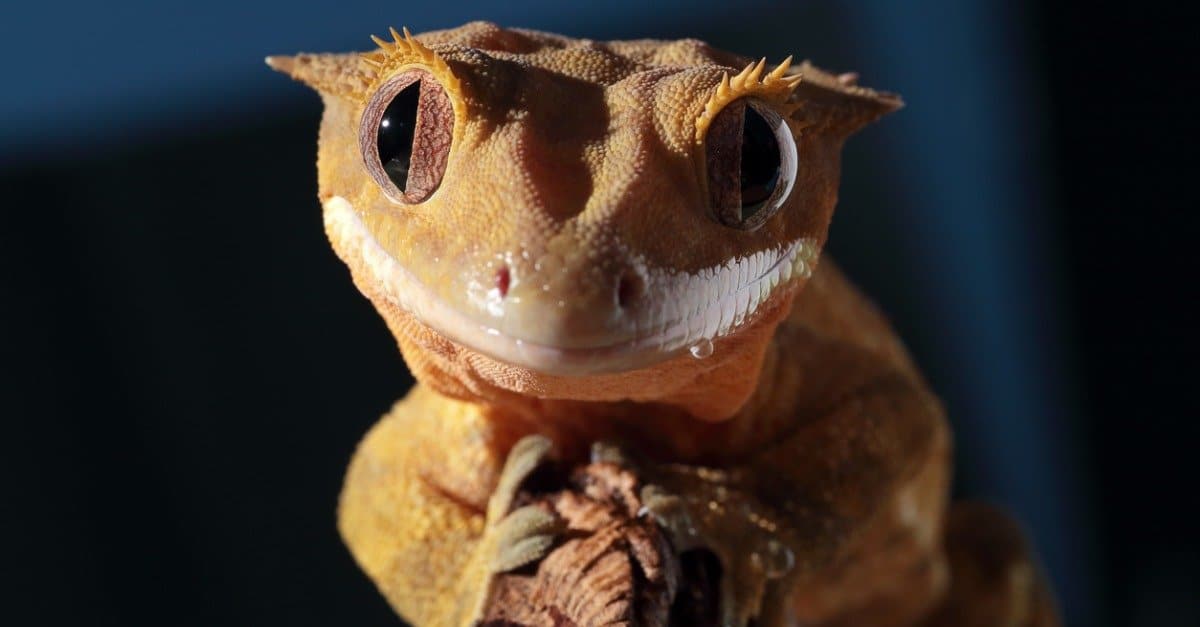
- Diplodactylida: This family includes 137 species in Australia, New Zealand, and New Caledonia. Its scientific name is derived from the Greek words for double (“diplo”) and finger (“daktylos.”) The crested gecko, a popular pet, is a member of this family.
- Carphodactylidae: Carphodactylidae is another family of Australian geckos, comprising 30 species. Its scientific name derives from the Greek words for finger and straw (“karphos”.)
- Pygopodidae: Pygopodidae look like snakes but are really geckos. The family consists of 35 species, native to Australia and New Guinea. “Pygo” is a Greek word for rump while “podi” is the Greek word for feet, so the family’s name roughly means “feet in their bottom.”
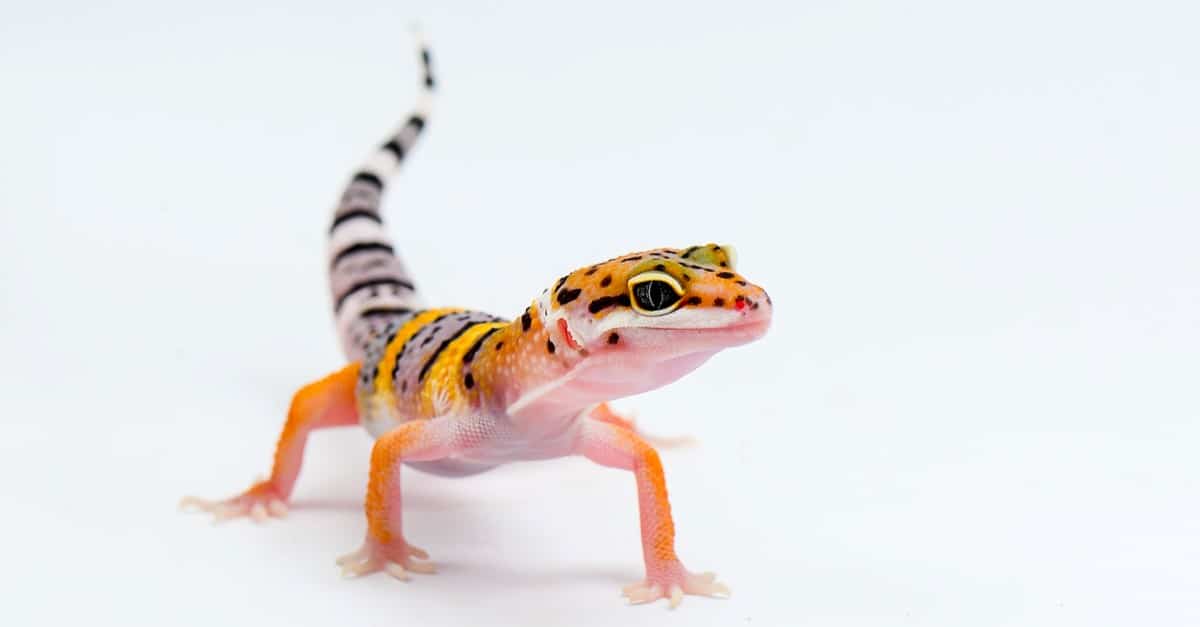
- Eublepharidae: Eublepharidae is a family of 30 species found in Asia, Africa, and North America. They are distinguished from other species by their moveable eyelids and their lack of adhesive toepads. This genus includes the leopard, the fat-tailed, and the clawed gecko.
- Sphaerodactylidae: The Sphaerodactylidae family includes more than 200 species distributed throughout all parts of the world. The scientific name derives from the Greek words for round (“sphaero”) and finger (“dactyl.”)
- Phyllodactylidae: “Phyllo” is the Greek word for leaf, and many of the 148 species that belong to this family are known as leaf-toed geckos. Phyllodactylidae is found in all parts of the world.
- Gekkonidae: Gekkonidae, or the common gecko, is the most widespread family, containing more than 950 species. Well-known species include the house, the tokay, the leaf-tailed, and the day gecko.
Evolution and Origins
Researchers have traced the oldest known gecko fossil to 100 million years old. Reptiles are thought to have descended from a common ancestor, which can be dated back to the Carboniferous Period, which occurred between 300-350 million years ago. The oldest known reptile fossil is hylonomus, and it has been estimated to date back 315 million years.
The exact time when geckos developed their remarkable climbing feet is unknown. A fossil found 100 million years old showed the tail and feet of a gecko, including the setae, or tiny hairs on the feet. Other adaptations that have been observed in modern species, like camouflage and the leaf-tailed gecko’s distinct tail resembling a dried leaf, demonstrate how far they have come from their ancient ancestor.
Human beings have been in awe of the gecko for its ability to stick to virtually any surface. Its feet are able to do this by using Van Der Waals, an electrical attraction between molecules, and the structure that makes it possible is called setae, which consists of millions of individual hairs. Scientists have even been working to recreate these hairs in order to produce their own adhesives.
Humans have identified five distinct subfamilies of geckos, and there are currently over 2,000 known species of these reptiles in the world, according to the Global Gecko Association. Geckos come in various colors and shades, with some being able to blend in with their surroundings. Additionally, some female geckos have the remarkable ability to reproduce without a mate, such as the mourning geckos.
Appearance
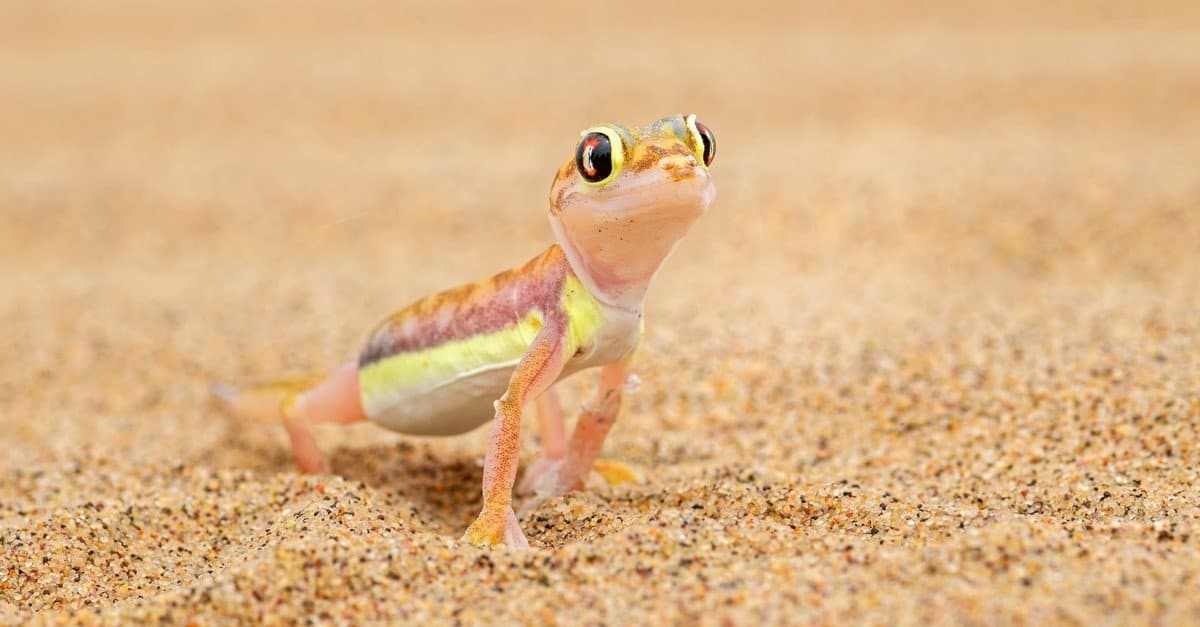
These reptiles are small lizards with stubby bodies, large heads, tails, and—except for members Pygopodidae family—prominent limbs. The animal’s color varies widely across species. The majority are grey or brown, the better to blend in with the rocks, sand, and dirt around them and so, to escape the notice of predators. However, the leopard gecko has bright yellow skin covered with brown spots. Some geckos are electric blue. The crested gecko is orange or red, while the tokay gecko has bright orange spots.
Their tails also vary widely in shape and morphology, depending upon the species. Some are long and tapering, while others are shorter and blunter or even globular. These reptiles store fat in their tails so they’ll have access to calories when food sources are scarce. Their tails have evolved to fall off easily when the animal is pursued by predators. When this happens, the animal will regenerate its tail. Their tails actually have their own nerve control center that allows the tail to move and lunge independently for up to half an hour after their separation from the body.
These reptiles have approximately 100 teeth. Their teeth don’t grind down because they replace their teeth every three to four months.
Their skin is covered with millions of infinitesimal, hairlike spines that are very soft to the touch. These spines trap water droplets that keep dust and other air contaminants away from the gecko’s skin. The microscopic hairs that cover their toes are called “setae.” These hairs work differently than the hair that covers the animal’s body. Setae are actually tiny enough to activate molecular Van der Waals forces that enable geckos to easily climb vertical surfaces, like walls, and even to move comfortably on ceilings.
Diet
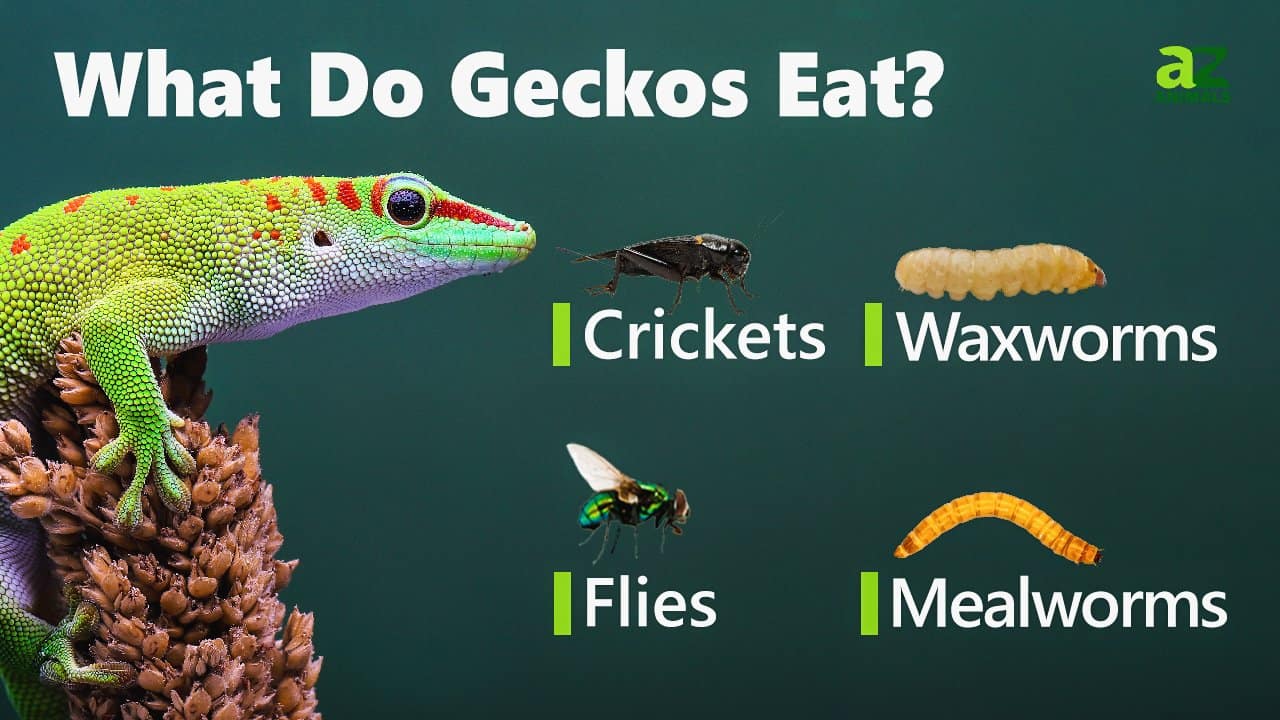
These reptiles are primarily insectivores, but they also eat worms, fruit, and flower nectar. Leaf-tailed geckos like to snack on land snails. Large species of geckos, such as the New Caledonian gecko, have even been known to eat small birds and rodents.
What eats geckos?
Snakes, birds, spiders, and cats.