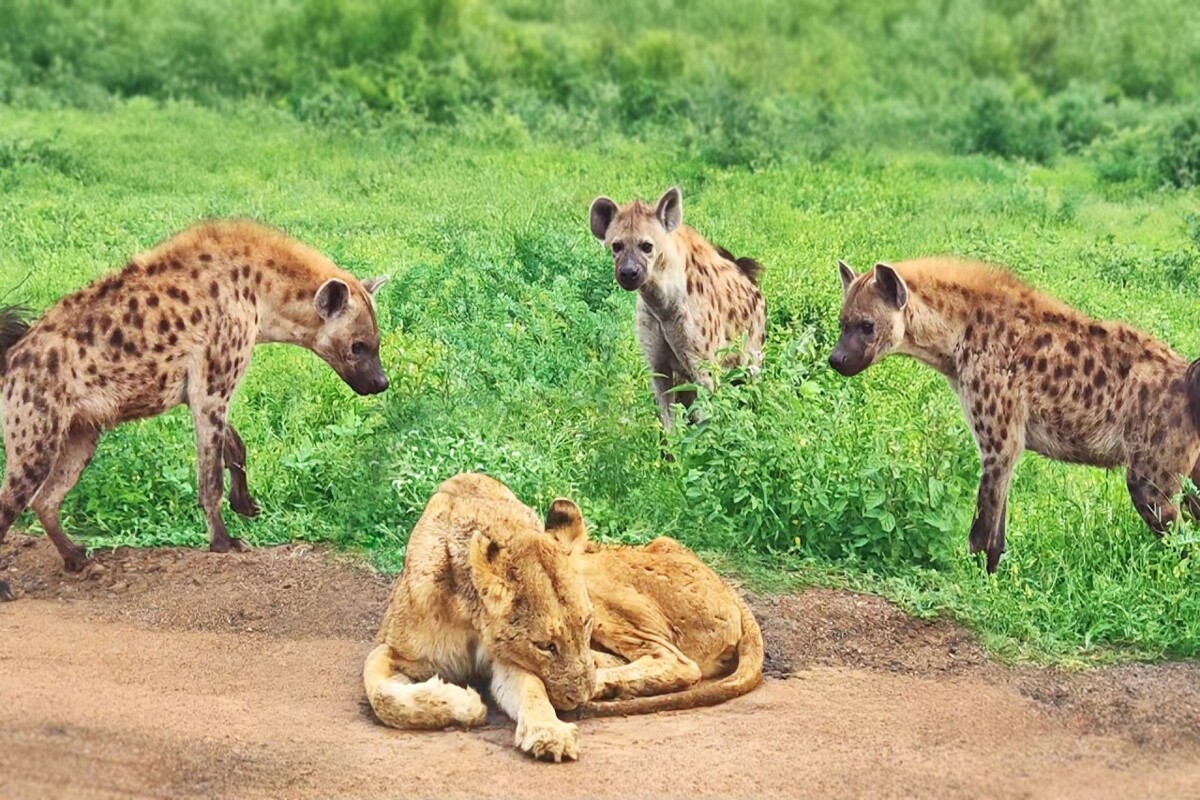
A road through Kruger National Park suddenly became the dining room for an entire lion pride.
There were lions everywhere.
Some were crowded around a huge buffalo carcass, others were resting nearby, and one particularly large lioness appeared to be keeping a close eye on everything happening around the kill.
For safari-goer Abdurrashid Dhodhat, who had been hoping his children would get to see some lions, this was far more than they expected.
They had not just found one lion.
They had found almost the entire pride.
The incredible sighting took place on the S23 road, past Biyamiti Weir in Kruger National Park, South Africa. Abdurrashid captured the footage and sent it to Latest Sightings, which published the encounter on October 3, 2026.
Watch the original Latest Sightings report
A Feast For The Whole Pride
The first thing that stands out is just how many lions were gathered around the carcass.
There were so many bodies surrounding the buffalo that the carcass itself was almost completely hidden from view.
Almost the entire pride appeared to be taking advantage of the meal.
Some lions were actively feeding, while others were lying beside the road.
Those resting lions may already have eaten their share, or they may simply have been waiting for an opportunity to move closer. From the footage alone, it is impossible to know exactly why each individual was resting.
But one thing was obvious.
There was plenty of food.
African lion facts — Discover Wildlife
Meet The African Lion
The animals surrounding the carcass were African lions (Panthera leo), one of the world’s most recognizable big cats.
Animal Diversity Web — African Lion (Panthera leo)
Lions are unusual among cats because they live in social groups called prides. Their social lifestyle also influences how they hunt, feed and defend food.
Animal Diversity Web notes that lions hunt a wide range of large mammals and that hunting in groups can increase hunting success. It also records buffalo among the large prey targeted by some lion prides.
That makes the buffalo lying in the middle of the S23 road a particularly valuable prize.
It was not a meal for one lion.
It was potentially food for an entire social group.
Meet The Cape Buffalo
The victim was an African buffalo (Syncerus caffer), a large and notoriously formidable member of Africa’s savanna ecosystem.
Animal Diversity Web — African Buffalo (Syncerus caffer)
African buffalo can weigh hundreds of kilograms, with Animal Diversity Web recording a broad species mass range extending from less than 300 kilograms to more than 835 kilograms.
They are also dangerous animals for lions to tackle.
Buffalo are known for defending themselves aggressively, particularly when several members of a herd can respond together. Bulls can even successfully fend off attacking lions.
That is what makes a successful lion kill of a buffalo such a valuable prize.
The lions have not simply found an easy meal.
They have secured one of the more difficult prey animals in the African bush.
A Successful Hunt
By the time Abdurrashid arrived, the difficult part was already over.
The lions had made the kill.
The footage does not show how the buffalo was brought down, so there is no reason to invent a dramatic account of the hunt itself.
What the cameras did capture was the aftermath.
And the aftermath was spectacular.
The pride had gathered around the carcass and was feeding almost simultaneously.
For the lions, this was the reward for the earlier effort.
Eyes On The Prize
A buffalo carcass is not something a pride can simply leave unattended.
The smell of a fresh kill can attract other carnivores and scavengers from surprisingly far away.
Hyenas are obvious competitors.
But they are not the only animals that could benefit from a lion kill.
Other predators and scavengers can also investigate an opportunity when they hear or smell a disturbance.
Latest Sightings specifically notes that the commotion surrounding a large buffalo kill could attract other meat-eating animals looking for an easy meal.
That may help explain the behavior of one particularly large lioness.
The Lioness On Patrol
While most of the pride was eating, one enormous lioness seemed to have a different job.
She was not focused on the carcass.
Instead, she moved around the area while repeatedly looking outward.
It looked almost as though she was patrolling the perimeter.
Latest Sightings suggests that she may have been watching for scavengers or potential threats approaching the kill. The report also notes that the nearby safari vehicles may have been another possible focus of her attention.
We cannot know precisely what was going through her mind.
But her behavior created an interesting contrast.
Most of the pride was eating.
One lioness was watching.
A Valuable Meal Attracts Competition
Lions are predators, but they are also opportunistic scavengers.
They can take advantage of carcasses they did not kill themselves.
The same principle applies to other carnivores.
A fresh carcass represents a large amount of energy without the cost of hunting.
That is why kills can become centers of competition.
A pride has invested energy in obtaining its food.
Allowing another predator to arrive and take part of the carcass can reduce the reward.
So staying alert around a kill makes sense.
The Road Becomes A Dining Room
The lions had spread across the S23 road.
For the safari vehicles approaching the scene, there was simply nowhere to go.
The pride was occupying the road.
Some vehicles had approached from one direction and were forced to stop because of the number of lions around the carcass.
Abdurrashid was particularly fortunate.
He had approached from the opposite direction.
That gave him an unusually clear view of the feeding pride.
Instead of seeing the back of a long line of safari vehicles, he had a front-row view.
Front Row Seats
Safari sightings are often about luck.
You can spend hours searching for lions and see nothing.
You can drive through exactly the same area the following day and find a pride lying directly beside the road.
For Abdurrashid and his family, the timing could hardly have been better.
They had been hoping to find lions.
Instead, they found a whole pride gathered around a buffalo.
And because they had approached from the opposite direction, they had a relatively unobstructed view.
Then Came The Cub
Among all the adults surrounding the carcass was an especially entertaining sight.
A small lion cub hurried across the road.
The youngster moved from one side to the other while the larger lions continued feeding.
It was a tiny animal in the middle of a very large gathering.
Smithsonian’s National Zoo — Lion information
Young lions remain dependent on the pride while they develop the physical and behavioral abilities required for adult life.
The cub in this sighting was therefore not simply a miniature adult.
It was still growing into the role it will eventually occupy within the pride.
A Buffalo Can Feed A Lot Of Lions
The size of the carcass explains why so many lions were able to gather around it.
A successful buffalo kill represents a substantial food resource.
Lions are large carnivores with high energetic demands, and a large carcass can provide food for numerous pride members.
Animal Diversity Web records that African lions consume a variety of mammals, with larger prey such as buffalo forming part of the diet of some prides.
For a pride, a buffalo is therefore the equivalent of a large communal meal.
Everyone has a reason to be nearby.
Feeding Time Can Be Competitive
A pride may look peaceful when many lions are lying around a carcass.
But feeding can be surprisingly competitive.
Lions have to navigate the presence of other pride members while trying to obtain enough food.
Males, females and younger animals may have different access to the carcass depending on the social circumstances.
Animal Diversity Web notes that males can be particularly aggressive around food, even though females often carry out much of the hunting.
So a large feeding gathering is not necessarily a perfectly organized dinner.
It is a social negotiation around a limited resource.
Why Some Lions Were Resting
Several lions were lying beside the road rather than feeding.
There are several possible explanations.
They may already have eaten.
They may have been waiting.
They may simply have been resting between feeding bouts.
Lions spend substantial amounts of time resting, and after a successful hunt there is little reason to waste energy.
But we cannot determine the exact reason for each resting animal from the footage.
The important point is that the pride had enough food for some individuals to step away from the immediate feeding frenzy.
The Buffalo Had Changed Everything
Before the kill, the pride had to hunt.
After the kill, the priorities changed.
Now they had to:
eat, protect the carcass and avoid losing the food to competitors.
That is why the lioness moving around the outside of the group is so interesting.
The hunt may have been finished, but the competition over the carcass was not necessarily finished.
A Kill Attracts More Than Lions
A buffalo carcass can become a gathering point for an entire community of scavengers.
Spotted hyenas, vultures and other scavenging animals may all take advantage of remains when the opportunity appears.
National Geographic — African Lion Facts
The lions therefore had a reason to make the most of their advantage while they had it.
The more of the buffalo they could consume before competitors arrived, the less food would remain.
The Pride Had Numbers On Its Side
There was another advantage to having almost the entire pride present.
They did not have to leave the carcass completely unattended while other members went elsewhere.
The group was already there.
That meant the lions could continue feeding while maintaining a large social presence around the kill.
Latest Sightings points out that with so much of the pride already gathered, the lions could make full use of the buffalo before scavengers had much opportunity to feed.
What Happens To The Carcass?
With so many lions feeding, a buffalo carcass can disappear surprisingly quickly.
Muscle tissue is consumed.
Organs are removed.
Skin and connective tissue may be pulled apart.
Eventually, the larger remains become accessible to scavengers.
By the time other animals reach the site, there may be very little left.
The original report suggests that with the entire pride feeding, scavengers would likely have been left with little more than bones.
The Circle Continues
Even after the lions have finished, the story is not necessarily over.
Bones, scraps and other remains can provide food for scavengers and decomposers.
Vultures may clean exposed tissue.
Hyenas can crush and consume bones.
Insects and microorganisms continue the process afterward.
A kill therefore moves energy through the ecosystem in several stages.
The lions are simply the most visible part of that process.
Why Buffalo Are Such Dangerous Prey
African buffalo are not passive animals.
SANBI — African Buffalo information
Animal Diversity Web describes buffalo as formidable prey because of their size, aggression and anti-predator behavior. Buffalo can gather into large herds, increase vigilance and respond aggressively to threats.
Lions therefore have to choose their opportunities carefully.
A successful buffalo hunt is a major achievement.
It is also one reason a carcass can be so valuable once the danger of the hunt has passed.
Lions And Buffalo Have A Long History
Across African savannas, lions and buffalo are locked into one of the classic predator-prey relationships.
Buffalo have evolved defenses against lions.
Lions have evolved strategies for hunting buffalo.
The relationship is constantly changing.
A buffalo herd may detect lions and move away.
A lion may wait for a vulnerable individual.
Several lions may cooperate.
A buffalo bull may turn and fight.
The outcome depends on circumstances.
This Was Not An Ordinary Lion Sighting
Seeing one lion beside a road is already exciting for many safari-goers.
Seeing two or three is memorable.
Seeing an entire pride feeding on a buffalo is something else entirely.
The animals were not hidden deep in thick vegetation.
They were directly across the road.
Vehicles were forced to stop.
The lions had effectively taken over the S23.
For everyone watching, the road had become an unexpected wildlife theatre.
A Cub In The Middle Of It All
Perhaps the most charming detail was the little cub crossing the road.
While the adults were focused on the buffalo, the youngster hurried across the scene.
For the people watching, it provided a completely different perspective on the sighting.
The buffalo kill was dramatic.
The adult lions were impressive.
But the tiny cub reminded everyone that this was also a family group.
A pride is not simply a collection of hunters.
It is a social community containing adults and young animals at very different stages of life.
The Pride Has To Make Every Meal Count
Life for a lion pride is energetically demanding.
Hunting is risky.
Success is never guaranteed.
And large meals cannot be taken for granted.
That is why a successful buffalo kill can be so valuable.
A large carcass can provide substantial nutrition to many members of the pride.
The lions in this sighting were therefore making full use of an opportunity that had already cost them considerable effort to obtain.
The Roadside Spectacle
There was something almost surreal about the setting.
Cars and safari vehicles on one side.
Lions spread across the road.
A buffalo carcass in the middle.
And a cub wandering through the scene.
This is one of those moments when the boundary between a normal road and the wild seems to disappear.
The vehicles had to wait.
The lions had priority.
Giving Wildlife Space
Although the vehicles were close enough to observe the lions, the animals remained wild.
A lion guarding a carcass can be unpredictable.
The presence of multiple lions, a food source and a cub makes the situation even more important to treat cautiously.
Wildlife-viewing guidelines generally emphasize keeping a safe distance, avoiding sudden movements and never attempting to interfere with animals around a kill.
The best wildlife encounters are the ones where the animals remain completely in control of the situation.
A Meal Worth Waiting For
For the lions, there was no need to rush.
The buffalo was already down.
The pride was together.
The food was available.
The surrounding area was being watched.
All they had to do was eat.
That may be why the sighting feels so calm despite the violence that must have preceded it.
The drama had already happened.
The cameras arrived for the aftermath.
All In A Day’s Work
Eventually, the lions would leave the road.
The buffalo would be reduced to scraps and bones.
The vehicles would move on.
And the S23 would become a road again rather than a lion dining room.
But for the people who witnessed it, this was far more than an ordinary safari drive.
They had gone looking for lions for the children to see.
They found an entire pride.
And the pride had found dinner.
Watch The Original Wildlife Footage
The sighting was filmed by Abdurrashid Dhodhat in Kruger National Park, near the S23 road past Biyamiti Weir. Latest Sightings published the report on October 3, 2026.
Entire Lion Pride Eat Buffalo In The Road — Latest Sightings
The original report is particularly worth seeing for the scale of the pride, the patrolling lioness and the small cub crossing the road.
More Wildlife Stories From khxyz
If you enjoy dramatic predator and prey encounters, you can also explore these wildlife stories from khxyz:
- Wild Dogs Want to Save Brother From Lion
- Impalas Try Jumping Over 7 Lions
- Cornered Bushpig Tries Fighting 5 Lions
- 4 Porcupines Teach 3 Lions a Painful Lesson
- Lion Cub Learns Why You Don’t Bite Dad’s Tail
- Lioness Teaches Tiny Cubs to Climb Tree