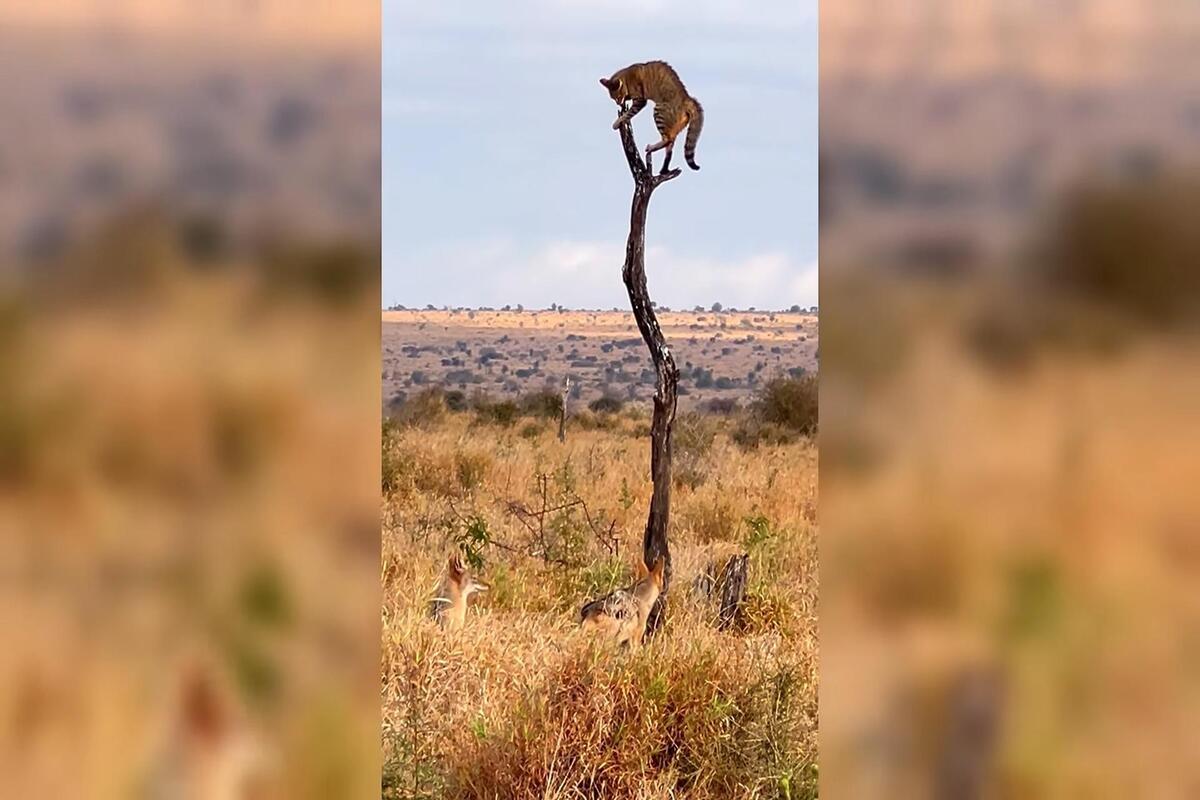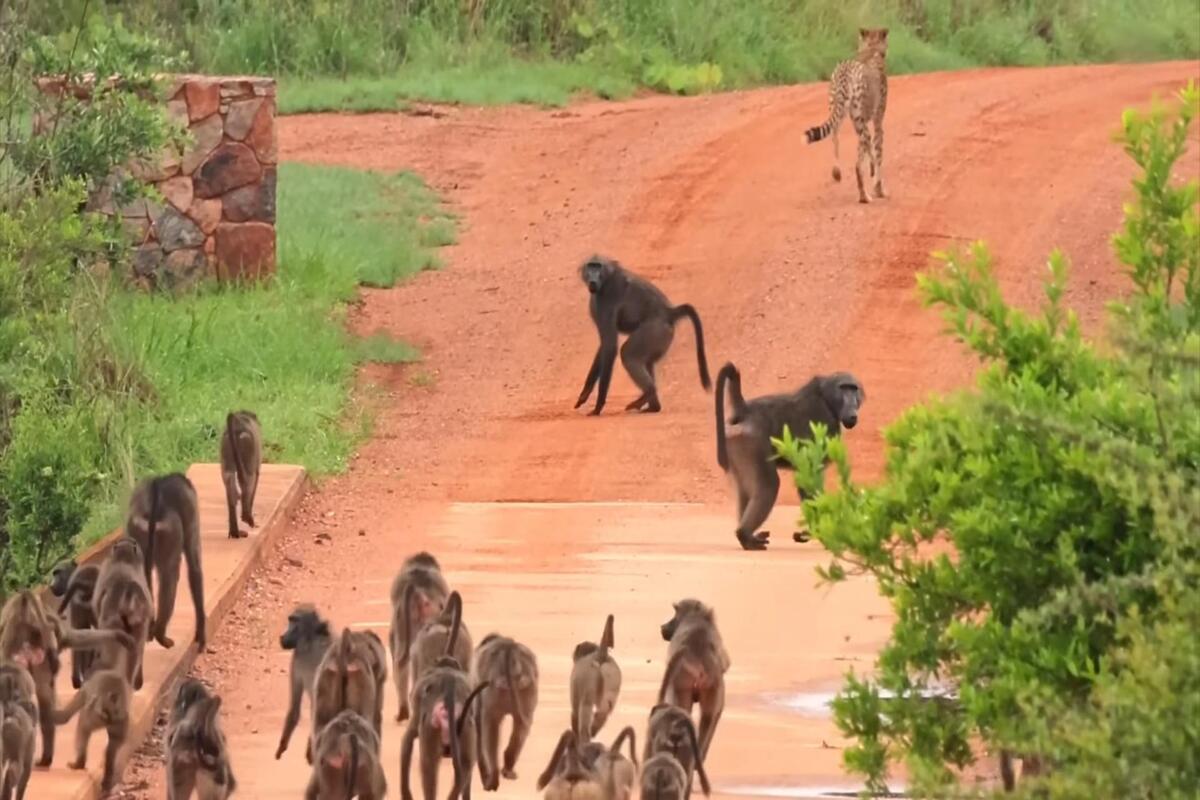
A mother cheetah and her nearly grown youngster were resting peacefully near a bridge when more than 50 baboons suddenly appeared.
What followed was anything but peaceful.
The enormous troop moved toward the two cheetahs, forcing them onto a high-water bridge. The young cheetah became increasingly nervous, while its mother initially stood her ground and snarled at the approaching primates.
Then a large male baboon charged.
The young cheetah reacted by running—and suddenly found itself heading straight toward the rest of the troop.
With dozens of baboons barking and screeching around it, the young predator had to find a way through the mob.
Somehow, it did.
The youngster escaped into the roadside bush, while the baboons turned their attention toward its mother.
The mother cheetah eventually ran up the road, easily creating distance from the pursuing troop.
And remarkably, the two cheetahs were later reunited and reported to be uninjured.
A Peaceful Rest Turns Into Chaos
The encounter was filmed by ranger Liam Todd at Lapalala Wilderness in South Africa’s Waterberg region. Lapalala is a large protected conservation area within the Waterberg Biosphere and covers approximately 48,000 hectares.
According to the original report, Liam had found a mother cheetah and her sub-adult offspring resting near a high-water bridge.
There was nothing unusual about the scene at first.
The two cheetahs were simply resting.
Then the baboons arrived.
A troop began advancing toward the pair.
The atmosphere changed almost instantly.
More Than 50 Baboons Close In
The video is striking because of the sheer difference in numbers.
There were only two cheetahs.
There were more than 50 baboons.
A baboon may not look like a traditional predator, but large baboons possess powerful jaws, long canine teeth and considerable strength.
The Animal Diversity Web describes chacma baboons, which occur across southern Africa, as large primates living in savanna, grassland and woodland environments. Adult males can weigh substantially more than females and possess much larger canine teeth.
That size difference between males and females becomes important during encounters with potential threats.
The troop was not simply a collection of frightened monkeys.
It had large adult males capable of confronting danger.
The Cheetahs Are Forced Onto the Bridge
As the baboons advanced, the cheetahs were pushed toward the bridge.
This was a terrible position for the young cat.
Behind it was limited space.
Ahead were dozens of baboons.
The bridge effectively became a narrow corridor.
The young cheetah watched the approaching troop carefully.
Its body language showed increasing discomfort.
The mother remained nearby.
For a moment, neither cheetah immediately ran.
Why Didn’t the Cheetahs Run Immediately?
Cheetahs are famous for running away from danger.
But speed is not always the first option.
The cheetah, Acinonyx jubatus, is the fastest land mammal, but its body is built primarily for short, explosive pursuits rather than prolonged combat.
SANBI describes the cheetah as a highly specialized sprinting predator, with a deep chest accommodating its large lungs and heart.
Running blindly into a large troop of baboons would have been extremely risky.
The young cheetah therefore initially remained near its mother.
Both cats snarled at the approaching animals.
It was a warning.
The Baboons Refuse to Back Down
The warning did not work.
The troop continued advancing.
This is where the social structure of baboons becomes important.
Baboons live in complex social groups rather than as solitary animals. Animal Diversity Web describes the genus Papio as containing several closely related species and notes their highly social nature.
The Latest Sightings report describes the troop as having a multilayered structure involving reproductive units, males, females and young, with males playing an important role in group security.
For the cheetahs, they were facing an entire society.
Not one opponent.
Not two opponents.
An organized troop.
The Young Cheetah Makes a Warning Lunge
Eventually, the younger cheetah became too uncomfortable to remain still.
It made a threatening lunge toward the baboons.
For a moment, it looked as though the display might work.
It did not.
Instead, the aggressive movement attracted the attention of a large male baboon.
The male charged toward the young cheetah.
Suddenly, the youngster was no longer confronting the troop on its own terms.
It was being pushed back.
A Large Male Baboon Charges
The large male’s charge changed everything.
The young cheetah veered away.
But there was a problem.
The movement took it toward another section of the baboon troop.
The youngster had effectively moved from one danger zone into another.
There was nowhere obvious to go.
Then it ran.
The Young Cheetah Runs Straight Through the Mob
The young cheetah suddenly accelerated toward the troop.
The baboons reacted immediately.
They barked.
They screeched.
They moved toward the fleeing cat.
For a few seconds, the young cheetah appeared completely surrounded by danger.
Yet this was where one of the cheetah’s greatest advantages became obvious.
Speed.
The cheetah is anatomically specialized for rapid acceleration, with long limbs, a flexible spine and other adaptations associated with high-speed running.
The youngster did not need to defeat the baboons.
It only needed one opening.
The Escape Happens in Seconds
The young cheetah somehow found a route through the troop.
It accelerated and skirted around the agitated baboons.
Then it disappeared into the dense bush beside the road.
The entire escape happened incredibly quickly.
One moment the young predator was trapped among dozens of primates.
The next, it was gone.
The baboons had lost their immediate target.
But they still had one cheetah left to deal with.
The Mother Cheetah Is Now Alone
The mother remained on the bridge.
She had just watched her youngster run through a mass of angry baboons.
Now the troop turned its attention toward her.
The situation had changed again.
The mother had a choice.
Stay and continue confronting the baboons.
Or leave.
She chose to leave.
The Mother Looks Back
Before retreating, the mother gave a quick look behind her.
Then she began moving in the opposite direction.
The baboons followed.
The chase was on.
But unlike the young cheetah, the mother did not run directly through the center of the troop.
She created distance.
The baboons increased their pace.
The mother increased hers.
Speed Becomes the Cheetah’s Best Defense
This is where the physical design of the cheetah becomes crucial.
SANBI describes the cheetah as the fastest land mammal and explains that its body is specialized for sprinting.
Cheetahs can accelerate rapidly and use their long legs, flexible spine and tail for balance while changing direction.
The mother did not need to fight the baboons.
She simply needed to stay ahead of them.
And she did.
The Latest Sightings report states that she easily outpaced the pursuing baboons as she ran up the road.
The Baboons Give Up the Chase
Eventually, the distance became too great.
The baboons stopped pursuing the mother.
Their immediate threat had disappeared.
The troop began settling down.
The dramatic confrontation was over.
The guardian and sentry males returned to their positions, and the troop continued with its normal activities.
For the baboons, the disturbance was finished.
For the cheetahs, there was still one important question.
Where was the youngster?
The Mother and Cub Are Reunited
Fortunately, the encounter had a positive ending.
Liam Todd later reported that the mother and her sub-adult offspring were reunited.
Both cheetahs were unscathed.
That detail changes the entire story.
What looked like a potentially disastrous confrontation ended with both cheetahs escaping.
The young cheetah’s speed and agility had helped it escape the troop.
The mother used speed to create distance from the pursuing baboons.
Neither animal needed to fight.
They survived by getting away.
Why Baboons Can Be Dangerous to Cheetahs
It may seem strange that a group of baboons could force a pair of cheetahs to retreat.
But numbers can dramatically change an encounter.
An adult chacma baboon can weigh roughly 15 kg for females and more than 25 kg for adult males, according to Animal Diversity Web. Males also have much larger canine teeth.
A cheetah is much larger than an individual baboon, but that does not mean it wants to fight several dozen of them.
One baboon is one opponent.
Fifty baboons are a completely different problem.
Cheetahs Are Built for Speed, Not Fighting
The cheetah’s greatest weapon is speed.
Its body is optimized for chasing prey across open ground.
But that specialization comes with trade-offs.
Cheetahs are comparatively lightly built for a large carnivore and can lose kills to stronger predators.
SANBI notes that conflict with larger predators is one of the important threats facing cheetahs.
This helps explain why avoiding unnecessary physical confrontation can be important.
A cheetah does not need to prove that it is stronger.
It needs to survive.
Cheetahs Face Competition From Other Predators
Cheetahs live alongside many larger carnivores.
Depending on the ecosystem, they may encounter lions, leopards, hyenas and other competitors.
These larger predators can steal kills or pose direct threats.
The cheetah therefore occupies a difficult ecological position.
It is an exceptional hunter.
But it is not the strongest carnivore in its environment.
This is one reason its ability to accelerate rapidly and escape danger is so valuable.
The Young Cheetah’s Age Matters
The video describes the youngster as a sub-adult, rather than a tiny newborn cub.
That distinction is important.
A sub-adult cheetah is already much more capable of running and hunting than a very young cub.
But it has not necessarily reached full adult independence.
Young cheetahs still have much to learn.
A mother provides protection and experience while offspring develop the skills required to survive.
Learning to Read Dangerous Animals
Every encounter with another species can provide information.
A young cheetah that encounters a large troop of baboons learns something important about them.
Baboons can be aggressive.
Large males can charge.
Numbers matter.
And running into the middle of the troop is dangerous.
The video does not prove exactly what the youngster “learned,” but its behavior demonstrates the immediate survival value of recognizing danger and changing direction quickly.
Baboons Have Their Own Defense System
The baboons were not randomly moving around.
They were living as a social group.
Animal Diversity Web describes baboons as complex social primates, with group structures that vary among species.
In the footage, the adult males were particularly important to the confrontation.
The Latest Sightings report describes them as guardian and sentry males involved in group security.
This provides an important explanation for why the troop was so confident approaching the cheetahs.
A lone baboon would have been in a very different situation.
The Power of Numbers
The encounter demonstrates a basic principle found throughout nature:
numbers can compensate for individual vulnerability.
One baboon cannot match a cheetah in speed.
A troop of dozens does not need to.
The group can advance together.
Individual animals can respond to movement.
Adult males can confront threats.
Younger animals can remain within the group.
The entire troop becomes difficult for a predator to challenge.
The Bridge Created a Dangerous Bottleneck
The bridge made the encounter even more dramatic.
Open ground would have given the cheetahs more options to change direction.
But the bridge created a confined route.
The baboons could approach from the front while the cheetahs had limited space to maneuver.
The young cheetah’s eventual escape required extraordinary agility.
It had to find a gap and use it immediately.
Dense Bush Becomes the Escape Route
After escaping the troop, the youngster disappeared into dense roadside vegetation.
That was another important advantage.
Cheetahs are generally associated with open habitats because they hunt using speed and visibility.
But vegetation can also provide refuge.
Once the youngster was hidden, the baboons could no longer maintain the same direct pressure.
The chase had ended.
A Rare Predator-Primates Encounter
The encounter is unusual because of the species involved.
A mother cheetah and her sub-adult offspring were confronted by a large baboon troop, and the confrontation escalated into an actual pursuit.
Most wildlife encounters do not produce such a dramatic sequence.
The video captured:
- A large baboon troop approaching two cheetahs
- The cheetahs standing their ground
- The young cheetah making a warning lunge
- A large male baboon charging
- The youngster becoming surrounded
- A high-speed escape
- The troop pursuing the mother
- The mother outrunning the baboons
- The two cheetahs eventually reuniting
The entire sequence shows how quickly the balance of power can change in the African bush.
Lapalala Wilderness and the Waterberg
The encounter happened at Lapalala Wilderness, a major protected area in South Africa’s Limpopo Province.
The reserve lies within the Waterberg Biosphere, a landscape known for its diverse habitats and wildlife.
According to information summarized by Wikipedia, Lapalala covers approximately 48,000 hectares and forms part of the Central Bushveld landscape.
The variety of habitats helps support a wide range of wildlife.
That includes predators such as cheetahs and social mammals such as baboons.
Cheetahs Are Under Pressure
Beyond this particular encounter, the video also highlights why cheetah conservation matters.
SANBI lists the cheetah as Vulnerable globally and notes that its historical range has been dramatically reduced. Habitat alteration, loss of prey and conflict with larger predators are among the pressures affecting the species.
A more recent SANBI assessment document notes that most of the world’s adult cheetahs occur in southern and eastern Africa, while South Africa’s free-ranging population remains relatively small compared with historical abundance.
Every protected area capable of supporting a viable cheetah population therefore has conservation value.
The Baboons Were Not the Villains
It is easy to watch the young cheetah surrounded by baboons and think of the troop as attacking an innocent animal.
But that is a human interpretation.
The baboons were responding to the presence and behavior of a predator.
The footage shows them advancing, barking, screeching and pursuing the cheetahs, but it does not establish a human-like intention such as revenge or cruelty.
They were animals responding to another animal in their environment.
That distinction matters when interpreting wildlife behavior.
The Cheetahs Were Not Defeated
The dramatic title might make it sound as though the cheetahs were overwhelmed.
But the final outcome was very different.
Both escaped.
The young cheetah used agility to break through the troop.
The mother used speed to outrun her pursuers.
And the two were eventually reunited.
In the language of survival, escape was the outcome that mattered.
What Makes Cheetahs So Special?
The encounter demonstrates several of the cheetah’s defining characteristics.
Acceleration
Cheetahs can accelerate extremely quickly.
Agility
Their flexible bodies allow them to make rapid directional changes.
Speed
They are the fastest land mammals.
Visual hunting
Their eyesight is important for locating prey across open landscapes.
Lightweight construction
Their body is optimized for rapid pursuit rather than prolonged physical combat.
These adaptations helped both cheetahs escape an encounter where strength and numbers favored the baboons.
What Makes Baboons So Successful?
Baboons have a very different survival strategy.
They rely heavily on social living.
A troop provides many eyes.
It provides social support.
It provides adult males capable of confronting threats.
And it provides safety through numbers.
Animal Diversity Web describes chacma baboons as adaptable animals occupying a wide range of southern African habitats.
The troop’s social structure is therefore just as important to its survival as the cheetah’s speed is to its survival.
Two Completely Different Survival Strategies
The confrontation can almost be viewed as a contest between two evolutionary strategies.
The baboons had:
Numbers.
Social cooperation.
Adult males.
Group defense.
The cheetahs had:
Speed.
Agility.
Acceleration.
The ability to escape into vegetation.
Neither strategy is universally superior.
Each works under different circumstances.
On the bridge, the baboons had the advantage.
Once the cheetahs reached open ground, speed became much more important.
The Moment the Tables Turned
At first, the baboons appeared to control the encounter.
They approached.
They forced the cheetahs onto the bridge.
They chased the youngster.
They pursued the mother.
But the moment the cheetahs gained enough space to run, the situation changed.
The baboons could no longer keep up.
That is the fascinating thing about wildlife encounters.
There is rarely one permanent winner.
The advantage can change within seconds.
A Mother and Her Youngster Survive
Perhaps the most satisfying part of this story is what happened after the chase.
The mother and youngster were reunited.
Neither was injured.
After all the barking, charging and running, the encounter ended without a fatal outcome.
For the cheetahs, the most important thing was getting away from the danger.
And they did.
Watch the Original Video
Watch the complete encounter here:
Cheetah Mom and Cub Mobbed by 50+ Baboons on Bridge — Latest Sightings
The video was published by Latest Sightings on March 5, 2025. It was recorded by ranger Liam Todd at Lapalala Wilderness Reserve in the Waterberg.
More Wildlife Encounters From khzyz
If you enjoy dramatic encounters between predators and other wildlife, explore more stories from khzyz: