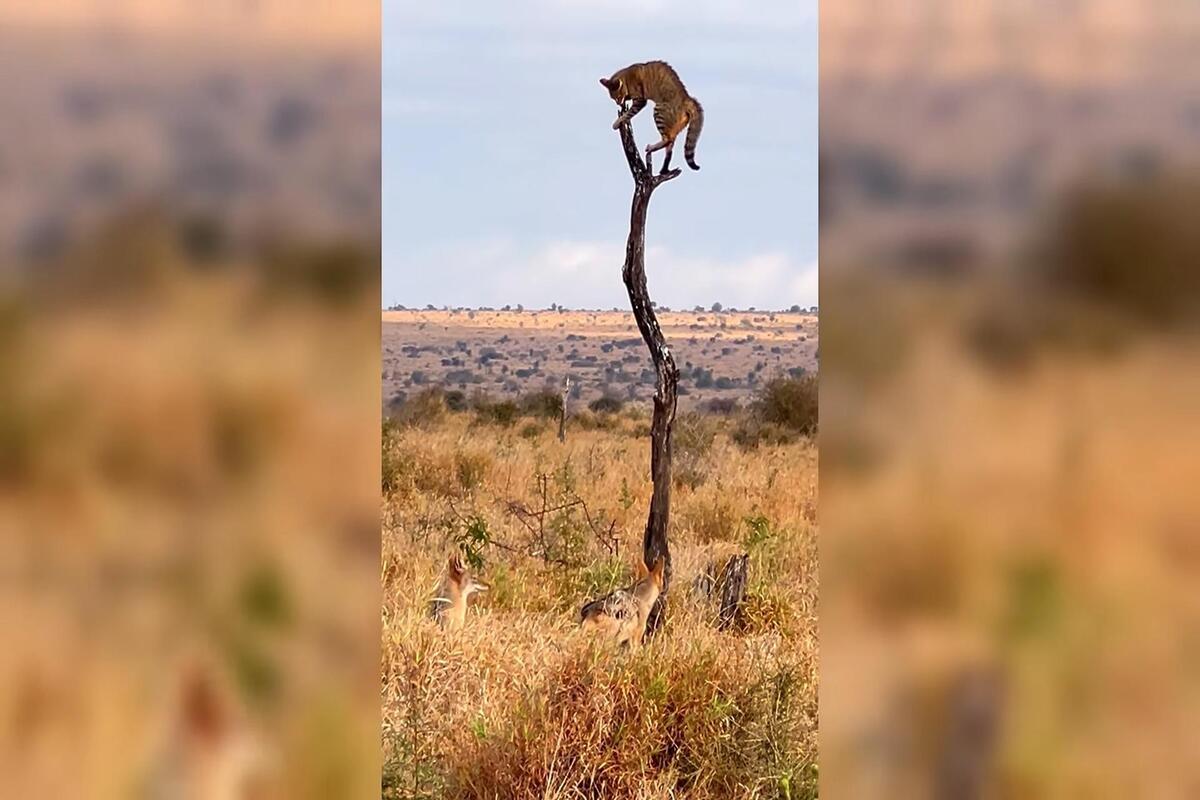
An African wildcat normally spends its life on the ground, moving quietly through grass, scrub and open woodland in search of small prey.
But on this day in Kruger National Park, staying on the ground was no longer an option.
Two jackals began chasing the small cat, forcing it toward a dead, almost branchless tree. With the jackals waiting below, the African wildcat climbed higher and higher until it was balancing on the narrow top of the trunk.
It was an extraordinary predator-versus-predator encounter.
The sighting was filmed by Enslin Davel just off the S90 in Kruger National Park, also known as the Old Main Road, in the central part of the reserve. Latest Sightings described the encounter as an extremely rare sighting of two jackals chasing an African wildcat into a tree.
What happened next showed just how useful a little bit of height can be when a small predator is suddenly outnumbered.
An Unexpected Encounter in the Bushveld
The African wildcat is one of Africa’s smaller wild cats, but its size should not be mistaken for weakness.
The African wildcat, Felis lybica, is a highly adaptable predator found across much of Africa as well as parts of western and central Asia. It can live in environments ranging from savannas and grasslands to more arid landscapes.
It is also closely related to the domestic cat.
In fact, the African wildcat is considered the principal ancestor of the domestic cat, with domestication beginning thousands of years ago in the Near East.
But this wildcat was not behaving like a domestic cat.
It was fighting for space.
And two jackals were closing in.
Two Jackals Give Chase
According to Latest Sightings, the encounter began when the two jackals chased the wildcat for a short distance. The cat eventually spotted a tree and used it as an escape route.
The fact that there were two jackals immediately changed the situation.
A single jackal might have been easier for the cat to avoid.
Two animals could approach from different directions, reducing the wildcat’s escape options.
The jackal is not a single species but a common name used for several African and Eurasian canids. In southern Africa, the black-backed jackal is one of the most familiar species. Jackals are opportunistic predators and scavengers capable of hunting a wide variety of smaller animals.
Were They Trying to Kill the Wildcat?
The footage shows the jackals pursuing and cornering the wildcat, but their exact motivation cannot be established simply by watching the encounter.
It would be tempting to say they were definitely trying to kill it.
But predator interactions are more complicated than that.
Jackals can compete with other carnivores for food and space, and they may attack smaller predators under certain circumstances. SANBI notes that black-backed jackals can hunt a variety of animals and also have important interactions with larger carnivores and other competitors.
So the safest description is that the jackals were threatening and pursuing the wildcat.
Whether their goal was killing it, driving it away, or exploiting an opportunity cannot be determined with certainty from the footage alone.
The Wildcat Finds a Dead Tree
Then came the wildcat’s most important decision.
It climbed.
The tree was far from an ideal climbing structure.
There were no comfortable branches spreading outward.
Instead, the cat climbed onto the dry trunk and eventually reached the top.
Latest Sightings described the tree as an arid, branchless structure, making the wildcat’s balance especially impressive.
For an animal accustomed to moving close to the ground, this was a dramatic change of environment.
The ground was dangerous.
The tree was awkward.
But awkward was better than dangerous.
African Wildcats Are Mostly Ground-Dwellers
This is what makes the sighting particularly interesting.
The African wildcat is primarily terrestrial.
Unlike a leopard, which is famous for climbing trees, resting in branches and carrying prey into trees, the African wildcat normally spends most of its time on the ground.
Latest Sightings specifically points out this difference, noting that African wildcats can climb when necessary but are not specialized tree-dwelling cats.
That makes this encounter unusual.
The cat was not climbing because it had chosen a comfortable place to rest.
It was climbing because the ground had become dangerous.
A Small Cat With a Big Survival Instinct
African wildcats may be small, but they are experienced hunters.
Their typical diet includes small mammals, birds, reptiles and other appropriately sized prey.
Their sandy or grayish coat helps them blend into dry vegetation, making them difficult to spot while hunting.
The African wildcat generally weighs only a few kilograms, with adult weights commonly reported around 3–8 kg depending on sex and location. Latest Sightings gives the same approximate range for the animal in this encounter.
That is tiny compared with many of the predators sharing its environment.
A lion may weigh more than 100 kg.
A leopard can be several times heavier.
Even a jackal can be a serious opponent for a small wildcat.
Survival therefore depends heavily on awareness, camouflage, speed and choosing the right escape route.
The Tree Becomes a Fortress
Once the wildcat reached the top of the trunk, the entire situation changed.
The jackals could no longer simply chase it.
They were now below.
The cat was above.
The narrow trunk created a physical barrier between them.
The jackals remained close, apparently waiting for the cat to make a mistake. Latest Sightings reported that the jackals stayed beneath the tree but were unable to force the wildcat down.
For the wildcat, patience suddenly became a survival tool.
It did not need to defeat the jackals.
It only needed to avoid being caught.
The Incredible Balancing Act
The wildcat’s position at the top of the trunk is one of the most remarkable parts of the video.
There was little room for error.
A slip could send the cat straight back toward the waiting jackals.
The animal therefore had to maintain its balance while watching the predators below.
Cats are well known for their balance and coordination, but the African wildcat’s normal lifestyle does not require the same tree-climbing specialization seen in species such as leopards.
The encounter demonstrates how quickly an animal can use abilities that may not normally be central to its daily life when circumstances become dangerous.
Why Climbing Worked
Height can provide an enormous advantage to a small animal.
On the ground, the wildcat had to worry about two moving predators.
At the top of the trunk, the jackals had limited access.
The African wildcat had effectively changed the terrain.
It turned a chase into a waiting game.
This is one of the fundamental principles of survival in the wild: an animal does not always need to overpower a competitor.
Sometimes it simply needs to make itself difficult to reach.
The Jackals Wait Below
The two jackals did not immediately leave.
They remained near the tree.
Their persistence is not surprising considering how opportunistic black-backed jackals can be.
SANBI describes black-backed jackals as highly adaptable animals with broad diets. They normally forage alone or in pairs and can pursue small vertebrates and other prey.
They also have sophisticated communication systems, including vocalizations, scent marking and body postures.
So although the video focuses on the physical confrontation, the jackals were also operating as social canids.
Two individuals can create more pressure than one.
Black-Backed Jackals Are Remarkably Adaptable
If the jackals in this encounter were black-backed jackals, their behavior fits the species’ general ecological flexibility.
The black-backed jackal, Lupulella mesomelas, occurs across parts of eastern and southern Africa. It is found in environments ranging from savanna and scrub to more open and arid landscapes.
SANBI describes the species as an opportunistic animal capable of eating many different types of food.
It can hunt small mammals and other animals, scavenge carcasses and take advantage of whatever resources are available.
That flexibility is one reason jackals are such successful predators.
A Jackal Can Be More Than a Scavenger
Jackals are sometimes portrayed simply as scavengers waiting for lions to finish eating.
That is misleading.
The black-backed jackal is an active hunter as well as a scavenger.
SANBI reports that black-backed jackals hunt small vertebrates and invertebrates and can pursue larger prey. In some circumstances, groups can cooperate to subdue difficult prey.
That makes the pursuit of an African wildcat easier to understand.
The jackals were not helpless scavengers.
They were capable predators confronting another predator.
Predator Versus Predator
This is what makes the encounter so fascinating.
There was no traditional predator-versus-prey relationship.
The wildcat was itself a hunter.
The jackals were hunters too.
Both species depend on many of the same resources.
Both can occupy similar habitats.
And both have to navigate a landscape containing larger carnivores.
The interaction therefore represents competition between carnivores rather than a straightforward hunting sequence.
The Wildcat Has Other Enemies Too
The African wildcat lives in an environment crowded with dangerous predators.
According to Latest Sightings, lions, leopards, hyenas, African wild dogs and jackals can all pose threats to African wildcats, especially vulnerable kittens.
This makes the wildcat’s size a double-edged sword.
Being small allows it to hunt prey that larger carnivores may ignore.
It also allows it to move through dense vegetation and disappear quickly.
But being small means it cannot afford many physical confrontations with larger predators.
Escape is often safer than fighting.
The Wildcat Does Not Need to Win a Fight
One of the biggest lessons from this encounter is that survival does not always mean defeating an opponent.
The wildcat did not need to chase the jackals away.
It did not need to attack them.
It did not need to prove that it was stronger.
It simply needed to avoid being caught.
The dead tree provided exactly that opportunity.
By moving vertically, the wildcat changed the rules of the confrontation.
Why Leopards Are Different
The encounter also highlights the extraordinary climbing ability of leopards.
A leopard is much more specialized for climbing than an African wildcat.
Leopards are powerful climbers and frequently use trees to rest, escape competitors and sometimes store kills.
An African wildcat can climb, but its lifestyle is primarily terrestrial.
That distinction is important because seeing a small wildcat in a tree might otherwise make people assume it behaves like a miniature leopard.
It does not.
This was an emergency use of height.
The Tree May Have Saved the Cat
The most important detail in the entire encounter is simple:
the tree gave the wildcat time.
Time is often more valuable than strength.
The jackals could wait.
The wildcat could wait too.
Every minute spent above the ground was a minute in which the cat was not being chased.
Eventually, the jackals would have to make another decision.
The wildcat would have to do the same.
A Dangerous Game of Patience
Imagine the situation from a survival perspective.
Below the tree are two jackals.
Above them is a small cat.
The cat cannot remain there forever.
The jackals cannot climb the trunk easily enough to reach it.
Neither side has a perfect solution.
This creates a classic wildlife standoff.
The first animal to make a mistake could lose.
For the wildcat, moving too early could mean falling directly into danger.
For the jackals, waiting too long could mean losing their opportunity completely.
The Wildcat’s Escape Route
The available footage and Latest Sightings report establish that the wildcat successfully used the tree as a refuge.
The report describes the tree as a safe place where the cat was able to remain out of reach of the jackals.
It does not provide enough evidence to establish every detail of what happened after the filmed encounter.
That is worth remembering.
Wildlife videos sometimes end before the complete story does.
Rather than inventing an outcome, it is better to focus on what the footage clearly demonstrates: the wildcat used the tree to escape the immediate pressure created by the two jackals.
An Extremely Rare Sighting
Latest Sightings described two jackals chasing an African wildcat into a tree as an extremely rare event.
African wildcats are not commonly seen performing dramatic tree escapes.
Jackals are common and adaptable.
But seeing these three predators interact in exactly this way requires an unusual combination of circumstances.
That is what makes wildlife footage valuable.
It can reveal behavior that would otherwise go unseen.
Kruger National Park Provides the Perfect Setting
The sighting took place near the S90 in Kruger National Park, one of Africa’s most important protected areas.
The park contains an enormous variety of mammals, birds, reptiles and other wildlife.
Its large size and relatively natural predator communities create opportunities for unusual interactions between species.
The S90, also known as the Old Main Road, runs through the central section of the park between the Satara region and the Olifants/Balule area. Latest Sightings identified this as the location where Enslin Davel filmed the encounter.
The Importance of Small Predators
Big cats and large carnivores often receive most of the attention in African wildlife stories.
But smaller predators play important ecological roles too.
The African wildcat helps control populations of small mammals and other prey.
The black-backed jackal also consumes a wide variety of food and can act as both hunter and scavenger.
SANBI describes the black-backed jackal as an important predator and scavenger within southern African ecosystems.
These smaller carnivores are part of the complicated food web that keeps the ecosystem functioning.
A Battle Without a Winner
It is easy to watch a confrontation like this and ask which animal won.
But this particular encounter is better understood as an escape rather than a victory.
The jackals successfully chased the wildcat into a difficult position.
The wildcat successfully reached safety in the tree.
Neither animal needed to completely defeat the other for the encounter to be biologically important.
The wildcat’s objective was survival.
For the moment, the tree accomplished that.
What This Encounter Teaches Us
This rare encounter demonstrates several important lessons about wildlife survival.
Small predators can be extremely resourceful.
The African wildcat was confronted by two competitors but quickly found an alternative escape route.
Terrain can change everything.
On open ground, the jackals had the advantage of numbers. On top of the trunk, their advantage was greatly reduced.
Climbing ability does not have to be specialized to be useful.
The African wildcat is primarily terrestrial, yet it was able to use a tree when circumstances demanded it.
Predators also compete with predators.
The wildcat and jackals are both hunters, meaning their interactions can involve competition as well as direct predation.
Survival is often about avoiding unnecessary fights.
The wildcat did not need to defeat the jackals. It only needed to avoid them.
Watch the Original Video
Watch the full encounter here:
Two Jackals Trap A Wildcat on a Dead Tree — YouTube
The footage captures one of the more unusual predator interactions seen in Kruger National Park, with an African wildcat using a dead tree as an emergency refuge while two jackals wait below.
More Wildlife Encounters From khxyz
If you enjoy unusual predator encounters, you can explore more wildlife stories from khxyz:
- Python Tries to Escape Crocodile
- Hidden Crocodile Bites at Leopard From Below
- Hyena Walks Into Two Hidden Male Lions
- Leopard Hides and Waits for Impalas
- 4 Porcupines Teach 3 Lions a Lesson
Final Thoughts
The African bushveld is full of animals that appear to know exactly where they belong.
But when danger arrives, those rules can change instantly.
An African wildcat normally belongs on the ground.
On this occasion, the ground was no longer safe.
Two jackals gave chase, and the small cat responded by climbing a dead tree that offered almost no conventional branches or shelter.
It was an extraordinary display of agility and survival instinct.
The jackals remained below, but the wildcat stayed out of reach.
The encounter is a reminder that survival in the wild is not always about being the biggest, strongest or most dangerous animal.
Sometimes it is about recognizing an opportunity.
Sometimes it is about changing direction.
And sometimes, when two determined predators are waiting below, the safest place in the bush is the top of a dead tree.
 Add as Preferred Source