Lone Buffalo Takes On Entire Lion Pride in Incredible Last Stand

There are bad days in the African bush, and then there are days when an entire lion pride decides that you are dinner.

For one African buffalo, a drink at the water’s edge suddenly turned into a fight for its life.

The buffalo had apparently come down to the water when the lions made their move. Before long, it was trapped between the pride and the water, with lions appearing from the long grass on several sides.

There was nowhere obvious to run.

So the buffalo did something remarkable.

It turned around and faced them.

The incredible encounter was filmed by Danielle Sheedy from Elephant Walk Retreat and sent to Latest Sightings. The exact outcome remained unknown, but the buffalo managed to retreat into shallow water, where the lions were unwilling to follow.

Living Life On The Edge

Water is essential to life in Africa.

It is also a place where predators know prey animals have to visit.

According to Latest Sightings, the lions appeared to have ambushed the buffalo while it was drinking at the water’s edge.

For the buffalo, the water was supposed to be a source of safety and hydration.

Instead, it became part of the trap.

The lions had positioned themselves between the animal and open ground.

And once the buffalo realized what was happening, its options were disappearing quickly.

Meet The African Buffalo

The animal at the centre of the encounter was an African buffalo (Syncerus caffer).

African buffalo — Animal Diversity Web

African buffalo — National Geographic

African buffalo are among Africa’s most formidable large herbivores.

National Geographic records adults weighing roughly 660 to 1,840 pounds, with large horns that provide an important defensive weapon. Buffalo normally live in herds, and gathering in large numbers helps reduce the risk of individual animals being singled out by predators.

But this buffalo was alone.

That made the situation much more dangerous.

Meet The African Lion

The predators were African lions (Panthera leo), the only truly social big cats.

Lion facts — Discover Wildlife

African lion — Animal Diversity Web

Discover Wildlife notes that lions can live in prides containing many individuals, with females often making up the majority of the group.

That social lifestyle is extremely important when lions take on large prey.

One lion might struggle.

Several lions working together can create very different odds.

And this buffalo appeared to have the entire pride against it.

A Lion’s Favourite Kind Of Opportunity

An adult buffalo is not easy prey.

It is big.

It is heavily built.

It has powerful legs.

And those horns can cause serious injuries.

That is why lions generally have to choose their opportunities carefully.

The Discover Wildlife guide to African buffalo describes the species as a formidable prey animal, noting that buffalo are capable of charging when threatened and that their horns can inflict serious damage.

A lion that makes a mistake around an adult buffalo can pay a heavy price.

Going Out With A Bang

The buffalo was horribly outnumbered.

Latest Sightings could not establish the exact number of lions involved because several remained hidden in the long grass, but at least five lions were attacking.

Five lions against one buffalo.

And the buffalo could only watch one direction at a time.

That was the problem.

If it faced one lion, another could potentially move around behind it.

If it turned toward that second lion, the first could change position.

The pride had numbers.

The buffalo had horns.

One Direction At A Time

This is where the buffalo’s defensive strategy became fascinating.

It could not fight the entire pride simultaneously.

Instead, it kept turning to face the lions.

When one approached from the front, the buffalo faced it.

When another moved around the side, the buffalo shifted.

Its horns were always pointed toward the immediate threat.

Latest Sightings describes the lions trying to attack from different directions while the buffalo repeatedly turned to confront them.

The buffalo was essentially trying to keep its back protected.

The Horns Are Serious Weapons

The horns of an adult buffalo are not simply for display.

They are used in fights between buffalo and can also be used against predators.

One of the most distinctive features of a mature African buffalo is the heavy boss between the horns, particularly prominent in adult males.

African buffalo facts — National Geographic

This structure adds strength to the skull and makes the head exceptionally well suited to pushing and fighting.

For a lion approaching from the front, that is a serious obstacle.

The Buffalo Turns The Water Into A Shield

Then the buffalo discovered something important.

The water was not only a place where it could become trapped.

It could also protect its back.

If the buffalo stood with its rear toward deeper water, the lions could not easily approach from behind without entering the water.

The animal had effectively turned the shoreline into a defensive position.

Latest Sightings describes this as the buffalo using the water to prevent the lions from getting behind it.

It was cornered.

But the corner had become a shield.

Making The Best Of A Bad Situation

The lions continued trying to break through the buffalo’s defenses.

They approached the flanks.

They tried to make it turn.

They attempted to draw it away from the water.

But every time the buffalo managed to return to the shoreline, it could once again put the water behind itself.

That made the pride’s job much harder.

The lions needed the buffalo to move.

The buffalo needed only to keep facing them.

The Importance Of Position

Predator-prey encounters are not always decided by strength.

Position can be just as important.

The lions were stronger as a group.

But the buffalo had found a position where their numerical advantage was less useful.

They could not surround it properly.

They could not easily reach its rear.

And they could not force it away from the water for long.

This is one of the reasons terrain matters so much in wildlife encounters.

The same animals can have completely different outcomes depending on where the confrontation happens.

The Lions Try To Pull It Away

According to Latest Sightings, the lions managed several times to draw the buffalo farther from the water.

That was exactly what they needed.

Once the buffalo moved away from the shoreline, the lions had more space to approach from multiple directions.

The buffalo would then have to turn repeatedly.

That created openings.

But the lions could not quite coordinate their attack well enough to take advantage of every opportunity.

The buffalo kept returning to its defensive position.

A Buffalo Is Not Easy To Scare

African buffalo have evolved under pressure from large predators.

Animal Diversity Web describes several anti-predator responses, including heightened caution, scrutiny, flight and defensive aggression. Buffalo can also respond aggressively when escape is blocked.

That last part is exactly what we see here.

The buffalo could no longer simply run away.

So it fought.

Herds Are The Normal Defence

A lone buffalo is an unusual sight compared with the enormous herds often associated with the species.

Large herds provide safety through numbers.

More eyes can detect predators.

A predator has more individuals to choose from.

And adults can defend younger members.

National Geographic notes that buffalo commonly live in herds ranging from dozens to hundreds, with much larger gatherings occurring in some regions.

This buffalo had none of those advantages.

It was standing alone.

Why Adult Buffalo Can Fight Lions

Buffalo are among the few prey animals capable of seriously injuring or even killing attacking lions.

Animal Diversity Web records that adult buffalo bulls can successfully fend off multiple lions, although such encounters can leave the buffalo badly injured.

The same source describes reciprocal aggression as one of the buffalo’s major anti-predator strategies.

So when the buffalo in this footage turns toward the lions, it is not doing something completely unusual for the species.

It is using one of its most important last-resort defenses.

But Five Lions Are Five Problems

The difficulty was not facing one lion.

It was facing several.

One lion could occupy the buffalo’s attention.

Another could approach from the side.

A third could wait behind.

The buffalo’s horns could defend one direction at a time.

The lions therefore had an obvious advantage if they could coordinate their movements.

The challenge was getting all those moving parts to work together.

The Long Grass Helps The Lions

The lions were difficult to count because several were hidden in the long grass.

That made the buffalo’s situation even more dangerous.

It could see the lions that were directly in front of it.

But it could not necessarily keep track of every predator around it.

The long grass gave the lions cover.

It also allowed them to approach without being constantly exposed.

For an animal trying to defend itself from several predators, that uncertainty is a serious problem.

The Buffalo Keeps Turning

The buffalo’s repeated movements became a defensive dance.

Face one lion.

Turn.

Face another.

Step forward.

Retreat.

Return to the water.

Watch the grass.

Turn again.

The animal was constantly trying to maintain the safest possible orientation.

That behavior may look frantic.

But there is a clear logic to it.

Keep the horns facing the danger.

Keep the water behind you.

Do not allow the lions to get around the side.

The Lions Need A Mistake

The pride did not necessarily need to overpower the buffalo immediately.

They needed an opening.

If the buffalo turned too far, a lion could attack from behind.

If it moved too far away from the water, the lions could surround it.

If it became exhausted, its ability to turn quickly would decline.

That is the advantage predators can gain through persistence.

They do not always have to win immediately.

They can wait for the prey animal to make a mistake.

But The Buffalo Finds A Better Option

Eventually, the buffalo had nowhere else to go.

So it entered the water.

Not deep water.

Just shallow enough for the animal to move out toward the centre.

And suddenly, the situation changed again.

The lions stopped.

A Safe Space

Latest Sightings reports that the lions were unwilling to follow the buffalo into the water.

The buffalo had found something that its attackers could not easily take away.

Distance.

It moved far enough from shore that the lions could no longer launch an easy attack.

For the first time in the encounter, the predator-prey balance shifted.

The buffalo was still surrounded.

But the lions could not reach it.

Why Didn’t The Lions Follow?

There are several possible reasons, but we should not pretend to know exactly why these particular lions stopped.

Entering water can reduce a lion’s mobility.

It can make an attack more difficult.

The bottom may be uneven.

The depth may increase quickly.

And the lions may simply have judged that following the buffalo was not worth the risk.

The footage does not establish their precise motivation.

What is clear is that they remained at the water’s edge.

The Buffalo Wins The Standoff

For the moment, at least.

The buffalo had survived the most dangerous part of the encounter.

It had been trapped.

It had been attacked.

It had been surrounded.

But it had prevented the lions from getting the position they needed.

Then it used the water to create enough distance to escape the immediate attack.

Latest Sightings says the eventual outcome remained unknown, including how or whether the buffalo later made its way safely out of the water.

Survival Wasn’t Guaranteed

That uncertainty is important.

We should not turn the footage into a story with a perfectly happy ending.

The cameras captured the buffalo reaching the water.

They did not establish what happened afterward.

The buffalo may have eventually escaped safely.

It may have remained in the water for some time.

Its condition was also unknown.

What we can say is that the lions failed to kill it during the confrontation that was filmed.

That alone is remarkable.

Lions Don’t Always Win

It is easy to think of lions as unstoppable predators.

They are not.

They are powerful hunters, but they can be injured by prey.

A buffalo can hurt a lion.

A zebra can kick a lion.

An elephant can kill one.

Even the most powerful predator has to calculate risk.

Discover Wildlife notes that lions are apex predators but also highlights that they are not invulnerable.

The buffalo in this sighting was a perfect example.

The pride had the numbers.

But the buffalo had enough defensive power to make the lions hesitate.

A Battle Of Patience

The encounter became less about speed and more about patience.

The lions waited for the buffalo to move.

The buffalo waited for the lions to commit.

Each side was looking for an opportunity.

The buffalo needed to maintain its defensive position.

The lions needed to break it.

Neither could afford a careless move.

Water Changes The Rules

Water can be dangerous for prey animals.

Crocodiles can lurk beneath the surface.

Deep water can prevent terrestrial animals from escaping quickly.

But shallow water can also become a defensive refuge.

In this case, the buffalo used the water in exactly that way.

It was not swimming away.

It was creating a boundary.

The lions were on one side.

The buffalo was on the other.

The Buffalo’s Last Stand

The phrase “last stand” is dramatic, but it captures the appearance of the footage.

The buffalo was alone.

The lions were numerous.

The animal had nowhere obvious to run.

Yet it continued turning toward the attackers.

It refused to simply collapse.

It used its horns.

It used its size.

It used the shoreline.

And eventually, it used the water.

A Reminder Of Why Buffalo Matter

African buffalo are sometimes overshadowed by the more glamorous members of Africa’s Big Five.

But they are remarkable animals.

Discover Wildlife — African buffalo and the Big Five

They are powerful herbivores capable of running at high speeds, defending themselves aggressively and living in enormous social groups.

Discover Wildlife describes buffalo as important ecosystem engineers and highlights their remarkable strength and resilience.

The footage at the water’s edge shows exactly why they have earned such a formidable reputation.

A Dangerous Meal For A Lion

From the lions’ perspective, an adult buffalo can be an extremely valuable meal.

But it is also dangerous prey.

The larger the buffalo, the greater the potential reward.

And the greater the potential risk.

A lion that attacks from the wrong angle can be struck by the horns.

A lion that gets too close can be charged.

A lion that misjudges the animal can be seriously injured.

The pride therefore had to balance hunger against danger.

The Buffalo Had One Major Advantage

It had nothing to lose.

The buffalo was already trapped.

Running had become extremely dangerous.

Fighting was dangerous.

Entering the water was dangerous.

But standing still would also be dangerous.

The animal therefore used every option available.

That is often what survival looks like in the wild.

There is no perfect choice.

There is simply the choice that gives an animal the best chance in that moment.

The Moment The Lions Stop

After all the attempts to break through the buffalo’s defense, the scene ends with a remarkable change.

The buffalo moves into the water.

The lions remain on land.

And suddenly, the predator’s confidence disappears.

They watch.

The buffalo moves farther away.

The confrontation pauses.

For the moment, the buffalo has won.

What The Sighting Teaches Us

This encounter shows why predator-prey relationships are rarely as simple as “lion versus buffalo.”

The lion has strength.

The buffalo has strength.

The lions have numbers.

The buffalo has horns.

The lions have coordination.

The buffalo has the terrain.

And in this case, the terrain may have made all the difference.

Nature Doesn’t Always Follow The Expected Ending

If the footage had been reduced to a single sentence, it might have been:

A lion pride attacks a lone buffalo.

But that description misses the best part.

The buffalo did not simply become prey.

It adapted.

It changed position.

It used the shoreline.

It repeatedly faced the lions.

And eventually, it found a refuge the pride would not enter.

That is what makes this sighting so memorable.

The Final Question Remains

Did the buffalo survive?

We don’t know.

Latest Sightings explicitly says the final outcome was unknown.

And sometimes that is where a wildlife story has to end.

There is no convenient camera angle showing the animal safely disappearing into the bush.

No guaranteed happy ending.

Just a buffalo standing in the water while a pride of lions waits on shore.

For that moment, at least, the buffalo was alive.

And the lions had failed.

Watch The Original Wildlife Footage

The remarkable encounter was filmed by Danielle Sheedy from Elephant Walk Retreat and submitted to Latest Sightings. The report was published on October 3, 2026.

Watch “Lone Buffalo Takes On Entire Lion Pride” — Latest Sightings

The footage is worth watching for the buffalo’s defensive positioning, the lions moving through the grass and the moment the buffalo finally retreats into the water.

More Wildlife Stories From khxyz

If you enjoy dramatic encounters between African predators and prey, explore more wildlife stories from khxyz:
Zebra Stallion Attacks Newborn Foal as Mother Fights Back

A safari group in Kruger National Park expected to witness one of the most beautiful moments in the African wilderness: the birth of a zebra foal.

Instead, they witnessed a brutal struggle that unfolded almost immediately after the birth.

A pregnant zebra mare was lying on the ground, already in labor, when a stallion approached.

Rather than leaving her alone, the male began aggressively harassing the exhausted mare.

She attempted to continue giving birth.

The stallion continued.

Eventually, the foal emerged.

But there was almost no time for the newborn to recover.

The stallion turned his attention toward the tiny foal, appearing to bite and press down on it while the exhausted mother struggled to stand and defend her newborn.

The mother fought back.

She kicked.

She pushed.

She tried repeatedly to place herself between the stallion and her baby.

But the male continued the attack.

The extraordinary encounter was filmed on the S106 in Kruger National Park, South Africa, by a visitor named Nadine, who had stopped with her family after noticing that the mare was giving birth. The footage was published by Latest Sightings on January 16, 2025.

What happened next is one of the darkest examples of animal behavior ever captured on camera.

A Safari Turns Into a Birth Scene

Nadine and her family had stopped near a herd of zebras after noticing a female lying down.

At first, everything looked promising.

The mare was clearly in labor.

For wildlife watchers, seeing a wild zebra give birth is an extraordinary opportunity because births are rarely witnessed so closely in the wild.

The family expected to see a healthy foal enter the world.

Instead, a stallion approached the mare.

According to the original account, the male began aggressively harassing her while she was still in labor.

The situation immediately became dangerous.

The Mare Is Already Exhausted

Giving birth is physically demanding for any mammal.

For this mare, the situation was made considerably worse because she was being disturbed while trying to deliver her foal.

The plains zebra normally gives birth to a single foal after a gestation of roughly a year.

SANBI reports a gestation period of approximately 360–390 days, with a newborn weighing around 30–35 kilograms.

A newborn therefore enters the world after an enormous investment of time and energy by its mother.

This particular mare had reached the final moments of that long process.

But the stallion would not leave her alone.

The Stallion Keeps Attacking

The mare tried to remain focused on giving birth.

The stallion continued to approach her.

The footage shows the male repeatedly harassing and attacking the mare while she was lying down.

The behavior was dangerous because the female was already physically compromised by labor.

She could not simply run away.

She could not easily protect herself.

And she could not postpone the birth indefinitely.

Nature was forcing the process forward.

The Foal Begins to Emerge

Eventually, the mare’s labor progressed.

The unborn foal became partially visible.

At this stage, the situation became even more difficult.

The mare had to give birth while an aggressive adult male was standing nearby.

She eventually lay down again.

The birth continued.

And then the foal emerged.

For a few seconds, it seemed possible that the worst was over.

It wasn’t.

A Newborn Foal Enters a Dangerous World

A zebra foal is remarkably capable immediately after birth.

According to SANBI’s information on Burchell’s zebra, newborn foals can stand within about 11 minutes, walk within approximately 19 minutes, and begin suckling within roughly 67 minutes.

That rapid development is essential.

A young zebra cannot remain helpless for long on an African savanna filled with predators.

But the foal in this video did not have even those first precious minutes.

The stallion immediately noticed the newborn.

The Stallion Turns Toward the Foal

After attacking the mother, the stallion redirected his attention toward the newborn.

The Latest Sightings footage shows the male approaching the foal and appearing to bite and press down on it.

The newborn was barely able to move.

At one point, the foal appears to raise its head.

That brief movement makes the scene even more disturbing.

The foal was alive.

And the attack continued.

The Mother Is Still Exhausted

The mare remained only centimeters away.

But she had just given birth.

She appeared exhausted and initially struggled to respond.

The foal was still lying beside her.

The stallion remained between them.

For a short time, the mother appeared almost unable to understand what was happening.

Then she reacted.

The Mother Gets Back on Her Feet

The mare stood.

This was an important turning point.

Despite still having the afterbirth emerging, she began moving toward the stallion.

The mother was no longer simply trying to complete the birth.

She was confronting the animal attacking her newborn.

The footage shows her repeatedly attempting to drive the male away.

She kicked.

She pushed.

She moved around him.

But the stallion repeatedly countered her movements.

A Mother Fights for Her Foal

The mare’s response is consistent with the protective behavior expected in a zebra family group.

National Geographic has documented how zebra family groups can respond collectively when predators approach, with the stallion sometimes attacking the threat while the family remains together.

The situation in this video was different because the threat was another zebra.

But the basic importance of protecting vulnerable young remains clear.

The mare repeatedly placed herself between the stallion and the foal.

Why the Foal Was So Vulnerable

The newborn had almost no ability to defend itself.

It had only just entered the world.

Its muscles were still developing.

It could not run.

It could not kick effectively.

It depended almost completely on the adults around it.

That makes the first moments after birth one of the most dangerous periods in a zebra’s life.

SANBI notes that zebra foals are preyed upon by lions, spotted hyenas, cheetahs and leopards.

But this foal faced a different kind of danger.

The threat came from within its own species.

This Was Not a Predator Attack

The stallion was not a lion.

He was not a leopard.

He was another zebra.

That distinction is important.

The behavior documented in the video is generally described as male infanticide or infanticidal aggression, a phenomenon documented in some harem-forming mammals.

However, it is important not to assume that every aggressive interaction between an adult male and a foal is automatically infanticide.

In this particular footage, the stallion clearly attacked the newborn, and the original report interpreted the behavior as an attempt to kill a foal that was apparently not his.

Male Infanticide Has Been Documented in Zebras

This behavior is not completely unknown.

A scientific study of captive plains zebras recorded nine cases of infanticide and additional cases of probable abortion associated with newly introduced males. The researchers found that foal mortality was substantially higher in groups with introduced males than in groups where the original sire remained.

That evidence demonstrates that male-directed attacks on unrelated offspring can occur in plains zebras.

But there is an important complication.

Wild populations do not necessarily show the same frequency.

What Wild Zebra Research Reveals

A long-term study of wild plains zebras in Hwange National Park, Zimbabwe, followed populations for more than 10 years.

Researchers recorded frequent changes in harem stallions.

But they observed no infanticide attacks during the study period.

The researchers concluded that if male infanticide occurs in wild plains zebras, it is likely rare and has little demographic effect at the population level.

This is an important scientific qualification.

The behavior is documented.

But it should not be described as an everyday or inevitable behavior among wild zebra stallions.

Why Would a Stallion Attack Another Foal?

One leading evolutionary hypothesis involves reproduction.

If a male takes over a group containing females that are already caring for young sired by another male, those females may not immediately return to reproductive condition.

Killing a dependent offspring could potentially shorten the period before the female becomes receptive again.

This hypothesis has been proposed for infanticide in several harem-forming mammals.

The original Latest Sightings report presents this as the likely explanation for the stallion’s behavior.

However, we cannot establish the stallion’s precise motivation from this particular video.

The Stallion May Have Recently Taken Over

Latest Sightings suggested that the male may have recently taken control of the mare’s group.

That would fit one proposed evolutionary explanation for infanticidal behavior.

But there is no direct evidence from the footage establishing that this specific stallion had recently taken over the herd.

Therefore, it is more accurate to say that a recent takeover is one possible explanation, not a confirmed fact.

Zebra Harems Have a Dominant Stallion

Plains zebras have a distinctive social structure.

SANBI describes family groups containing a dominant stallion, several females and their offspring.

These groups are commonly referred to as harems.

Male zebras that do not hold harems may live in bachelor groups.

The stallion’s reproductive position is therefore an important part of the social structure.

Stallions Fight for Breeding Rights

Male zebras do not simply inherit a herd permanently.

They must maintain their position.

SANBI notes that stallions fight for breeding rights and access to females, while bachelor males form groups in which dominance can be established through competition.

Research into plains zebra social organization likewise describes harem groups built around one stallion and several mares and young.

That creates a social environment in which reproductive competition can be intense.

Why a New Male Could Be a Threat to Existing Foals

If a stallion replaces another male, the newborns already present in the group may not be genetically related to him.

This is where the infanticide hypothesis becomes relevant.

The new male’s reproductive interests may differ from those of the previous stallion.

Researchers have documented similar patterns in other mammals where males compete to control breeding groups.

But again, this is an evolutionary explanation—not evidence that we know what this individual zebra was consciously trying to accomplish.

The Mare Refuses to Give Up

Whatever the stallion’s motivation, the mare’s behavior was clear.

She fought back.

The video shows her repeatedly attempting to drive the male away.

She moved toward him.

She kicked.

She tried to push him away from the foal.

She placed herself between the stallion and the newborn whenever possible.

Her body was exhausted, but she continued resisting.

The Stallion Is Much More Powerful

An adult stallion has a major physical advantage over a newborn foal.

He is larger.

He is stronger.

He has powerful teeth.

He can deliver dangerous kicks.

The mare therefore had an extremely difficult opponent to drive away.

She was not fighting a predator that wanted to leave.

She was confronting a member of her own species that repeatedly returned to the foal.

Zebra Kicks Can Be Dangerous

Zebras are surprisingly powerful fighters.

Unlike antelope, they do not have horns.

Instead, they use their teeth and hind hooves as weapons.

SANBI specifically notes that zebras can use their teeth and hind hooves to fight predators and other zebras.

That explains the mare’s repeated kicking attempts.

Her hind legs were among her most powerful defensive tools.

Why the Stallion Could Keep Coming Back

The mare’s attacks were dangerous.

But she had another problem.

She was exhausted.

She had just given birth.

The stallion was an adult male in much better physical condition.

Every time she pushed him away, he could return.

The mare could not simply overpower him.

She had to rely on repeated defensive movements.

The Foal Barely Moves

The most disturbing moment comes when the newborn becomes almost completely still.

The Latest Sightings description says that the foal briefly raised its head before appearing to succumb to the continued attack.

By this stage, the mare was still trying to protect it.

The stallion remained focused on the newborn.

The outcome was becoming increasingly difficult to change.

The Mother Keeps Fighting

The mare continued her attempts to drive the stallion away.

She had already completed the most physically demanding part of the birth.

Yet she still had to fight.

The scene demonstrates why maternal protection can be so important for young ungulates.

A newborn cannot survive alone.

Its mother is its first and most immediate line of defense.

The Attack Eventually Ends

The footage ends before every detail of the foal’s condition can be independently established.

However, the original Latest Sightings report states that the mare’s efforts were unsuccessful and that the foal did not survive.

The mother had fought repeatedly.

But she could not overpower the stallion.

The newborn was lost.

Why We Should Be Careful With the Word “Cruel”

The video is understandably difficult to watch.

But describing the stallion as “cruel” would impose a human moral judgment on animal behavior.

The more useful scientific description is that the male displayed aggressive behavior toward a newborn foal.

If the behavior was infanticidal, it may have been shaped by reproductive competition.

That does not make the scene less disturbing.

It simply explains why evolutionary behavior does not always resemble human morality.

Infanticide Is Not Unique to Zebras

Male infanticide has been documented in numerous mammal species.

It is especially associated with situations where males compete for reproductive access to females.

In some species, eliminating dependent young can potentially shorten the time before females become reproductively available.

This is known as the sexual-selection hypothesis for infanticide.

The plains zebra research shows why scientists must test such hypotheses against real populations rather than assuming that an observed behavior is common everywhere.

The Scientific Mystery Around Wild Zebras

The difference between captive and wild research is particularly interesting.

Captive plains zebras have documented cases of infanticide.

But the long-term Hwange study did not observe infanticide despite frequent stallion turnovers.

That means the behavior may be influenced by environmental conditions, social structure, population density or other factors.

The exact frequency in wild populations remains difficult to determine.

Birth Is Normally a Rapid Process for the Foal

The newborn zebra’s ability to stand quickly is one of its most important adaptations.

Within minutes, it needs to become mobile.

This is partly because zebras live in landscapes where predators can quickly exploit vulnerable young.

SANBI reports that foals can stand in approximately 11 minutes and walk within about 19 minutes after birth.

But this foal never had the opportunity to complete that normal sequence.

The stallion attacked before the newborn could properly recover.

The First Hours Are Critical

The first hours of life are extremely important for a zebra foal.

The youngster must:

  • Stand
  • Recognize its mother
  • Find the udder
  • Nurse
  • Remain close to the family group
  • Begin developing the ability to follow adults

A healthy newborn can accomplish these tasks surprisingly quickly.

The foal in this encounter was prevented from doing so.

The Mother-Foal Bond

A mare and foal develop an important relationship within the zebra family group.

Wikipedia’s overview of zebra behavior notes that mothers and foals have particularly strong social relationships, including frequent grooming.

SANBI also describes zebra family groups as socially bonded, with grooming playing an important role.

The mother’s repeated attempts to reach her newborn therefore occurred within a broader social system in which the mare and foal normally depend heavily on one another.

Zebras Normally Defend Their Young

A zebra family group is not defenseless.

When threatened by predators such as hyenas or wild dogs, zebras can form defensive arrangements around young.

National Geographic describes zebra family groups in which the stallion may attack an approaching predator while other family members cluster around the young.

This makes the video especially unusual.

The threat was not outside the group.

It came from an adult male zebra.

The Stallion’s Role Is Normally Protective Too

In normal circumstances, the dominant stallion can help defend the family group.

SANBI notes that stallions can remain toward the rear of a fleeing group and kick or bite attackers.

The stallion in this video was behaving in the opposite way toward the newborn.

That contrast makes the encounter so striking.

A Conflict Between Two Natural Priorities

The mare’s immediate priority was protecting the newborn.

The stallion’s behavior, if infanticidal, may have been connected to reproductive competition.

These are two different evolutionary pressures colliding.

The mare benefits from keeping her offspring alive.

A male unrelated to the foal may potentially benefit reproductively from removing a competing offspring.

That conflict can produce some of the harshest behavior seen in social mammals.

Why the Stallion Attacked During Birth

The timing is particularly disturbing.

The male began harassing the mare while she was still in labor.

The Latest Sightings report interpreted this as an attempt to prevent the birth.

If the stallion was responding to reproductive competition, attacking during late pregnancy or immediately after birth could theoretically increase his chances of mating with the mare sooner.

But the footage alone cannot establish whether that was his precise motivation.

The Difference Between Observation and Explanation

This distinction is important when writing about wildlife.

We can observe:

  • The mare was giving birth.
  • The stallion attacked her.
  • The foal was born.
  • The stallion attacked the newborn.
  • The mare attempted to intervene.
  • The foal did not survive according to the original report.

We can also discuss scientific explanations for why such behavior may evolve.

But we should not present an evolutionary hypothesis as if we had direct access to the stallion’s thoughts.

That is why the reproductive explanation should remain clearly identified as a scientific hypothesis.

Kruger National Park

The encounter took place in Kruger National Park, one of Africa’s largest and most famous protected areas.

The park covers approximately 19,485 square kilometres and supports an extraordinary range of mammals, birds, reptiles and other wildlife.

Its large landscapes allow natural social and predator-prey interactions to continue on a scale that is difficult to observe elsewhere.

The S106, where this encounter was filmed, passes through zebra habitat as well as areas used by numerous predators and herbivores.

Zebras Are Important Grazers

Plains zebras are not just visually iconic animals.

They also play an important ecological role.

SANBI notes that zebras are bulk grazers and can consume vegetation that is too fibrous or low-quality for many other large herbivores.

By feeding on taller grasses, they can alter vegetation structure and influence the feeding opportunities available to other herbivores.

Their role therefore extends beyond simply being prey for lions and hyenas.

Plains Zebra Conservation

The plains zebra remains one of Africa’s most widespread zebra species.

IUCN material has historically assessed Equus quagga as a species of conservation concern below the threatened categories, while more recent conservation assessments have highlighted population declines and regional pressures.

SANBI’s South African assessment also highlights habitat fragmentation and other pressures affecting plains zebra populations.

Protected landscapes such as Kruger therefore remain important for maintaining wild zebra populations.

Why This Video Matters

The footage is disturbing.

But it also documents behavior that is rarely seen so clearly.

Most visitors to a wildlife reserve will never witness a zebra giving birth.

Even fewer will witness a conflict between a mare and a stallion immediately surrounding the birth of a foal.

The video therefore provides a rare opportunity to observe the complicated social behavior of plains zebras.

The Mare Could Not Win the Fight

The mare did everything visible in the footage that she could.

She stood.

She kicked.

She pushed.

She tried to position herself between the stallion and the foal.

But the stallion was stronger.

The foal was already severely compromised.

And the mother was exhausted from giving birth.

The physical odds were against her.

The Saddest Moment Comes After the Birth

Birth is supposed to mark the beginning of a new life.

For this foal, it lasted only moments before becoming a struggle for survival.

The newborn never had the chance to stand properly.

It never had the chance to nurse.

It never had the chance to follow its mother.

That is what makes the footage so difficult to watch.

Nature Can Be Beautiful and Brutal at the Same Time

Wildlife documentaries often show spectacular births, playful young animals and protective mothers.

But nature does not separate beauty from violence.

Both can happen within the same few minutes.

A zebra birth can become a struggle between adults.

A newborn can become the focus of aggression.

And a mother can fight desperately while still losing her offspring.

That contradiction is part of life in the wild.

The Stallion’s Behavior Is Rare but Documented

It would be incorrect to conclude from this video that zebra stallions commonly kill foals.

The long-term Hwange study found no observed infanticide over more than a decade of monitoring.

At the same time, captive research has documented multiple cases.

The correct conclusion is therefore more nuanced:

Male infanticide is a documented behavior in plains zebras, but its occurrence in wild populations appears to be uncommon.

That distinction is essential.

What This Encounter Teaches Us About Zebra Society

The encounter demonstrates how complex zebra society can be.

A family group may contain:

  • A dominant stallion
  • Several mares
  • Their offspring
  • Strong mother-foal relationships
  • Bachelor males living separately
  • Competition between males for reproductive access

SANBI documents this family structure and notes that bachelor males can form separate groups.

The social lives of zebras are therefore far more complicated than their familiar striped appearance suggests.

What This Encounter Teaches Us About Mothers

The mare’s behavior demonstrates the importance of maternal defense.

She was exhausted.

She had just completed childbirth.

Yet she repeatedly returned to confront the stallion.

We should avoid assigning a human emotional label such as “heroism” as a scientific fact.

But the observable behavior was unmistakable:

the mother repeatedly attempted to protect her newborn.

What This Encounter Teaches Us About Newborns

Newborn animals are especially vulnerable.

The first minutes and hours can determine whether a young animal survives.

A zebra foal normally develops mobility extremely quickly.

But that advantage only works if the newborn is given the opportunity to stand, nurse and remain with its mother.

This foal never received that opportunity.

The Original Video Ends at the Hardest Point

The footage eventually ends.

That may actually be a mercy for viewers.

The original account states that the mother was unable to save the foal.

There is no happy reversal.

No sudden arrival of another herd member.

No predator appearing to distract the stallion.

The mother fights alone.

And eventually, she loses.

A Rare Window Into Wild Zebra Behavior

The video is disturbing, but it provides an unusually close look at the realities of zebra social behavior.

It shows:

  • Birth
  • Maternal defense
  • Stallion aggression
  • Social hierarchy
  • Reproductive competition
  • Newborn vulnerability
  • The physical power of adult zebras

Most people will never witness all of these behaviors in one encounter.

Watch the Original Video

Watch the original Latest Sightings footage here:

Zebra Stallion Crushes Foal Mid-Birth While Mom Fights Back

The video was published by Latest Sightings on January 16, 2025. It was filmed on the S106 in Kruger National Park by Nadine and her family while they were watching a zebra give birth.

More Wildlife Encounters From khxyz

If you enjoy dramatic African wildlife encounters, explore more stories from khxyz:

Buffalo Herd Leaves Injured Calf Behind as Lioness Moves In

The buffalo herd was moving down the road when something became painfully obvious.

One small calf could not keep up.

It was limping badly, struggling to put weight on an injured leg while the rest of the herd continued forward.

Ahead of them, a lioness was waiting.

She watched the herd carefully.

The healthy adult buffalo remained together, but the injured calf was falling farther and farther behind.

Then the gap became too large.

The herd continued moving.

The calf was left alone.

And the lioness finally made her move.

What followed was a heartbreaking reminder that life in the African wilderness can be brutally unforgiving, even for animals that normally rely on the protection of a powerful herd. The encounter was filmed by Lizaan Schlesinger near Satara in Kruger National Park, South Africa, and published by Latest Sightings on December 1, 2025.

A Buffalo Herd Moves Through Kruger

The encounter began on a rainy late Sunday afternoon near Satara.

Lizaan Schlesinger and other safari-goers arrived at the sighting at around 6:00 p.m., and according to her account, the hunt began only minutes later.

The animals were African buffalo, Syncerus caffer, one of Africa’s most formidable large herbivores.

African buffalo are famous for their enormous herds and their willingness to confront predators.

They are not ordinary prey.

A healthy adult buffalo can be extremely dangerous to a lion.

But the animal in the middle of this story was not a healthy adult.

It was a young calf with a badly injured leg.

Something Was Wrong With the Calf

At first glance, the buffalo appeared to be moving together normally.

But observers soon noticed a problem.

One calf was struggling behind the main herd.

Its leg was badly injured, and it could not move at the same speed as the other buffalo.

Every step widened the distance.

The calf tried to keep going.

The herd kept moving.

And the lioness watched.

Latest Sightings described the calf’s inability to keep pace as the key factor that transformed an ordinary buffalo crossing into a predator-prey encounter.

The Herd Had Safety in Numbers

The African buffalo is a highly social species.

Buffalo herds can range from relatively small groups to enormous gatherings containing hundreds or even more than a thousand animals. Animal Diversity Web describes large herds as one of the buffalo’s major defenses against predators because large numbers make it harder for a predator to isolate an individual.

The African Wildlife Foundation similarly identifies large herds as an important anti-predator adaptation, with females and offspring making up much of the main herd.

For a healthy calf in the center of that group, there can be considerable protection.

For an injured calf at the back, the situation is very different.

The Calf Could Not Keep Up

The calf kept limping.

The herd continued forward.

There was no dramatic stampede.

There was no sudden collapse of the entire group.

Instead, the distance gradually increased.

This is one of the most difficult aspects of the footage to watch.

The calf was not immediately abandoned in a dramatic moment.

It simply became separated because its injured leg prevented it from maintaining the herd’s pace.

The farther it fell behind, the more vulnerable it became.

The Lioness Was Already Watching

The lioness was positioned ahead of the buffalo.

She did not immediately attack the main herd.

That would have been extremely risky.

Healthy adult buffalo can be dangerous prey, particularly when several adults are together.

Animal Diversity Web describes buffalo as formidable prey because of their size, aggression and group defense. Lions are their principal predators among animals targeting buffalo older than a year.

The lioness therefore had a much easier opportunity.

She waited for the vulnerable animal.

Why Buffalo Are So Difficult for Lions to Hunt

The African buffalo is heavily built and armed with powerful horns.

Adult bulls can weigh hundreds of kilograms.

Even cows are large and dangerous.

The Smithsonian’s National Museum of Natural History notes that African buffalo can use their horns and hooves as formidable weapons against attacking lions.

A lion attempting to bring down a healthy adult buffalo risks serious injury.

That is why isolation is so important.

A lion does not necessarily need to overpower an entire herd.

It needs an opportunity to separate one vulnerable individual.

The Calf Becomes the Opportunity

As the herd moved farther away, the lioness’s opportunity became clearer.

The calf was isolated.

It was injured.

It was moving slowly.

And there were no adult buffalo immediately surrounding it.

The circumstances that normally protect a buffalo calf had disappeared.

The lioness began closing the distance.

Buffalo Normally Protect Their Young

This makes the outcome particularly striking.

African buffalo are known for strong anti-predator behavior.

When threatened, buffalo can bunch together, mob predators and aggressively confront lions.

Wikipedia’s overview of African buffalo behavior notes that herds can respond to distress calls from threatened members and that calves are often positioned within the herd for protection.

Animal Diversity Web similarly reports that buffalo use large herds to increase vigilance and reduce the probability that an individual will be singled out.

So why did this calf end up alone?

The footage shows the separation, but it does not establish that the herd consciously decided to sacrifice the calf.

That distinction is important.

Did the Herd Intentionally Leave the Calf?

The Latest Sightings report describes the calf as being left behind, but it does not provide scientific evidence that the herd deliberately decided to abandon it.

The calf was severely impaired.

The herd was moving.

The distance simply became too great.

It is tempting to describe the event as a conscious decision by the buffalo, but the footage cannot tell us what individual animals understood or intended.

What we can say is much simpler:

The calf became separated from the herd, and the lioness exploited that separation.

The Lioness Waits for the Right Moment

The lioness did not rush toward the main herd.

She watched.

The buffalo continued moving.

The calf continued limping.

Every second increased the separation.

For a predator, patience can be just as important as speed.

A failed attack on healthy buffalo could be dangerous.

A successful attack on an isolated calf could be considerably less risky.

The Final Gap Opens

Eventually, the distance became too large.

The calf could no longer simply catch up.

The herd continued forward.

The lioness was now between the calf and a potential escape route.

This was the moment the balance shifted completely.

A few minutes earlier, the calf had been part of a powerful herd.

Now it was a lone young animal facing a large predator.

The Lioness Makes Her Move

The lioness finally accelerated toward the calf.

According to the Latest Sightings report, she moved from a determined stride into a sprint and reached the calf within seconds.

The attack was quick.

The calf could not escape.

Its injured leg made the situation even worse.

The lioness brought it down.

A Tragic End for the Calf

The calf did not survive.

The Latest Sightings account states that the lioness killed it after catching up with it.

It is a painful scene to watch.

But it is also an important example of how predator-prey relationships work in the wild.

The lioness was not attacking a healthy buffalo herd.

She had found a vulnerable young animal separated from its main defense.

The Lioness Does Something Unexpected

After killing the calf, the lioness did not immediately begin feeding.

Instead, she repeatedly lifted her head and looked around.

This became one of the most intriguing details of the encounter.

Why was she waiting?

Why was she scanning the area?

Why did she not immediately settle down to eat?

The answer is uncertain.

Was She Waiting for Other Lions?

Lizaan Schlesinger suggested that the lioness may have been looking for a male and female lion that she had seen with her during the previous two days.

That is a plausible interpretation, but it remains an observation rather than a confirmed explanation.

The lioness could have been checking her surroundings for several reasons.

She might have been assessing potential competitors.

She might have been responding to the nearby safari vehicles.

She might have been alert to the buffalo herd.

Or she might have been waiting for companions.

The footage alone cannot determine which explanation was correct.

Lions Are Social Predators

The behavior becomes more interesting when we consider lion social structure.

Unlike most cats, lions are highly social.

They commonly live in prides containing related females, their offspring and one or more adult males, although pride composition can change over time.

The Smithsonian’s National Zoo notes that female lions are the primary hunters and raise the cubs.

Because lions can share food and cooperate, an individual lion may sometimes remain near a kill rather than immediately consuming everything alone.

Female Lions Do Much of the Hunting

The lioness in this encounter was doing what female lions are well known for.

Female lions commonly perform much of the hunting for a pride.

The Smithsonian identifies females as the primary hunters.

Research on lion hunting behavior also shows that lions can take buffalo, although prey selection varies with sex, social group and local conditions. A study of lions in Kruger National Park found that buffalo were an important prey species, particularly for some male lions.

This calf represented a much easier target than a healthy adult buffalo.

Why a Buffalo Calf Is Different

A buffalo calf does not have the physical power of an adult.

It has smaller horns.

It has less body mass.

It cannot run as quickly.

And if it is injured, its options become even more limited.

This is why keeping calves inside the herd is so important.

The adults provide the defensive advantage.

The calf itself cannot.

The Herd Moves Away

One of the hardest moments in the footage is watching the buffalo herd continue moving while the calf falls farther behind.

The main group remains focused on forward movement.

The calf remains behind.

There is no opportunity for it to catch up.

Eventually, the herd disappears farther down the road.

The calf is alone.

The lioness is no longer facing a herd.

She is facing one injured youngster.

The Harsh Logic of Herd Survival

It is important not to describe the buffalo as cruel or uncaring.

Wild animals operate under different pressures from humans.

A herd must continue moving.

It must maintain cohesion.

It must respond to predators.

It must find food and water.

An injured individual can become a major vulnerability.

The footage does not tell us whether any buffalo recognized exactly what was happening to the calf or why the herd continued forward.

That uncertainty is part of the story.

Buffalo Herds Are Complex Societies

African buffalo are not simply animals that wander around in random groups.

Their herds have social structure.

Cambridge’s Ecology and Management of the African Buffalo describes savanna buffalo as gregarious animals whose core groups include adult females, subadults, juveniles and calves.

The African Wildlife Foundation also notes a particularly strong and prolonged relationship between mothers and offspring. Calves may nurse for up to a year and remain dependent on their mothers during this period.

This makes the loss of a calf biologically significant.

The Mother Was Not Clearly Identified

The video and report focus on the herd and the injured calf.

They do not establish with certainty which adult buffalo was the calf’s mother or whether she was among the animals that moved away.

That is an important detail to leave unresolved.

It would be easy to invent a dramatic scene in which a mother desperately watches from the herd.

But the available report does not establish that.

The safest account is that the calf was left behind as the herd continued moving.

The Lioness Had the Advantage

Once the calf was isolated, the physical balance was completely different.

The lioness was healthy enough to hunt.

The calf was injured.

The lioness had speed.

The calf had difficulty walking.

The lioness had teeth and claws.

The calf’s best defense would normally have been the herd.

That defense was gone.

Why Lions Often Target the Vulnerable

Predators naturally benefit from selecting prey that can be captured at manageable risk.

For lions, a young, injured or isolated animal can represent an easier opportunity than a healthy adult surrounded by other adults.

Animal Diversity Web notes that lions are major predators of buffalo and that buffalo anti-predator behavior is strongly linked to reducing the chance of an individual being isolated.

The calf’s injury therefore had consequences far beyond simply making it walk slowly.

It removed one of its most important survival advantages.

The Buffalo’s Greatest Weapon Was Gone

For an adult buffalo, the greatest defense may be its horns.

For a herd, the greatest defense is collective action.

For a calf, the greatest defense is the adults surrounding it.

Once the calf was alone, none of those defenses could be used effectively.

That is why the separation was so decisive.

The Lioness Had Been Patient

The lioness did not attack the herd.

She waited.

This was crucial.

A lion attempting to enter the center of a buffalo herd could be attacked by multiple adults.

A lion waiting for an isolated individual avoids much of that danger.

Animal Diversity Web notes that lions often attack buffalo individuals on the outskirts of herds, where they are easier to isolate.

The behavior seen in this video fits that broader predator-prey pattern.

A Healthy Buffalo Can Fight Back

The danger for lions becomes obvious when we consider what happens if buffalo turn around.

African buffalo are capable of chasing lions.

Large bulls can even kill lions that fail to escape.

Animal Diversity Web documents repeated examples of aggressive buffalo responses toward lions, including bulls successfully defending themselves against multiple attackers.

That is why the lioness was better off attacking the calf after the herd had moved away.

Why the Lioness Didn’t Chase the Herd

The herd contained many healthy adult buffalo.

Chasing them would have been risky.

The isolated calf represented a much better opportunity.

The lioness could secure food without confronting an entire herd.

This is one of the most important principles of predator behavior:

The safest meal is often the one that requires the least risk.

Rainy Weather Added Another Element

The sighting happened on a rainy late Sunday afternoon.

The wet conditions created a very different atmosphere from the dry, dusty scenes often associated with African safari footage.

Rain can influence animal movement, visibility and the condition of roads and vegetation.

But we should not assume that the rain caused the buffalo’s separation or the lioness’s hunting behavior.

The report simply establishes that the encounter took place during wet conditions.

The Safari Vehicle Watches From Nearby

The observers were able to remain close enough to document the entire sequence.

Lizaan Schlesinger described arriving at around 18:00, with the hunt beginning approximately six minutes later.

The emotional response from people inside the vehicle was intense.

The report says audible sobs could be heard as the calf was attacked.

That reaction is understandable.

Watching a young animal struggle while knowing the outcome is approaching can be extremely difficult.

But the Lioness Was Also Surviving

It is important to separate human emotion from ecological reality.

The calf’s death was heartbreaking to witness.

But the lioness was not acting out of cruelty.

She was a predator obtaining food.

Lions require large quantities of animal protein to survive.

The calf represented an available food source.

The same event can therefore be tragic for one animal and essential for another.

Predator and Prey Are Connected

Without herbivores, lions could not survive.

Without predators, herbivore populations could change dramatically.

Predation is one of the processes that connects the species within an ecosystem.

The lioness depends on buffalo and other herbivores.

The buffalo depend on vegetation.

The entire system is interconnected.

This is why individual encounters can look brutal while still being part of a functioning ecosystem.

The Buffalo Calf Was Already in Trouble

The most important fact is that the calf was already injured before the lioness attacked.

The injury appears to have been the reason it could not keep up.

That means the lioness did not create the original vulnerability.

She exploited it.

This distinction matters.

Predators frequently take advantage of prey that is already compromised by injury, age or other factors.

The Herd’s Decision Remains a Mystery

The title says the buffalo “left” the calf behind.

The footage certainly shows the herd moving away while the calf remained behind.

But whether this represented an intentional decision cannot be established.

The animals may have failed to maintain contact.

The herd may have been responding to its own movement priorities.

The calf may have been unable to follow despite attempts to keep pace.

Without direct evidence of the herd’s decision-making, we should not turn an observed separation into a claim about deliberate abandonment.

A Difficult Lesson About Social Animals

Social animals receive major benefits from living together.

But social living does not eliminate risk.

It can actually create difficult trade-offs.

A large herd needs to move as a group.

Individuals can become injured.

Young animals can fall behind.

Predators can exploit gaps.

The same social structure that protects a healthy calf can become less effective when an individual can no longer keep up.

The Calf’s Injury Changed Everything

Imagine the encounter without the injured leg.

The calf would have been moving with the herd.

The lioness would have faced dozens of buffalo.

The calf would have remained surrounded by adults.

The attack might never have happened.

The injury therefore changed the entire predator-prey equation.

One physical problem transformed a protected herd member into an isolated target.

Why Calves Usually Stay Near Adults

Young buffalo have much to gain from remaining within the herd.

The group provides:

  • More eyes watching for predators
  • More adults capable of confronting threats
  • Greater confusion for attacking predators
  • Physical barriers between calves and predators
  • A much lower chance of being individually isolated

African buffalo are well adapted to this social strategy. Animal Diversity Web identifies large herd formation as a major anti-predator adaptation.

The Famous Battle at Kruger Shows the Opposite Outcome

This encounter is particularly interesting when compared with the famous Battle at Kruger.

In that well-known wildlife sequence, lions attacked a buffalo calf and crocodiles briefly became involved, but the buffalo herd eventually regrouped and confronted the predators.

The calf survived after the herd intervened.

The contrast is striking.

In the Battle at Kruger, the herd returned.

In this encounter near Satara, the injured calf remained behind.

Two buffalo-calf encounters.

Two very different outcomes.

Buffalo Defense Can Be Extraordinary

The species has earned a reputation for fighting back against lions.

African buffalo have been recorded chasing lions and even killing them.

This is why a lion attacking an adult buffalo is never a simple meal.

The Smithsonian’s collection describes African buffalo as capable of using their horns and hooves against lions, while the lion must work cooperatively to bring down large buffalo.

But the lioness in this story found a situation where those defenses were absent.

The Lioness Finally Has Her Meal

After bringing down the calf, the lioness had secured food.

But she did not immediately settle into feeding.

Instead, she repeatedly looked around.

This was unusual enough for the observers to comment on it.

The report suggests she may have been waiting for other lions.

But again, that remains an interpretation rather than a confirmed fact.

Why Lions May Wait Before Feeding

There are several possible explanations for a lion delaying feeding.

She could be checking for competitors.

She could be listening for other lions.

She could be responding to nearby vehicles.

She could simply be remaining alert after the struggle.

Or she could have been waiting for companions.

Because we cannot ask the lioness, her precise motivation remains unknown.

The Kill Was Not the End of the Story

The observers eventually had to leave.

They needed to return to Satara before the park’s gate-closing time.

The lioness remained with the calf.

The herd was already gone.

For the people who witnessed it, the scene was likely difficult to forget.

The event lasted only a short time, but it revealed a complicated chain of survival decisions.

A Calf, a Herd and a Predator

Three forces shaped the encounter.

The calf’s injury made it slow.

The herd’s movement created separation.

The lioness’s patience allowed her to exploit that separation.

Remove any one of those elements and the outcome could have been completely different.

That is what makes wildlife encounters so unpredictable.

What This Encounter Teaches Us About Buffalo

The encounter demonstrates several important facts about African buffalo.

They are social.

They rely heavily on group defense.

They can be extremely aggressive toward predators.

Their calves benefit greatly from remaining among adults.

But even one of Africa’s most formidable herbivores has vulnerabilities.

An injured calf can become isolated.

And isolation can be deadly.

What This Encounter Teaches Us About Lions

The lioness also demonstrated several important aspects of lion behavior.

She did not attack a large herd head-on.

She waited.

She watched.

She exploited an isolated target.

And once the calf was separated, she moved quickly.

That is an efficient predator strategy.

Nature Does Not Promise a Rescue

Many wildlife encounters involving buffalo calves end with adults charging the predator away.

This one did not.

There was no last-second rescue.

No herd returning at the final moment.

No dramatic reversal.

Instead, the lioness succeeded.

That can be difficult to watch.

But it is also why documenting natural behavior matters.

Not every wildlife story has a happy ending.

The Hardest Part to Understand

The hardest part for human viewers may be seeing the herd continue forward.

Humans naturally interpret the scene through ideas of family responsibility.

But animal behavior does not always map neatly onto human morality.

We cannot know whether individual buffalo recognized the calf’s condition, understood the approaching lioness or deliberately chose not to return.

The only defensible conclusion is that the calf fell behind and the herd did not return before the lioness reached it.

A Reminder of How Quickly Fortunes Change

At the beginning of the encounter, the buffalo herd had overwhelming numbers.

The lioness was alone.

If she had approached the healthy adults, she would have faced serious danger.

Minutes later, the lioness had a vulnerable calf isolated in front of her.

The numbers had not changed because the buffalo became weaker.

They changed because one animal became separated.

That is the power of isolation.

Why the Encounter Is So Important

This is more than a dramatic lion attack.

It is a close look at how predator-prey interactions can depend on tiny differences in condition.

A healthy calf inside the herd is difficult to attack.

An injured calf outside the herd is much easier.

The difference can be only a few metres.

But those metres can determine life or death.

Watch the Original Video

Watch the complete encounter here:

Buffalos Leave Slow Calf Behind to Face a Lioness by Itself — Latest Sightings

The video was published by Latest Sightings on December 1, 2025, and the footage was filmed by Lizaan Schlesinger near Satara in Kruger National Park.

More Wildlife Encounters From khxyz

If you enjoy dramatic encounters between buffalo, lions and other African predators, explore more wildlife stories from khxyz:
Hyenas Show Mercy on Old & Blind Lioness in Kruger

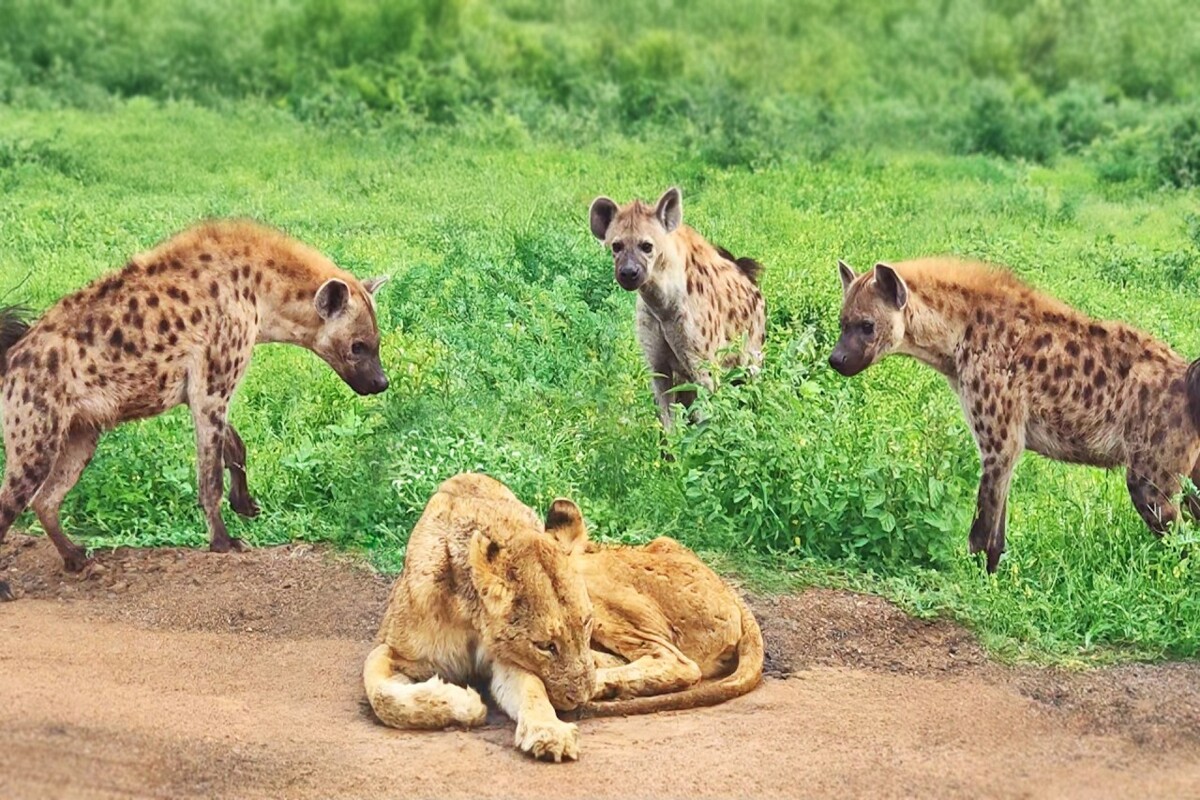
Old blind lioness surrounded by spotted hyenas in Kruger National Park

A lone lioness lay beside the road in Kruger National Park, looking nothing like the powerful predator people normally imagine when they hear the word “lion.”

She appeared extremely old and frail.

More troubling still, the lioness appeared to be blind.

Then a group of spotted hyenas came walking down the road.

For a lioness, this was an extremely dangerous situation.

Lions and spotted hyenas are among Africa’s most important large predators, and the two species compete directly for food. They can steal from each other’s kills, confront one another over carcasses, and sometimes kill one another. Animal Diversity Web describes this relationship as direct competition that can lead to violent encounters.

Yet the hyenas in this remarkable encounter did something unexpected.

They approached.

They investigated.

They came remarkably close.

And then they walked away.

There was no dramatic attack.

No chase.

No prolonged fight.

Instead, the hyenas appeared to recognize that the strange lioness lying before them was not behaving like a normal, dangerous adult lion.

The encounter was filmed by Steyn Jacobsohn on the S25 in Kruger National Park, South Africa, and published by Latest Sightings on February 10, 2025.

A Lioness Who Could Barely Respond

The sighting began with a normal lion sighting.

Steyn Jacobsohn and the other observers expected to find a lion.

What they discovered was much more unusual.

It was a lioness, but something was clearly wrong.

According to Steyn’s account, the lioness appeared to be blind, although he did not know what had caused her condition.

As she lifted her head, the impairment was apparent.

She did not respond normally to movement around her.

She seemed unable to identify what was approaching.

And she appeared physically weak.

The African lion is normally an exceptionally capable predator. Lions possess powerful forelimbs, large canine teeth and strong jaws, while lionesses are important hunters within prides.

But this lioness was in a very different condition.

Her usual defenses appeared severely reduced.

Then the Hyenas Appeared

The road was quiet.

Then hyenas came down the road.

At first, the animals did not seem to notice the lioness.

This was remarkable in itself.

A lion lying beside a road should normally attract immediate attention from another large predator.

But the hyenas initially passed behind her without appearing to realize exactly what was there.

The lioness also appeared unaware of them.

She turned her head at times, but there was no obvious aggressive response.

Neither species immediately understood the situation.

Then the hyenas picked up her scent.

Everything changed.

The Hyenas Turn Back

After passing behind the lioness, the hyenas detected her presence.

They began approaching.

For a moment, the encounter looked as though it could become extremely violent.

The hyenas were more numerous.

The lioness was alone.

And she was apparently unable to see properly.

Under normal circumstances, that combination could be disastrous for a solitary lion.

But the hyenas did not rush in.

They slowed down.

They approached cautiously.

That hesitation became one of the strangest aspects of the entire encounter.

Lions and Hyenas Are Ancient Competitors

To understand how unusual the scene was, it helps to understand the relationship between these two species.

The spotted hyena is not simply a scavenger waiting for lions to finish hunting.

Spotted hyenas are powerful predators in their own right.

Animal Diversity Web describes them as one of Africa’s top predators and notes that they can hunt a wide range of prey, including large mammals.

Lions and hyenas can therefore compete for exactly the same resources.

A lion may kill prey.

Hyenas may try to steal it.

Hyenas may make a kill.

Lions may attempt to take it.

The resulting encounters can become extremely aggressive.

The Lioness Is Normally the Dangerous One

Under normal conditions, a lioness would be a formidable opponent.

Lionesses are the primary hunters in many lion prides and frequently work together when targeting large prey.

Animal Diversity Web notes that African lions live in social groups and occupy habitats with abundant ungulate prey, while lions can also compete aggressively with other predators.

A healthy adult lioness therefore represents a serious threat to a hyena.

Even several hyenas have to consider the risks of approaching a lion.

That may explain some of the caution visible in the footage.

The hyenas did not know exactly what condition the lioness was in.

They approached carefully.

The Hyenas Move Closer

The hyenas continued toward her.

Their tails were raised.

Their attention was fixed on the lioness.

But something was missing.

There was no explosive attack.

Latest Sightings noted that the hyenas did not produce the intense whooping often associated with excitement and group activity in spotted hyenas during such encounters.

Instead, they appeared uncertain.

The lioness was not behaving as expected.

The Lioness Turns Her Head

The sounds of movement in the grass finally caught the lioness’s attention.

She turned toward the hyenas.

But there was no charge.

No attempt to run.

No obvious effort to attack.

She simply turned her head.

The hyenas continued to approach.

For the observers, this was an extraordinary sight.

A lioness was surrounded by one of her species’ most important competitors, yet she appeared almost incapable of responding.

A Soft Growl

Eventually, the lioness gave a low growl.

It was not the explosive roar of a powerful lion confronting a rival.

It was a much weaker warning.

The hyenas heard it.

But they still did not attack.

This is one of the moments that makes the footage so unusual.

The lioness was communicating that she was aware of the animals around her.

The hyenas were communicating through posture and movement.

Both species were assessing the situation.

The Hyenas Seem Confused

Latest Sightings described the hyenas as appearing confused by the lioness’s lack of reaction.

That interpretation is important because it avoids claiming that the hyenas necessarily felt “pity” in the human sense.

We cannot know what the animals were thinking.

What we can observe is that their behavior was unusually cautious.

They did not immediately attack.

They came closer.

They watched.

And they eventually moved on.

Did the Hyenas Show Mercy?

The video’s title calls it “mercy.”

That is a powerful description.

But scientifically, it is safer to describe the behavior as unusually tolerant or non-aggressive rather than claiming that the hyenas consciously felt compassion.

Animal behavior can be explained through many possibilities.

The hyenas may have been curious.

They may have recognized that the lioness posed little immediate threat.

They may have been uncertain about approaching an unusual animal.

They may have been responding to the absence of normal defensive behavior.

Or several factors may have influenced the encounter at once.

The footage cannot tell us exactly which explanation is correct.

Why Didn’t the Hyenas Attack?

There is no confirmed answer.

But the behavior is fascinating.

A healthy lion can be dangerous.

A sick or injured lion can be a very different proposition.

The hyenas may have assessed the situation and found little reason to take the risks associated with an attack.

Animal Diversity Web notes that spotted hyenas and lions compete directly and that their encounters can result in death.

Avoiding unnecessary injury is therefore an important consideration for any hyena.

A predator does not necessarily attack every vulnerable animal it encounters.

Predators Have to Manage Risk

Wild predators live in a world where injuries matter.

A broken leg can prevent hunting.

A damaged jaw can make feeding difficult.

A serious wound can become infected.

For a hyena, even a weakened lion may still have claws and teeth.

The safest strategy may sometimes be to investigate without committing to a physical confrontation.

That could help explain why these hyenas came close but stopped short of attacking.

The Lioness Was Not Acting Like a Normal Lion

One of the strongest clues was her behavior.

She did not rise.

She did not charge.

She did not chase the hyenas.

She barely reacted.

The hyenas may have been responding to that unusual behavior.

From their perspective, they were not facing the same kind of lion they would normally encounter.

Instead, they found an animal that appeared severely compromised.

The Mystery Behind Her Blindness

One of the most important details is that the cause of the lioness’s blindness was not established.

Steyn Jacobsohn said he did not know what had happened to her. Latest Sightings mentioned possible cataracts as one theory and also noted speculation about a previous spitting cobra encounter, but neither explanation was confirmed.

That uncertainty should remain part of the story.

It would be misleading to state that a snake caused her blindness.

Likewise, it would be misleading to state that she definitely had cataracts.

The footage only establishes that her eyesight appeared severely impaired.

What Could Cause Vision Problems in a Wild Lion?

Wild animals can experience vision problems for many reasons.

Age-related changes, injuries, infections and other diseases can affect eyesight.

Cataracts, for example, involve clouding of the eye’s lens and can impair vision.

But without veterinary examination, it is impossible to determine what caused this lioness’s condition.

That is why the original account wisely leaves the cause uncertain.

Old Age Changes Everything

Age can dramatically alter the survival prospects of a predator.

A young lion can hunt.

A healthy adult lioness can chase prey.

But an elderly animal may gradually lose physical condition.

Vision can deteriorate.

Teeth can wear down.

Muscle mass can decrease.

The ability to pursue prey can decline.

For a predator, these changes are especially serious because the animal depends on physical ability to obtain food.

A Lioness Without Her Pride

The lioness was also alone.

That matters enormously.

Lions are unusual among cats because they are highly social.

A lion pride can contain related females, their offspring and, depending on the pride structure, adult males.

Social living can provide protection, hunting opportunities and access to food.

Animal Diversity Web describes lions as social animals living in prides and notes that social relationships are an important part of their ecology.

A solitary lioness therefore lacks many of the advantages normally provided by a pride.

Why Being Alone Is Dangerous

A lone healthy lion can still be dangerous.

A lone weak lion is another matter.

Without companions, the lioness had fewer opportunities to share food or receive protection.

She also had no other lions immediately available to help drive away the hyenas.

That made her position extremely vulnerable.

The Hyenas Keep Their Distance

Despite the apparent weakness of the lioness, the hyenas did not crowd directly around her.

They generally remained a few metres away.

That distance is revealing.

It suggests that the hyenas were still treating the lioness as an animal that deserved caution.

A lion’s reputation as a dangerous competitor does not disappear simply because one individual appears weak.

The hyenas still had to assess her.

The Strange Silence

Another unusual feature of the encounter was the relative lack of vocal aggression.

Spotted hyenas are highly vocal animals.

They communicate through whoops, giggles, growls, calls and other sounds.

But according to Latest Sightings, the hyenas did not produce the expected whooping behavior as they approached the lioness.

That silence added to the strange atmosphere.

The road was quiet.

The lioness barely moved.

The hyenas approached carefully.

It was almost as though everyone was waiting for something to happen.

A Spotted Hyena Is a Powerful Predator

The spotted hyena is a remarkable predator in its own right.

Animal Diversity Web reports that females are generally larger than males and that spotted hyenas possess exceptionally powerful jaws relative to their body size.

Their ability to consume bones is legendary.

Their social organization is also sophisticated.

They live in clans and cooperate in hunting, defense and other activities.

That social power helps explain why lions and hyenas have such a complicated relationship.

Hyenas Are Not Simply Scavengers

The old image of hyenas as cowardly scavengers is inaccurate.

Spotted hyenas are capable hunters.

They can pursue prey over long distances and kill animals themselves.

Animal Diversity Web notes that spotted hyenas use keen senses to hunt live prey and can chase prey at speeds approaching 60 km/h.

They also scavenge extensively.

Their ecological flexibility is one reason they are so successful.

Lions and Hyenas Compete Constantly

Because both species can hunt and scavenge, competition is unavoidable.

Animal Diversity Web states that lions and spotted hyenas often compete for food and can scavenge each other’s kills. These encounters may become antagonistic and sometimes fatal.

That makes the behavior in this video even more unusual.

Instead of exploiting a vulnerable rival, the hyenas simply investigated and moved on.

A Rare Moment of Restraint

The word “restraint” should also be used carefully.

The hyenas may not have consciously decided to spare the lioness.

There is no way to know that from the footage.

But behaviorally, there was restraint.

The animals approached without escalating into a physical attack.

They had an opportunity to interact aggressively.

They did not take it.

That is the observable fact.

One Hyena Scent-Marks Nearby

The encounter was not completely passive.

One hyena eventually scent-marked nearby.

Scent marking is an important part of hyena communication.

Animal Diversity Web notes that spotted hyenas use scent marking and other forms of communication to interact with members of their social group and establish information about their surroundings.

So while the hyenas did not attack the lioness, they were still behaving like hyenas.

They were investigating and communicating in their normal environment.

The Lioness Lowers Her Head

After the hyenas had spent time near her, the lioness lowered her head again.

Her chin rested against the ground.

She appeared exhausted.

This was perhaps the saddest moment of the encounter.

The animal that would normally command respect across the savanna was now unable to defend herself effectively.

The hyenas eventually moved away.

The lioness remained.

Then the Hyenas Leave

The hyenas eventually continued down the road.

The encounter was over.

There was no dramatic chase.

No attack.

No kill.

Just a group of predators passing by a severely weakened competitor.

Latest Sightings described the behavior as unusually calm and suggested that the hyenas may have concluded that the lioness was no longer a meaningful threat or that attacking her was not worth the risk.

That interpretation remains a possibility rather than a proven explanation.

What Happened to the Lioness?

This is where the story becomes uncertain.

The video ends while the lioness is still alive.

There is no confirmed account in the original video description establishing exactly what happened to her afterward. Latest Sightings suggested that, given her condition, her chances of surviving much longer were poor.

But that is not the same as knowing her eventual fate.

We should not invent an ending that the footage does not provide.

Her story remains unfinished.

Nature Is Not Always a Quick Death

The encounter also highlights a difficult reality of life in the wild.

Predators do not always die during dramatic hunts.

Sometimes old age or illness gradually reduces an animal’s ability to survive.

An animal may become unable to hunt effectively.

It may lose weight.

It may become vulnerable to competitors.

Eventually, it may die from starvation, disease, predation or a combination of factors.

This can be a slow process.

Why the Encounter Feels So Emotional

The image of an old, apparently blind lioness surrounded by hyenas naturally triggers an emotional response in human viewers.

The lion is an iconic symbol of strength.

Seeing one in such a vulnerable condition creates a powerful contrast.

But the scientific story is equally fascinating.

The footage shows how a predator’s social position and physical condition can completely change an interaction with another predator.

The lioness was still a lion.

But her behavior and apparent condition changed the risk calculation for the hyenas.

The Lion Was Still Dangerous

Even in her weakened condition, the lioness remained potentially dangerous.

That is why the hyenas did not simply walk directly over to her.

They approached cautiously.

A single bite or swipe could still cause injury.

Wild predators do not necessarily know precisely how strong another animal is.

They have to assess it.

The hyenas appeared to do exactly that.

A Balance Between Curiosity and Caution

The behavior can perhaps be understood as a balance.

The hyenas were curious enough to investigate.

But they were cautious enough not to commit to an attack.

That combination is common in wildlife.

An animal may approach something unfamiliar while remaining ready to retreat.

The raised tails and careful movements visible in the encounter suggest that the hyenas were alert to the situation.

Why the Hyenas May Have Walked Away

Several explanations are possible.

The lioness may have appeared too weak to be worth attacking.

The hyenas may have been uncertain about her condition.

They may have been investigating rather than hunting.

They may have recognized the risks of physical contact.

Or they may simply have lost interest.

The footage cannot distinguish conclusively between these possibilities.

What we know is that the encounter ended peacefully.

The Importance of Not Humanizing Wildlife Too Much

The phrase “showed mercy” makes for a powerful headline.

But wildlife behavior is often more complicated than human morality.

Animals do not need to experience compassion in the same way humans do for their behavior to appear compassionate.

The hyenas may have been responding to risk, novelty, uncertainty or the absence of a threat.

That does not make the encounter less remarkable.

It makes it more scientifically interesting.

Kruger National Park: A World of Predator Competition

The encounter happened in Kruger National Park, one of Africa’s most famous protected areas.

The park supports large populations of lions and spotted hyenas along with leopards, wild dogs and numerous herbivore species. Its biodiversity statistics include both lions and spotted hyenas among its major large predators.

This makes Kruger an extraordinary place to observe predator competition.

The same landscape can support several large carnivores at once.

And when their territories and food sources overlap, encounters are inevitable.

The S25 and the Wildlife Around It

The sighting occurred on the S25, a road within Kruger National Park.

Safari roads often provide unusual opportunities to observe wildlife because animals sometimes use or cross them.

In this case, the road became the stage for a remarkable predator interaction.

The lioness rested beside it.

The hyenas approached along it.

And the observers were able to document behavior that would otherwise have remained unseen.

The Difference Between a Healthy Lion and a Vulnerable Lion

This encounter provides a striking comparison.

A healthy adult lioness can be a dangerous opponent.

A severely weakened lioness may be unable to respond effectively.

The same species can therefore occupy completely different positions in the predator hierarchy depending on age and physical condition.

That is one of the harsh realities of natural selection.

Strength is not permanent.

Health is not guaranteed.

And every predator eventually faces the effects of age.

What This Encounter Teaches Us About Hyenas

The encounter challenges several common misconceptions about hyenas.

They are not simply cowardly scavengers.

They are powerful predators.

They are intelligent and socially complex.

They compete directly with lions.

And they do not necessarily attack every vulnerable animal they encounter.

The spotted hyena is one of Africa’s most important large carnivores and plays a major ecological role through both hunting and scavenging.

What This Encounter Teaches Us About Lions

It also provides an important reminder about lions.

Even an apex predator is not invincible.

Age, injury, disease and isolation can dramatically change an animal’s ability to survive.

The lioness’s condition showed what can happen when a predator loses the physical abilities that normally allow it to hunt and defend itself.

The Most Unusual Part Was What Did Not Happen

There are plenty of dramatic wildlife videos showing lions and hyenas fighting.

This one is memorable for the opposite reason.

The fight never happened.

The hyenas came close.

The lioness growled.

The hyenas investigated.

Then they left.

Sometimes the absence of violence is itself the most remarkable part of a wildlife encounter.

A Powerful Ending Without a Battle

The final image is haunting.

The hyenas disappear down the road.

The old lioness remains behind.

Her head lowers again.

The landscape becomes quiet.

There is no triumphant predator.

No victorious prey.

No dramatic ending.

Only an aging wild animal facing an uncertain future.

And perhaps that is why the footage stays with viewers.

Watch the Original Video

Watch the complete encounter here:

Hyenas Show Mercy on Old & Blind Lioness — Latest Sightings

The video was published by Latest Sightings on February 10, 2025. The footage was submitted by Steyn Jacobsohn and recorded on the S25 in Kruger National Park.

More Wildlife Encounters From khxyz

If you enjoy unusual predator encounters, explore more wildlife stories from khxyz:
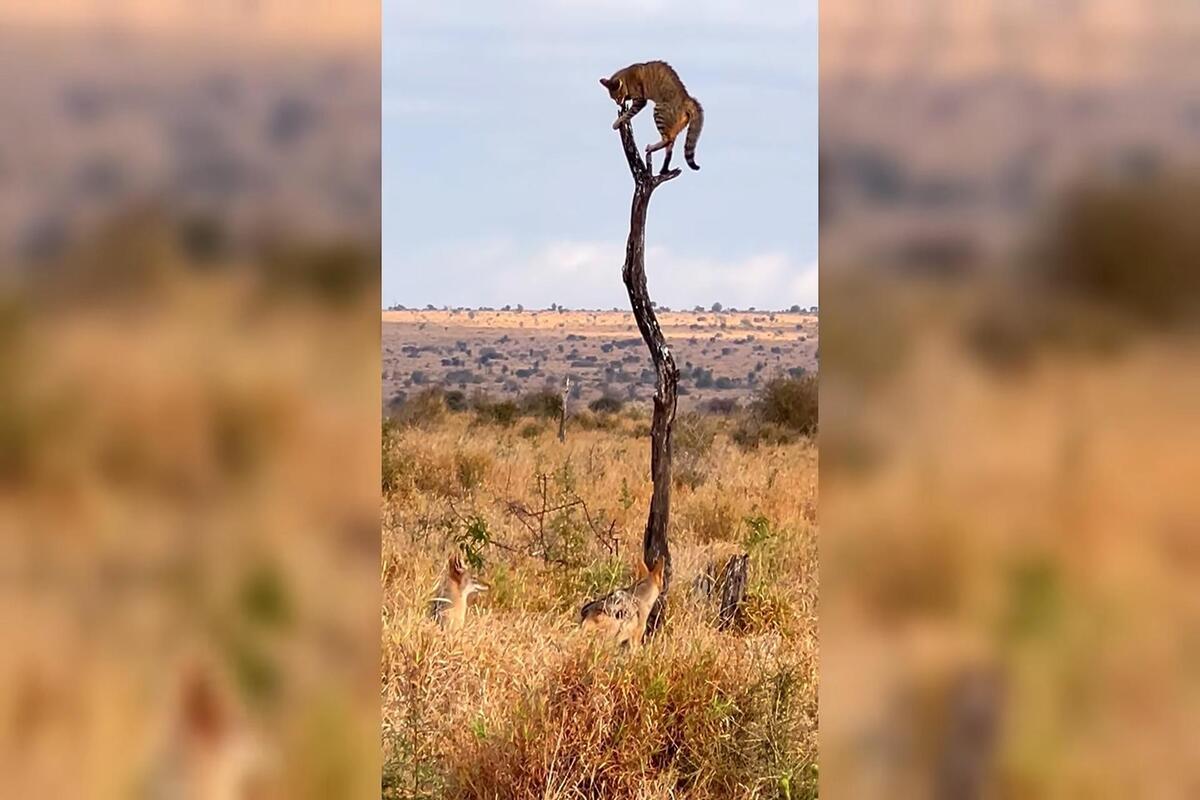
Cheetah Puts Everything on the Line to Protect Cub from Leopard

Mother cheetah confronting a leopard to protect her cub in Botswana

A mother cheetah was resting with her nearly grown cub in the Okavango Delta when something dangerous was watching them from a tree.

The leopard was almost impossible to see.

Hidden among the branches of a marula tree, it had already spotted the two cheetahs below. The mother was scanning the landscape, apparently unaware that another big cat was quietly watching from nearby.

Then the leopard moved.

The ambush was beginning.

But the leopard had made one mistake.

It had underestimated the mother.

Instead of immediately running away, the mother cheetah turned toward the threat and moved aggressively in its direction. What followed became an extraordinary standoff between two of Africa’s most famous cats.

The encounter was filmed by experienced guide Daryl Dell at andBeyond’s Xaranna Okavango Delta Camp in Botswana and published by Latest Sightings on February 19, 2025.

A Quiet Morning in the Okavango Delta

The encounter began during an early-morning safari.

Daryl Dell and his guests were searching for a mother cheetah and her older cub after having seen the pair the previous afternoon.

The Okavango Delta is one of Africa’s most remarkable wetland ecosystems, creating a mosaic of waterways, grasslands, woodland and seasonal floodplains.

It is also home to an extraordinary concentration of predators.

Cheetahs, leopards, lions, African wild dogs and spotted hyenas can all occur within the broader Okavango ecosystem.

That means a predator must constantly remain alert.

The mother cheetah appeared to understand that.

She climbed onto a termite mound and began scanning the surrounding landscape.

The Leopard Was Already Watching

Unknown to the cheetah, a leopard was sitting in a marula tree nearby.

The assistant guide spotted the leopard before the cheetahs did.

That gave the safari group a remarkable perspective.

They could see the danger.

The cheetahs could not.

The leopard is one of Africa’s most effective ambush predators. Animal Diversity Web describes leopards as solitary carnivores that commonly approach prey using a slow, crouching movement before launching a short attack.

Their spotted coats also provide excellent camouflage.

In this case, the leopard’s camouflage worked.

It remained still enough that the cheetahs did not immediately detect it.

The Cheetah Steps Off the Mound

Eventually, the mother apparently felt comfortable enough to leave the termite mound.

That was the moment the leopard had been waiting for.

The leopard climbed down from the tree and began moving through the vegetation.

The thick cover gave the leopard an enormous advantage.

It could approach without exposing itself.

The distance between the two predators quickly disappeared.

According to Latest Sightings, the leopard eventually came within roughly 20 metres of the cheetahs.

The mother and cub still had not fully recognized the danger.

A Leopard Gets Into Position

The leopard continued stalking.

It moved carefully through the vegetation, using cover to remain concealed.

This is classic leopard hunting behavior.

Unlike a cheetah, which often depends on speed and open ground, a leopard can use concealment to get remarkably close before attacking.

Animal Diversity Web describes leopards as ambush predators that can approach prey to within just a few metres before pouncing.

That makes dense Okavango vegetation particularly useful to a leopard.

The cheetah mother was about to discover exactly how close the danger had become.

The Cub Was the Vulnerable Target

The cub was no longer a tiny newborn.

Latest Sightings described it as a sub-adult.

That distinction matters.

The youngster was old enough to move around independently, but it was not yet fully independent from its mother.

And compared with an adult cheetah, a sub-adult was still a more vulnerable target.

The leopard had the size and strength advantage.

The mother therefore faced a dangerous choice.

Run?

Fight?

Or try to intimidate the leopard?

The Mother Climbs Another Mound

Something appeared to trigger another bout of caution in the mother.

She climbed a second mound to scan the surroundings.

This time, she was looking directly toward the leopard.

The leopard was extremely close.

Yet it remained almost perfectly still.

For several moments, neither animal moved.

It was one of those rare wildlife scenes where the smallest movement can completely change the outcome.

The safari guests could see the leopard.

The cheetah was looking toward the leopard.

But the predator remained difficult to distinguish from the surrounding vegetation.

Then the Leopard Moves

Eventually, the leopard shifted slightly.

That tiny movement was enough.

The camouflage was broken.

The mother cheetah detected the threat.

Suddenly, the situation was no longer an ambush.

The leopard had lost the element of surprise.

And the mother had a decision to make.

The Cheetah Does Something Unexpected

A cheetah’s most famous defense is speed.

If a larger predator approaches, running away is often the safest option.

Animal Diversity Web notes that most adult cheetahs flee from predators, while lions, hyenas and leopards are among the species known to kill cheetahs or cheetah cubs.

But this mother did something very different.

She moved toward the leopard.

Latest Sightings reported that instead of using her speed to escape, she became aggressive and moved directly toward the leopard while her cub remained behind her.

That changed everything.

A Mother Between Two Predators

The mother effectively positioned herself between the threat and her youngster.

It is important not to translate this into human emotions that cannot be directly measured.

But the observable behavior is clear.

The mother moved aggressively toward the leopard while the cub remained behind her.

That is consistent with defensive maternal behavior.

Animal Diversity Web records parental care and protection of young in cheetahs, and leopard research likewise documents strong maternal investment in offspring.

The mother was not simply fleeing.

She was confronting the immediate threat.

The Leopard Is Surprised

The leopard had approached expecting an opportunity.

Instead, it suddenly faced an adult cheetah moving toward it.

This was not the situation the leopard had prepared for.

The two cats began moving around each other.

The encounter became almost like a chase in reverse.

The leopard had been stalking the cheetahs.

Now the cheetah was pushing toward the leopard.

The hunter had suddenly become the animal being pressured.

Speed Versus Strength

This encounter highlights the enormous difference between the two species.

The cheetah is built primarily for speed.

The leopard is built for stealth, strength and versatility.

Cheetahs possess long legs, a flexible spine and specialized anatomy associated with high-speed pursuit.

Leopards, meanwhile, have powerful limbs and are exceptionally capable climbers.

Animal Diversity Web reports that leopards can run in short bursts at around 60 km/h and can tackle prey several times their own body mass.

A direct fight therefore carried significant risk for the smaller, more lightly built cheetah.

But the mother did not appear interested in fighting on the leopard’s terms.

She used movement and aggression to keep the leopard away from her cub.

The Cub Watches From Behind

Throughout the confrontation, the youngster remained behind its mother.

That was important.

The cub did not need to confront the leopard directly.

The mother was taking the lead.

The situation also demonstrates why remaining close to an experienced adult can be so valuable for a young predator.

Cheetah cubs face substantial mortality from other predators.

Animal Diversity Web identifies lions, hyenas and leopards among the predators known to kill cheetah cubs.

A mother therefore faces a difficult challenge: she must find food while also keeping vulnerable offspring alive in a landscape full of competitors.

Why Leopard Encounters Are So Dangerous

Leopards and cheetahs are not simply two unrelated predators that occasionally meet.

They can compete for prey and space.

Animal Diversity Web notes that leopards compete with other carnivores, including cheetahs, and are also known to scavenge from cheetahs.

That creates a complicated relationship.

A leopard can potentially kill a cheetah cub.

A leopard can also steal food from a cheetah.

And an encounter between adults can become dangerous for both animals.

For the mother in this video, keeping the leopard away from the cub was therefore critical.

The Leopard Retreats

The confrontation continued until the leopard began moving away.

Instead of pursuing the leopard as prey, the mother continued to pressure it.

The leopard eventually headed toward a nearby tree.

This is where the encounter becomes almost surreal.

A leopard is normally the cat associated with trees.

It is an excellent climber and frequently uses trees for resting, escaping competitors and storing food.

In this encounter, the leopard was effectively being pushed toward one of its most important natural refuges.

The Cheetah Escorts the Leopard

Latest Sightings described the remarkable ending by saying that the cheetah effectively “escorted” the leopard toward the nearest tree.

The wording captures the unusual reversal.

The leopard had started the encounter as the hidden predator.

It had approached the cheetahs under cover.

But once discovered, it ended up retreating toward a tree while the mother cheetah followed.

The cub remained safely behind.

The Leopard’s Tree Advantage

Once the leopard reached the tree, its physical advantages became important again.

Leopards are highly capable climbers.

Their muscular limbs, retractable claws and flexible bodies make trees useful refuges.

Animal Diversity Web describes leopards as partly arboreal and notes that they commonly use trees for feeding and other activities.

A cheetah cannot match a leopard’s climbing specialization.

So the tree provided the leopard with a natural escape route.

The confrontation was effectively over.

The Mother Had Achieved What She Needed

The most important result was not defeating the leopard.

It was keeping the leopard away from the cub.

The mother had successfully disrupted the ambush.

The leopard did not get the opportunity to attack the youngster.

The cub followed safely behind its mother.

Latest Sightings reported that the mother ultimately won the standoff and the cub remained safe.

In the language of wildlife survival, that was the important outcome.

Why Cheetah Mothers Face an Impossible Job

Raising cubs is one of the most difficult periods in a female cheetah’s life.

She has to hunt.

She has to find enough food.

She must avoid larger predators.

And she must protect offspring that are not yet capable of surviving independently.

This is particularly difficult because cheetahs are not built to defend themselves against every larger carnivore.

Their greatest weapon is speed.

But speed does not solve every problem.

If a cub is cornered, the mother may have to take a completely different approach.

The Importance of Maternal Protection

Cheetah mothers provide extensive care for their offspring.

Young cubs depend on their mother for food and protection while they develop.

Animal Diversity Web documents parental care in cheetahs and specifically identifies protection of young as part of their parental behavior.

The video provides a dramatic real-world example of why that protection matters.

A sub-adult may be capable of moving quickly.

But against a powerful leopard, speed alone may not always be enough.

Cheetah Cubs Face High Mortality

One of the harshest facts about cheetah biology is that cub survival is difficult.

Animal Diversity Web notes that cheetah cub mortality is particularly high and identifies several predators, including leopards, as threats.

This makes the encounter more significant.

The leopard was not simply another animal passing through.

It represented a genuine threat to the youngster.

The mother’s decision to confront it therefore occurred in a context where the survival of young cheetahs is already challenging.

A Leopard Is Also a Mother

There is another fascinating dimension to this encounter.

Leopards themselves invest heavily in their offspring.

Female leopards leave cubs concealed in dense vegetation, rock crevices or hollow trees while they hunt, and they frequently move den sites. These behaviors help reduce the risk of cubs being discovered by predators.

So the two animals involved are both mothers in their own species’ survival strategy.

One was protecting a sub-adult.

The other was acting as a solitary predator looking for an opportunity.

That is the complexity of wildlife.

Two Different Forms of Survival

The leopard relies heavily on:

  • Camouflage
  • Stealth
  • Ambush
  • Strength
  • Climbing

The cheetah relies heavily on:

  • Speed
  • Acceleration
  • Agility
  • Excellent vision
  • Rapid changes of direction

The encounter brought those different adaptations into direct conflict.

The leopard’s stealth created the initial advantage.

The cheetah’s awareness and aggression eventually changed the situation.

The Importance of the Termite Mound

The termite mounds were more than background scenery.

They gave the cheetah mother elevated positions from which she could scan the surroundings.

That was especially valuable in an environment where predators can hide in thick vegetation.

From higher ground, a cheetah can potentially gain a better view across the surrounding landscape.

In this encounter, the mother used a mound again just before detecting the leopard.

The Leopard’s Camouflage Nearly Worked

The leopard’s coat is another reason this encounter was so tense.

The rosette pattern breaks up the animal’s outline and can make it difficult to distinguish from shadows, branches and vegetation.

The leopard was sitting almost motionless in the marula tree before moving down and stalking through cover.

Its camouflage was so effective that even when the safari group knew where it was, it remained difficult to see.

That is exactly what an ambush predator needs.

One Small Movement Changed Everything

The entire ambush might have developed differently if the leopard had remained completely still.

But movement gave it away.

That tiny change allowed the cheetah to recognize the danger.

The moment the mother became aware of the leopard, the predator’s biggest advantage disappeared.

Stealth had become detection.

And detection allowed the cheetah to respond.

The Encounter Became a Standoff

Neither cat wanted unnecessary physical contact.

That is an important distinction.

A confrontation between two predators can be extremely costly.

An injury can make hunting difficult.

A damaged leg can be disastrous.

A deep bite can become infected.

For a cheetah, which depends heavily on physical performance, injury could have serious consequences.

For a leopard, the same is true.

The safest outcome for both animals was ultimately to create distance.

Why the Mother Did Not Simply Run

The most striking question from the video is why the mother did not immediately use her famous speed.

The footage does not allow us to know her exact internal motivation.

But the observed sequence is clear: after detecting the leopard, she moved toward it instead of immediately fleeing, while the cub remained behind her.

One reasonable biological interpretation is defensive behavior toward a vulnerable offspring.

But we should distinguish that interpretation from claims about human-like courage, sacrifice or conscious calculation.

What we can observe is extraordinary enough.

A Rare Big-Cat Encounter

Seeing a leopard and cheetah in the same area is already special.

Watching a leopard stalk a cheetah mother and sub-adult, followed by the mother confronting and driving the leopard away, is considerably rarer.

Latest Sightings described the sighting as an unusually rare encounter.

The safari guests were fortunate to witness a sequence that lasted long enough to show both the ambush and the reversal.

The Okavango Is Full of Predator Competition

The Okavango Delta supports a remarkable collection of carnivores.

Its seasonal floodwaters create islands, channels and grasslands where predators and prey constantly interact.

Cheetahs can take advantage of open areas.

Leopards can use woodland and vegetation.

Lions can operate in prides.

African wild dogs can pursue prey cooperatively.

Every predator has its own strategy.

But those strategies sometimes overlap.

That is when encounters like this become possible.

A Cub Safe Behind Its Mother

The final image is perhaps the most memorable.

The mother moves forward.

The leopard retreats.

The cub follows safely behind.

There is no dramatic kill.

No prolonged fight.

No obvious injury.

Instead, the encounter ends through intimidation, movement and distance.

That is often how wildlife conflicts are resolved.

The strongest animal does not necessarily win.

Sometimes the animal that successfully controls the distance wins the encounter.

What This Encounter Teaches Us

This rare confrontation provides several lessons about African predators.

Cheetahs are not helpless

Although they avoid many physical confrontations, cheetahs can respond aggressively when necessary.

Mothers protect vulnerable offspring

Cheetah mothers invest heavily in raising young, and predators such as leopards pose a genuine threat to cub survival.

Leopards depend on stealth

The leopard came remarkably close before its movement revealed its position.

Speed is not always the first defense

The mother did not immediately run.

She confronted the threat instead.

Trees give leopards an important advantage

Once the leopard reached a tree, its climbing ability gave it a natural refuge.

Avoiding injury matters

Neither predator needed a serious fight.

Creating distance was ultimately safer.

A Different Kind of Wildlife Victory

The title says the cheetah put everything on the line.

The footage certainly looks dramatic.

But the most useful way to understand the encounter is not as a human-style act of heroism.

It is as a rare example of defensive behavior between a mother and a vulnerable offspring under immediate predation risk.

The mother detected the threat.

She confronted it.

The leopard withdrew.

The cub remained safe.

Those observable facts tell a remarkable story on their own.

Watch the Original Video

Watch the complete encounter here:

Cheetah Puts Everything on the Line to Protect Cub from Leopard — Latest Sightings

The video was published by Latest Sightings on February 19, 2025, and features footage filmed by experienced guide Daryl Dell at andBeyond’s Xaranna Okavango Delta Camp in Botswana.

More Wildlife Encounters From khxyz

If you enjoy dramatic encounters involving big cats and vulnerable young animals, explore more wildlife stories from khxyz:


Cheetah Mom and Cub Mobbed by 50+ Baboons on Bridge

Cheetah mother and sub-adult cub surrounded by baboons on a bridge

A mother cheetah and her nearly grown youngster were resting peacefully near a bridge when more than 50 baboons suddenly appeared.

What followed was anything but peaceful.

The enormous troop moved toward the two cheetahs, forcing them onto a high-water bridge. The young cheetah became increasingly nervous, while its mother initially stood her ground and snarled at the approaching primates.

Then a large male baboon charged.

The young cheetah reacted by running—and suddenly found itself heading straight toward the rest of the troop.

With dozens of baboons barking and screeching around it, the young predator had to find a way through the mob.

Somehow, it did.

The youngster escaped into the roadside bush, while the baboons turned their attention toward its mother.

The mother cheetah eventually ran up the road, easily creating distance from the pursuing troop.

And remarkably, the two cheetahs were later reunited and reported to be uninjured.

A Peaceful Rest Turns Into Chaos

The encounter was filmed by ranger Liam Todd at Lapalala Wilderness in South Africa’s Waterberg region. Lapalala is a large protected conservation area within the Waterberg Biosphere and covers approximately 48,000 hectares.

According to the original report, Liam had found a mother cheetah and her sub-adult offspring resting near a high-water bridge.

There was nothing unusual about the scene at first.

The two cheetahs were simply resting.

Then the baboons arrived.

A troop began advancing toward the pair.

The atmosphere changed almost instantly.

More Than 50 Baboons Close In

The video is striking because of the sheer difference in numbers.

There were only two cheetahs.

There were more than 50 baboons.

A baboon may not look like a traditional predator, but large baboons possess powerful jaws, long canine teeth and considerable strength.

The Animal Diversity Web describes chacma baboons, which occur across southern Africa, as large primates living in savanna, grassland and woodland environments. Adult males can weigh substantially more than females and possess much larger canine teeth.

That size difference between males and females becomes important during encounters with potential threats.

The troop was not simply a collection of frightened monkeys.

It had large adult males capable of confronting danger.

The Cheetahs Are Forced Onto the Bridge

As the baboons advanced, the cheetahs were pushed toward the bridge.

This was a terrible position for the young cat.

Behind it was limited space.

Ahead were dozens of baboons.

The bridge effectively became a narrow corridor.

The young cheetah watched the approaching troop carefully.

Its body language showed increasing discomfort.

The mother remained nearby.

For a moment, neither cheetah immediately ran.

Why Didn’t the Cheetahs Run Immediately?

Cheetahs are famous for running away from danger.

But speed is not always the first option.

The cheetah, Acinonyx jubatus, is the fastest land mammal, but its body is built primarily for short, explosive pursuits rather than prolonged combat.

SANBI describes the cheetah as a highly specialized sprinting predator, with a deep chest accommodating its large lungs and heart.

Running blindly into a large troop of baboons would have been extremely risky.

The young cheetah therefore initially remained near its mother.

Both cats snarled at the approaching animals.

It was a warning.

The Baboons Refuse to Back Down

The warning did not work.

The troop continued advancing.

This is where the social structure of baboons becomes important.

Baboons live in complex social groups rather than as solitary animals. Animal Diversity Web describes the genus Papio as containing several closely related species and notes their highly social nature.

The Latest Sightings report describes the troop as having a multilayered structure involving reproductive units, males, females and young, with males playing an important role in group security.

For the cheetahs, they were facing an entire society.

Not one opponent.

Not two opponents.

An organized troop.

The Young Cheetah Makes a Warning Lunge

Eventually, the younger cheetah became too uncomfortable to remain still.

It made a threatening lunge toward the baboons.

For a moment, it looked as though the display might work.

It did not.

Instead, the aggressive movement attracted the attention of a large male baboon.

The male charged toward the young cheetah.

Suddenly, the youngster was no longer confronting the troop on its own terms.

It was being pushed back.

A Large Male Baboon Charges

The large male’s charge changed everything.

The young cheetah veered away.

But there was a problem.

The movement took it toward another section of the baboon troop.

The youngster had effectively moved from one danger zone into another.

There was nowhere obvious to go.

Then it ran.

The Young Cheetah Runs Straight Through the Mob

The young cheetah suddenly accelerated toward the troop.

The baboons reacted immediately.

They barked.

They screeched.

They moved toward the fleeing cat.

For a few seconds, the young cheetah appeared completely surrounded by danger.

Yet this was where one of the cheetah’s greatest advantages became obvious.

Speed.

The cheetah is anatomically specialized for rapid acceleration, with long limbs, a flexible spine and other adaptations associated with high-speed running.

The youngster did not need to defeat the baboons.

It only needed one opening.

The Escape Happens in Seconds

The young cheetah somehow found a route through the troop.

It accelerated and skirted around the agitated baboons.

Then it disappeared into the dense bush beside the road.

The entire escape happened incredibly quickly.

One moment the young predator was trapped among dozens of primates.

The next, it was gone.

The baboons had lost their immediate target.

But they still had one cheetah left to deal with.

The Mother Cheetah Is Now Alone

The mother remained on the bridge.

She had just watched her youngster run through a mass of angry baboons.

Now the troop turned its attention toward her.

The situation had changed again.

The mother had a choice.

Stay and continue confronting the baboons.

Or leave.

She chose to leave.

The Mother Looks Back

Before retreating, the mother gave a quick look behind her.

Then she began moving in the opposite direction.

The baboons followed.

The chase was on.

But unlike the young cheetah, the mother did not run directly through the center of the troop.

She created distance.

The baboons increased their pace.

The mother increased hers.

Speed Becomes the Cheetah’s Best Defense

This is where the physical design of the cheetah becomes crucial.

SANBI describes the cheetah as the fastest land mammal and explains that its body is specialized for sprinting.

Cheetahs can accelerate rapidly and use their long legs, flexible spine and tail for balance while changing direction.

The mother did not need to fight the baboons.

She simply needed to stay ahead of them.

And she did.

The Latest Sightings report states that she easily outpaced the pursuing baboons as she ran up the road.

The Baboons Give Up the Chase

Eventually, the distance became too great.

The baboons stopped pursuing the mother.

Their immediate threat had disappeared.

The troop began settling down.

The dramatic confrontation was over.

The guardian and sentry males returned to their positions, and the troop continued with its normal activities.

For the baboons, the disturbance was finished.

For the cheetahs, there was still one important question.

Where was the youngster?

The Mother and Cub Are Reunited

Fortunately, the encounter had a positive ending.

Liam Todd later reported that the mother and her sub-adult offspring were reunited.

Both cheetahs were unscathed.

That detail changes the entire story.

What looked like a potentially disastrous confrontation ended with both cheetahs escaping.

The young cheetah’s speed and agility had helped it escape the troop.

The mother used speed to create distance from the pursuing baboons.

Neither animal needed to fight.

They survived by getting away.

Why Baboons Can Be Dangerous to Cheetahs

It may seem strange that a group of baboons could force a pair of cheetahs to retreat.

But numbers can dramatically change an encounter.

An adult chacma baboon can weigh roughly 15 kg for females and more than 25 kg for adult males, according to Animal Diversity Web. Males also have much larger canine teeth.

A cheetah is much larger than an individual baboon, but that does not mean it wants to fight several dozen of them.

One baboon is one opponent.

Fifty baboons are a completely different problem.

Cheetahs Are Built for Speed, Not Fighting

The cheetah’s greatest weapon is speed.

Its body is optimized for chasing prey across open ground.

But that specialization comes with trade-offs.

Cheetahs are comparatively lightly built for a large carnivore and can lose kills to stronger predators.

SANBI notes that conflict with larger predators is one of the important threats facing cheetahs.

This helps explain why avoiding unnecessary physical confrontation can be important.

A cheetah does not need to prove that it is stronger.

It needs to survive.

Cheetahs Face Competition From Other Predators

Cheetahs live alongside many larger carnivores.

Depending on the ecosystem, they may encounter lions, leopards, hyenas and other competitors.

These larger predators can steal kills or pose direct threats.

The cheetah therefore occupies a difficult ecological position.

It is an exceptional hunter.

But it is not the strongest carnivore in its environment.

This is one reason its ability to accelerate rapidly and escape danger is so valuable.

The Young Cheetah’s Age Matters

The video describes the youngster as a sub-adult, rather than a tiny newborn cub.

That distinction is important.

A sub-adult cheetah is already much more capable of running and hunting than a very young cub.

But it has not necessarily reached full adult independence.

Young cheetahs still have much to learn.

A mother provides protection and experience while offspring develop the skills required to survive.

Learning to Read Dangerous Animals

Every encounter with another species can provide information.

A young cheetah that encounters a large troop of baboons learns something important about them.

Baboons can be aggressive.

Large males can charge.

Numbers matter.

And running into the middle of the troop is dangerous.

The video does not prove exactly what the youngster “learned,” but its behavior demonstrates the immediate survival value of recognizing danger and changing direction quickly.

Baboons Have Their Own Defense System

The baboons were not randomly moving around.

They were living as a social group.

Animal Diversity Web describes baboons as complex social primates, with group structures that vary among species.

In the footage, the adult males were particularly important to the confrontation.

The Latest Sightings report describes them as guardian and sentry males involved in group security.

This provides an important explanation for why the troop was so confident approaching the cheetahs.

A lone baboon would have been in a very different situation.

The Power of Numbers

The encounter demonstrates a basic principle found throughout nature:

numbers can compensate for individual vulnerability.

One baboon cannot match a cheetah in speed.

A troop of dozens does not need to.

The group can advance together.

Individual animals can respond to movement.

Adult males can confront threats.

Younger animals can remain within the group.

The entire troop becomes difficult for a predator to challenge.

The Bridge Created a Dangerous Bottleneck

The bridge made the encounter even more dramatic.

Open ground would have given the cheetahs more options to change direction.

But the bridge created a confined route.

The baboons could approach from the front while the cheetahs had limited space to maneuver.

The young cheetah’s eventual escape required extraordinary agility.

It had to find a gap and use it immediately.

Dense Bush Becomes the Escape Route

After escaping the troop, the youngster disappeared into dense roadside vegetation.

That was another important advantage.

Cheetahs are generally associated with open habitats because they hunt using speed and visibility.

But vegetation can also provide refuge.

Once the youngster was hidden, the baboons could no longer maintain the same direct pressure.

The chase had ended.

A Rare Predator-Primates Encounter

The encounter is unusual because of the species involved.

A mother cheetah and her sub-adult offspring were confronted by a large baboon troop, and the confrontation escalated into an actual pursuit.

Most wildlife encounters do not produce such a dramatic sequence.

The video captured:

  • A large baboon troop approaching two cheetahs
  • The cheetahs standing their ground
  • The young cheetah making a warning lunge
  • A large male baboon charging
  • The youngster becoming surrounded
  • A high-speed escape
  • The troop pursuing the mother
  • The mother outrunning the baboons
  • The two cheetahs eventually reuniting

The entire sequence shows how quickly the balance of power can change in the African bush.

Lapalala Wilderness and the Waterberg

The encounter happened at Lapalala Wilderness, a major protected area in South Africa’s Limpopo Province.

The reserve lies within the Waterberg Biosphere, a landscape known for its diverse habitats and wildlife.

According to information summarized by Wikipedia, Lapalala covers approximately 48,000 hectares and forms part of the Central Bushveld landscape.

The variety of habitats helps support a wide range of wildlife.

That includes predators such as cheetahs and social mammals such as baboons.

Cheetahs Are Under Pressure

Beyond this particular encounter, the video also highlights why cheetah conservation matters.

SANBI lists the cheetah as Vulnerable globally and notes that its historical range has been dramatically reduced. Habitat alteration, loss of prey and conflict with larger predators are among the pressures affecting the species.

A more recent SANBI assessment document notes that most of the world’s adult cheetahs occur in southern and eastern Africa, while South Africa’s free-ranging population remains relatively small compared with historical abundance.

Every protected area capable of supporting a viable cheetah population therefore has conservation value.

The Baboons Were Not the Villains

It is easy to watch the young cheetah surrounded by baboons and think of the troop as attacking an innocent animal.

But that is a human interpretation.

The baboons were responding to the presence and behavior of a predator.

The footage shows them advancing, barking, screeching and pursuing the cheetahs, but it does not establish a human-like intention such as revenge or cruelty.

They were animals responding to another animal in their environment.

That distinction matters when interpreting wildlife behavior.

The Cheetahs Were Not Defeated

The dramatic title might make it sound as though the cheetahs were overwhelmed.

But the final outcome was very different.

Both escaped.

The young cheetah used agility to break through the troop.

The mother used speed to outrun her pursuers.

And the two were eventually reunited.

In the language of survival, escape was the outcome that mattered.

What Makes Cheetahs So Special?

The encounter demonstrates several of the cheetah’s defining characteristics.

Acceleration

Cheetahs can accelerate extremely quickly.

Agility

Their flexible bodies allow them to make rapid directional changes.

Speed

They are the fastest land mammals.

Visual hunting

Their eyesight is important for locating prey across open landscapes.

Lightweight construction

Their body is optimized for rapid pursuit rather than prolonged physical combat.

These adaptations helped both cheetahs escape an encounter where strength and numbers favored the baboons.

What Makes Baboons So Successful?

Baboons have a very different survival strategy.

They rely heavily on social living.

A troop provides many eyes.

It provides social support.

It provides adult males capable of confronting threats.

And it provides safety through numbers.

Animal Diversity Web describes chacma baboons as adaptable animals occupying a wide range of southern African habitats.

The troop’s social structure is therefore just as important to its survival as the cheetah’s speed is to its survival.

Two Completely Different Survival Strategies

The confrontation can almost be viewed as a contest between two evolutionary strategies.

The baboons had:

Numbers.

Social cooperation.

Adult males.

Group defense.

The cheetahs had:

Speed.

Agility.

Acceleration.

The ability to escape into vegetation.

Neither strategy is universally superior.

Each works under different circumstances.

On the bridge, the baboons had the advantage.

Once the cheetahs reached open ground, speed became much more important.

The Moment the Tables Turned

At first, the baboons appeared to control the encounter.

They approached.

They forced the cheetahs onto the bridge.

They chased the youngster.

They pursued the mother.

But the moment the cheetahs gained enough space to run, the situation changed.

The baboons could no longer keep up.

That is the fascinating thing about wildlife encounters.

There is rarely one permanent winner.

The advantage can change within seconds.

A Mother and Her Youngster Survive

Perhaps the most satisfying part of this story is what happened after the chase.

The mother and youngster were reunited.

Neither was injured.

After all the barking, charging and running, the encounter ended without a fatal outcome.

For the cheetahs, the most important thing was getting away from the danger.

And they did.

Watch the Original Video

Watch the complete encounter here:

Cheetah Mom and Cub Mobbed by 50+ Baboons on Bridge — Latest Sightings

The video was published by Latest Sightings on March 5, 2025. It was recorded by ranger Liam Todd at Lapalala Wilderness Reserve in the Waterberg.

More Wildlife Encounters From khzyz

If you enjoy dramatic encounters between predators and other wildlife, explore more stories from khzyz:

Two Jackals Trap an African Wildcat on a Dead Tree

African wildcat trapped on a dead tree by two jackals in Kruger National Park

An African wildcat normally spends its life on the ground, moving quietly through grass, scrub and open woodland in search of small prey.

But on this day in Kruger National Park, staying on the ground was no longer an option.

Two jackals began chasing the small cat, forcing it toward a dead, almost branchless tree. With the jackals waiting below, the African wildcat climbed higher and higher until it was balancing on the narrow top of the trunk.

It was an extraordinary predator-versus-predator encounter.

The sighting was filmed by Enslin Davel just off the S90 in Kruger National Park, also known as the Old Main Road, in the central part of the reserve. Latest Sightings described the encounter as an extremely rare sighting of two jackals chasing an African wildcat into a tree.

What happened next showed just how useful a little bit of height can be when a small predator is suddenly outnumbered.

An Unexpected Encounter in the Bushveld

The African wildcat is one of Africa’s smaller wild cats, but its size should not be mistaken for weakness.

The African wildcat, Felis lybica, is a highly adaptable predator found across much of Africa as well as parts of western and central Asia. It can live in environments ranging from savannas and grasslands to more arid landscapes.

It is also closely related to the domestic cat.

In fact, the African wildcat is considered the principal ancestor of the domestic cat, with domestication beginning thousands of years ago in the Near East.

But this wildcat was not behaving like a domestic cat.

It was fighting for space.

And two jackals were closing in.

Two Jackals Give Chase

According to Latest Sightings, the encounter began when the two jackals chased the wildcat for a short distance. The cat eventually spotted a tree and used it as an escape route.

The fact that there were two jackals immediately changed the situation.

A single jackal might have been easier for the cat to avoid.

Two animals could approach from different directions, reducing the wildcat’s escape options.

The jackal is not a single species but a common name used for several African and Eurasian canids. In southern Africa, the black-backed jackal is one of the most familiar species. Jackals are opportunistic predators and scavengers capable of hunting a wide variety of smaller animals.

Were They Trying to Kill the Wildcat?

The footage shows the jackals pursuing and cornering the wildcat, but their exact motivation cannot be established simply by watching the encounter.

It would be tempting to say they were definitely trying to kill it.

But predator interactions are more complicated than that.

Jackals can compete with other carnivores for food and space, and they may attack smaller predators under certain circumstances. SANBI notes that black-backed jackals can hunt a variety of animals and also have important interactions with larger carnivores and other competitors.

So the safest description is that the jackals were threatening and pursuing the wildcat.

Whether their goal was killing it, driving it away, or exploiting an opportunity cannot be determined with certainty from the footage alone.

The Wildcat Finds a Dead Tree

Then came the wildcat’s most important decision.

It climbed.

The tree was far from an ideal climbing structure.

There were no comfortable branches spreading outward.

Instead, the cat climbed onto the dry trunk and eventually reached the top.

Latest Sightings described the tree as an arid, branchless structure, making the wildcat’s balance especially impressive.

For an animal accustomed to moving close to the ground, this was a dramatic change of environment.

The ground was dangerous.

The tree was awkward.

But awkward was better than dangerous.

African Wildcats Are Mostly Ground-Dwellers

This is what makes the sighting particularly interesting.

The African wildcat is primarily terrestrial.

Unlike a leopard, which is famous for climbing trees, resting in branches and carrying prey into trees, the African wildcat normally spends most of its time on the ground.

Latest Sightings specifically points out this difference, noting that African wildcats can climb when necessary but are not specialized tree-dwelling cats.

That makes this encounter unusual.

The cat was not climbing because it had chosen a comfortable place to rest.

It was climbing because the ground had become dangerous.

A Small Cat With a Big Survival Instinct

African wildcats may be small, but they are experienced hunters.

Their typical diet includes small mammals, birds, reptiles and other appropriately sized prey.

Their sandy or grayish coat helps them blend into dry vegetation, making them difficult to spot while hunting.

The African wildcat generally weighs only a few kilograms, with adult weights commonly reported around 3–8 kg depending on sex and location. Latest Sightings gives the same approximate range for the animal in this encounter.

That is tiny compared with many of the predators sharing its environment.

A lion may weigh more than 100 kg.

A leopard can be several times heavier.

Even a jackal can be a serious opponent for a small wildcat.

Survival therefore depends heavily on awareness, camouflage, speed and choosing the right escape route.

The Tree Becomes a Fortress

Once the wildcat reached the top of the trunk, the entire situation changed.

The jackals could no longer simply chase it.

They were now below.

The cat was above.

The narrow trunk created a physical barrier between them.

The jackals remained close, apparently waiting for the cat to make a mistake. Latest Sightings reported that the jackals stayed beneath the tree but were unable to force the wildcat down.

For the wildcat, patience suddenly became a survival tool.

It did not need to defeat the jackals.

It only needed to avoid being caught.

The Incredible Balancing Act

The wildcat’s position at the top of the trunk is one of the most remarkable parts of the video.

There was little room for error.

A slip could send the cat straight back toward the waiting jackals.

The animal therefore had to maintain its balance while watching the predators below.

Cats are well known for their balance and coordination, but the African wildcat’s normal lifestyle does not require the same tree-climbing specialization seen in species such as leopards.

The encounter demonstrates how quickly an animal can use abilities that may not normally be central to its daily life when circumstances become dangerous.

Why Climbing Worked

Height can provide an enormous advantage to a small animal.

On the ground, the wildcat had to worry about two moving predators.

At the top of the trunk, the jackals had limited access.

The African wildcat had effectively changed the terrain.

It turned a chase into a waiting game.

This is one of the fundamental principles of survival in the wild: an animal does not always need to overpower a competitor.

Sometimes it simply needs to make itself difficult to reach.

The Jackals Wait Below

The two jackals did not immediately leave.

They remained near the tree.

Their persistence is not surprising considering how opportunistic black-backed jackals can be.

SANBI describes black-backed jackals as highly adaptable animals with broad diets. They normally forage alone or in pairs and can pursue small vertebrates and other prey.

They also have sophisticated communication systems, including vocalizations, scent marking and body postures.

So although the video focuses on the physical confrontation, the jackals were also operating as social canids.

Two individuals can create more pressure than one.

Black-Backed Jackals Are Remarkably Adaptable

If the jackals in this encounter were black-backed jackals, their behavior fits the species’ general ecological flexibility.

The black-backed jackal, Lupulella mesomelas, occurs across parts of eastern and southern Africa. It is found in environments ranging from savanna and scrub to more open and arid landscapes.

SANBI describes the species as an opportunistic animal capable of eating many different types of food.

It can hunt small mammals and other animals, scavenge carcasses and take advantage of whatever resources are available.

That flexibility is one reason jackals are such successful predators.

A Jackal Can Be More Than a Scavenger

Jackals are sometimes portrayed simply as scavengers waiting for lions to finish eating.

That is misleading.

The black-backed jackal is an active hunter as well as a scavenger.

SANBI reports that black-backed jackals hunt small vertebrates and invertebrates and can pursue larger prey. In some circumstances, groups can cooperate to subdue difficult prey.

That makes the pursuit of an African wildcat easier to understand.

The jackals were not helpless scavengers.

They were capable predators confronting another predator.

Predator Versus Predator

This is what makes the encounter so fascinating.

There was no traditional predator-versus-prey relationship.

The wildcat was itself a hunter.

The jackals were hunters too.

Both species depend on many of the same resources.

Both can occupy similar habitats.

And both have to navigate a landscape containing larger carnivores.

The interaction therefore represents competition between carnivores rather than a straightforward hunting sequence.

The Wildcat Has Other Enemies Too

The African wildcat lives in an environment crowded with dangerous predators.

According to Latest Sightings, lions, leopards, hyenas, African wild dogs and jackals can all pose threats to African wildcats, especially vulnerable kittens.

This makes the wildcat’s size a double-edged sword.

Being small allows it to hunt prey that larger carnivores may ignore.

It also allows it to move through dense vegetation and disappear quickly.

But being small means it cannot afford many physical confrontations with larger predators.

Escape is often safer than fighting.

The Wildcat Does Not Need to Win a Fight

One of the biggest lessons from this encounter is that survival does not always mean defeating an opponent.

The wildcat did not need to chase the jackals away.

It did not need to attack them.

It did not need to prove that it was stronger.

It simply needed to avoid being caught.

The dead tree provided exactly that opportunity.

By moving vertically, the wildcat changed the rules of the confrontation.

Why Leopards Are Different

The encounter also highlights the extraordinary climbing ability of leopards.

A leopard is much more specialized for climbing than an African wildcat.

Leopards are powerful climbers and frequently use trees to rest, escape competitors and sometimes store kills.

An African wildcat can climb, but its lifestyle is primarily terrestrial.

That distinction is important because seeing a small wildcat in a tree might otherwise make people assume it behaves like a miniature leopard.

It does not.

This was an emergency use of height.

The Tree May Have Saved the Cat

The most important detail in the entire encounter is simple:

the tree gave the wildcat time.

Time is often more valuable than strength.

The jackals could wait.

The wildcat could wait too.

Every minute spent above the ground was a minute in which the cat was not being chased.

Eventually, the jackals would have to make another decision.

The wildcat would have to do the same.

A Dangerous Game of Patience

Imagine the situation from a survival perspective.

Below the tree are two jackals.

Above them is a small cat.

The cat cannot remain there forever.

The jackals cannot climb the trunk easily enough to reach it.

Neither side has a perfect solution.

This creates a classic wildlife standoff.

The first animal to make a mistake could lose.

For the wildcat, moving too early could mean falling directly into danger.

For the jackals, waiting too long could mean losing their opportunity completely.

The Wildcat’s Escape Route

The available footage and Latest Sightings report establish that the wildcat successfully used the tree as a refuge.

The report describes the tree as a safe place where the cat was able to remain out of reach of the jackals.

It does not provide enough evidence to establish every detail of what happened after the filmed encounter.

That is worth remembering.

Wildlife videos sometimes end before the complete story does.

Rather than inventing an outcome, it is better to focus on what the footage clearly demonstrates: the wildcat used the tree to escape the immediate pressure created by the two jackals.

An Extremely Rare Sighting

Latest Sightings described two jackals chasing an African wildcat into a tree as an extremely rare event.

African wildcats are not commonly seen performing dramatic tree escapes.

Jackals are common and adaptable.

But seeing these three predators interact in exactly this way requires an unusual combination of circumstances.

That is what makes wildlife footage valuable.

It can reveal behavior that would otherwise go unseen.

Kruger National Park Provides the Perfect Setting

The sighting took place near the S90 in Kruger National Park, one of Africa’s most important protected areas.

The park contains an enormous variety of mammals, birds, reptiles and other wildlife.

Its large size and relatively natural predator communities create opportunities for unusual interactions between species.

The S90, also known as the Old Main Road, runs through the central section of the park between the Satara region and the Olifants/Balule area. Latest Sightings identified this as the location where Enslin Davel filmed the encounter.

The Importance of Small Predators

Big cats and large carnivores often receive most of the attention in African wildlife stories.

But smaller predators play important ecological roles too.

The African wildcat helps control populations of small mammals and other prey.

The black-backed jackal also consumes a wide variety of food and can act as both hunter and scavenger.

SANBI describes the black-backed jackal as an important predator and scavenger within southern African ecosystems.

These smaller carnivores are part of the complicated food web that keeps the ecosystem functioning.

A Battle Without a Winner

It is easy to watch a confrontation like this and ask which animal won.

But this particular encounter is better understood as an escape rather than a victory.

The jackals successfully chased the wildcat into a difficult position.

The wildcat successfully reached safety in the tree.

Neither animal needed to completely defeat the other for the encounter to be biologically important.

The wildcat’s objective was survival.

For the moment, the tree accomplished that.

What This Encounter Teaches Us

This rare encounter demonstrates several important lessons about wildlife survival.

Small predators can be extremely resourceful.

The African wildcat was confronted by two competitors but quickly found an alternative escape route.

Terrain can change everything.

On open ground, the jackals had the advantage of numbers. On top of the trunk, their advantage was greatly reduced.

Climbing ability does not have to be specialized to be useful.

The African wildcat is primarily terrestrial, yet it was able to use a tree when circumstances demanded it.

Predators also compete with predators.

The wildcat and jackals are both hunters, meaning their interactions can involve competition as well as direct predation.

Survival is often about avoiding unnecessary fights.

The wildcat did not need to defeat the jackals. It only needed to avoid them.

Watch the Original Video

Watch the full encounter here:

Two Jackals Trap A Wildcat on a Dead Tree — YouTube

The footage captures one of the more unusual predator interactions seen in Kruger National Park, with an African wildcat using a dead tree as an emergency refuge while two jackals wait below.

More Wildlife Encounters From khxyz

If you enjoy unusual predator encounters, you can explore more wildlife stories from khxyz:

Final Thoughts

The African bushveld is full of animals that appear to know exactly where they belong.

But when danger arrives, those rules can change instantly.

An African wildcat normally belongs on the ground.

On this occasion, the ground was no longer safe.

Two jackals gave chase, and the small cat responded by climbing a dead tree that offered almost no conventional branches or shelter.

It was an extraordinary display of agility and survival instinct.

The jackals remained below, but the wildcat stayed out of reach.

The encounter is a reminder that survival in the wild is not always about being the biggest, strongest or most dangerous animal.

Sometimes it is about recognizing an opportunity.

Sometimes it is about changing direction.

And sometimes, when two determined predators are waiting below, the safest place in the bush is the top of a dead tree.