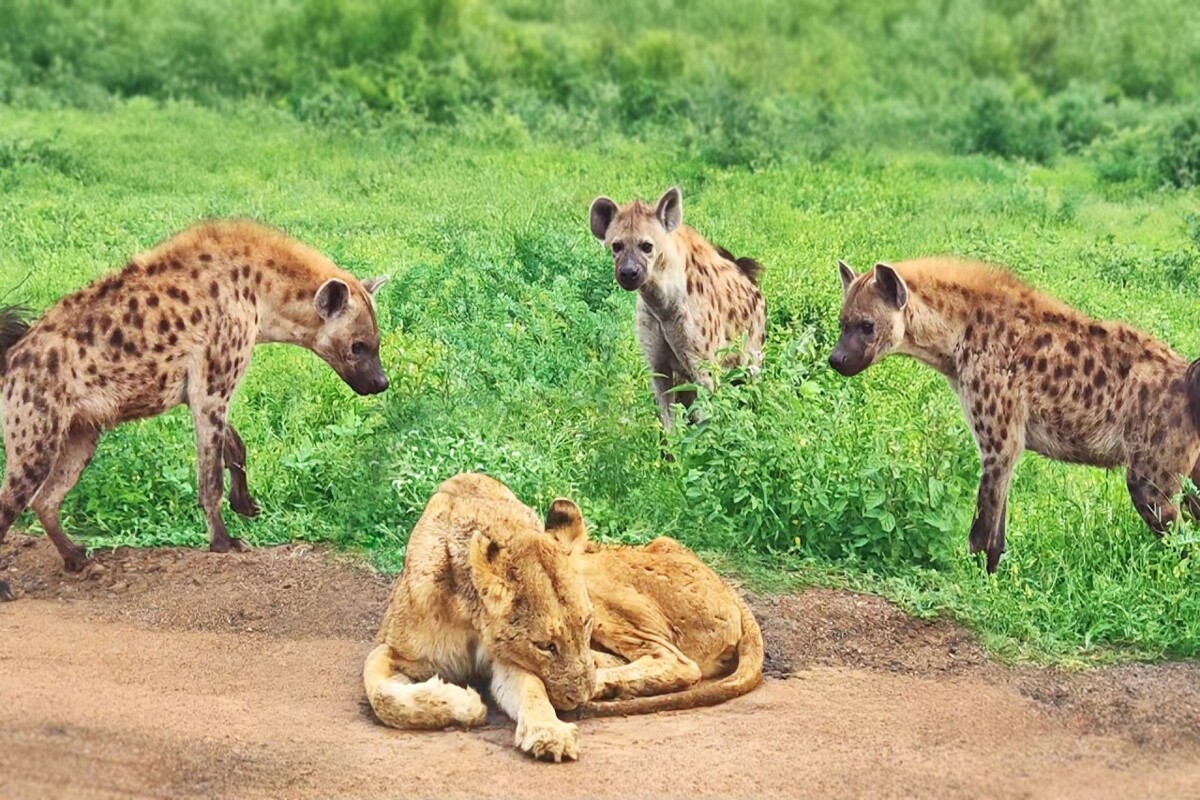
A lone lioness lay beside the road in Kruger National Park, looking nothing like the powerful predator people normally imagine when they hear the word “lion.”
She appeared extremely old and frail.
More troubling still, the lioness appeared to be blind.
Then a group of spotted hyenas came walking down the road.
For a lioness, this was an extremely dangerous situation.
Lions and spotted hyenas are among Africa’s most important large predators, and the two species compete directly for food. They can steal from each other’s kills, confront one another over carcasses, and sometimes kill one another. Animal Diversity Web describes this relationship as direct competition that can lead to violent encounters.
Yet the hyenas in this remarkable encounter did something unexpected.
They approached.
They investigated.
They came remarkably close.
And then they walked away.
There was no dramatic attack.
No chase.
No prolonged fight.
Instead, the hyenas appeared to recognize that the strange lioness lying before them was not behaving like a normal, dangerous adult lion.
The encounter was filmed by Steyn Jacobsohn on the S25 in Kruger National Park, South Africa, and published by Latest Sightings on February 10, 2025.
A Lioness Who Could Barely Respond
The sighting began with a normal lion sighting.
Steyn Jacobsohn and the other observers expected to find a lion.
What they discovered was much more unusual.
It was a lioness, but something was clearly wrong.
According to Steyn’s account, the lioness appeared to be blind, although he did not know what had caused her condition.
As she lifted her head, the impairment was apparent.
She did not respond normally to movement around her.
She seemed unable to identify what was approaching.
And she appeared physically weak.
The African lion is normally an exceptionally capable predator. Lions possess powerful forelimbs, large canine teeth and strong jaws, while lionesses are important hunters within prides.
But this lioness was in a very different condition.
Her usual defenses appeared severely reduced.
Then the Hyenas Appeared
The road was quiet.
Then hyenas came down the road.
At first, the animals did not seem to notice the lioness.
This was remarkable in itself.
A lion lying beside a road should normally attract immediate attention from another large predator.
But the hyenas initially passed behind her without appearing to realize exactly what was there.
The lioness also appeared unaware of them.
She turned her head at times, but there was no obvious aggressive response.
Neither species immediately understood the situation.
Then the hyenas picked up her scent.
Everything changed.
The Hyenas Turn Back
After passing behind the lioness, the hyenas detected her presence.
They began approaching.
For a moment, the encounter looked as though it could become extremely violent.
The hyenas were more numerous.
The lioness was alone.
And she was apparently unable to see properly.
Under normal circumstances, that combination could be disastrous for a solitary lion.
But the hyenas did not rush in.
They slowed down.
They approached cautiously.
That hesitation became one of the strangest aspects of the entire encounter.
Lions and Hyenas Are Ancient Competitors
To understand how unusual the scene was, it helps to understand the relationship between these two species.
The spotted hyena is not simply a scavenger waiting for lions to finish hunting.
Spotted hyenas are powerful predators in their own right.
Animal Diversity Web describes them as one of Africa’s top predators and notes that they can hunt a wide range of prey, including large mammals.
Lions and hyenas can therefore compete for exactly the same resources.
A lion may kill prey.
Hyenas may try to steal it.
Hyenas may make a kill.
Lions may attempt to take it.
The resulting encounters can become extremely aggressive.
The Lioness Is Normally the Dangerous One
Under normal conditions, a lioness would be a formidable opponent.
Lionesses are the primary hunters in many lion prides and frequently work together when targeting large prey.
Animal Diversity Web notes that African lions live in social groups and occupy habitats with abundant ungulate prey, while lions can also compete aggressively with other predators.
A healthy adult lioness therefore represents a serious threat to a hyena.
Even several hyenas have to consider the risks of approaching a lion.
That may explain some of the caution visible in the footage.
The hyenas did not know exactly what condition the lioness was in.
They approached carefully.
The Hyenas Move Closer
The hyenas continued toward her.
Their tails were raised.
Their attention was fixed on the lioness.
But something was missing.
There was no explosive attack.
Latest Sightings noted that the hyenas did not produce the intense whooping often associated with excitement and group activity in spotted hyenas during such encounters.
Instead, they appeared uncertain.
The lioness was not behaving as expected.
The Lioness Turns Her Head
The sounds of movement in the grass finally caught the lioness’s attention.
She turned toward the hyenas.
But there was no charge.
No attempt to run.
No obvious effort to attack.
She simply turned her head.
The hyenas continued to approach.
For the observers, this was an extraordinary sight.
A lioness was surrounded by one of her species’ most important competitors, yet she appeared almost incapable of responding.
A Soft Growl
Eventually, the lioness gave a low growl.
It was not the explosive roar of a powerful lion confronting a rival.
It was a much weaker warning.
The hyenas heard it.
But they still did not attack.
This is one of the moments that makes the footage so unusual.
The lioness was communicating that she was aware of the animals around her.
The hyenas were communicating through posture and movement.
Both species were assessing the situation.
The Hyenas Seem Confused
Latest Sightings described the hyenas as appearing confused by the lioness’s lack of reaction.
That interpretation is important because it avoids claiming that the hyenas necessarily felt “pity” in the human sense.
We cannot know what the animals were thinking.
What we can observe is that their behavior was unusually cautious.
They did not immediately attack.
They came closer.
They watched.
And they eventually moved on.
Did the Hyenas Show Mercy?
The video’s title calls it “mercy.”
That is a powerful description.
But scientifically, it is safer to describe the behavior as unusually tolerant or non-aggressive rather than claiming that the hyenas consciously felt compassion.
Animal behavior can be explained through many possibilities.
The hyenas may have been curious.
They may have recognized that the lioness posed little immediate threat.
They may have been uncertain about approaching an unusual animal.
They may have been responding to the absence of normal defensive behavior.
Or several factors may have influenced the encounter at once.
The footage cannot tell us exactly which explanation is correct.
Why Didn’t the Hyenas Attack?
There is no confirmed answer.
But the behavior is fascinating.
A healthy lion can be dangerous.
A sick or injured lion can be a very different proposition.
The hyenas may have assessed the situation and found little reason to take the risks associated with an attack.
Animal Diversity Web notes that spotted hyenas and lions compete directly and that their encounters can result in death.
Avoiding unnecessary injury is therefore an important consideration for any hyena.
A predator does not necessarily attack every vulnerable animal it encounters.
Predators Have to Manage Risk
Wild predators live in a world where injuries matter.
A broken leg can prevent hunting.
A damaged jaw can make feeding difficult.
A serious wound can become infected.
For a hyena, even a weakened lion may still have claws and teeth.
The safest strategy may sometimes be to investigate without committing to a physical confrontation.
That could help explain why these hyenas came close but stopped short of attacking.
The Lioness Was Not Acting Like a Normal Lion
One of the strongest clues was her behavior.
She did not rise.
She did not charge.
She did not chase the hyenas.
She barely reacted.
The hyenas may have been responding to that unusual behavior.
From their perspective, they were not facing the same kind of lion they would normally encounter.
Instead, they found an animal that appeared severely compromised.
The Mystery Behind Her Blindness
One of the most important details is that the cause of the lioness’s blindness was not established.
Steyn Jacobsohn said he did not know what had happened to her. Latest Sightings mentioned possible cataracts as one theory and also noted speculation about a previous spitting cobra encounter, but neither explanation was confirmed.
That uncertainty should remain part of the story.
It would be misleading to state that a snake caused her blindness.
Likewise, it would be misleading to state that she definitely had cataracts.
The footage only establishes that her eyesight appeared severely impaired.
What Could Cause Vision Problems in a Wild Lion?
Wild animals can experience vision problems for many reasons.
Age-related changes, injuries, infections and other diseases can affect eyesight.
Cataracts, for example, involve clouding of the eye’s lens and can impair vision.
But without veterinary examination, it is impossible to determine what caused this lioness’s condition.
That is why the original account wisely leaves the cause uncertain.
Old Age Changes Everything
Age can dramatically alter the survival prospects of a predator.
A young lion can hunt.
A healthy adult lioness can chase prey.
But an elderly animal may gradually lose physical condition.
Vision can deteriorate.
Teeth can wear down.
Muscle mass can decrease.
The ability to pursue prey can decline.
For a predator, these changes are especially serious because the animal depends on physical ability to obtain food.
A Lioness Without Her Pride
The lioness was also alone.
That matters enormously.
Lions are unusual among cats because they are highly social.
A lion pride can contain related females, their offspring and, depending on the pride structure, adult males.
Social living can provide protection, hunting opportunities and access to food.
Animal Diversity Web describes lions as social animals living in prides and notes that social relationships are an important part of their ecology.
A solitary lioness therefore lacks many of the advantages normally provided by a pride.
Why Being Alone Is Dangerous
A lone healthy lion can still be dangerous.
A lone weak lion is another matter.
Without companions, the lioness had fewer opportunities to share food or receive protection.
She also had no other lions immediately available to help drive away the hyenas.
That made her position extremely vulnerable.
The Hyenas Keep Their Distance
Despite the apparent weakness of the lioness, the hyenas did not crowd directly around her.
They generally remained a few metres away.
That distance is revealing.
It suggests that the hyenas were still treating the lioness as an animal that deserved caution.
A lion’s reputation as a dangerous competitor does not disappear simply because one individual appears weak.
The hyenas still had to assess her.
The Strange Silence
Another unusual feature of the encounter was the relative lack of vocal aggression.
Spotted hyenas are highly vocal animals.
They communicate through whoops, giggles, growls, calls and other sounds.
But according to Latest Sightings, the hyenas did not produce the expected whooping behavior as they approached the lioness.
That silence added to the strange atmosphere.
The road was quiet.
The lioness barely moved.
The hyenas approached carefully.
It was almost as though everyone was waiting for something to happen.
A Spotted Hyena Is a Powerful Predator
The spotted hyena is a remarkable predator in its own right.
Animal Diversity Web reports that females are generally larger than males and that spotted hyenas possess exceptionally powerful jaws relative to their body size.
Their ability to consume bones is legendary.
Their social organization is also sophisticated.
They live in clans and cooperate in hunting, defense and other activities.
That social power helps explain why lions and hyenas have such a complicated relationship.
Hyenas Are Not Simply Scavengers
The old image of hyenas as cowardly scavengers is inaccurate.
Spotted hyenas are capable hunters.
They can pursue prey over long distances and kill animals themselves.
Animal Diversity Web notes that spotted hyenas use keen senses to hunt live prey and can chase prey at speeds approaching 60 km/h.
They also scavenge extensively.
Their ecological flexibility is one reason they are so successful.
Lions and Hyenas Compete Constantly
Because both species can hunt and scavenge, competition is unavoidable.
Animal Diversity Web states that lions and spotted hyenas often compete for food and can scavenge each other’s kills. These encounters may become antagonistic and sometimes fatal.
That makes the behavior in this video even more unusual.
Instead of exploiting a vulnerable rival, the hyenas simply investigated and moved on.
A Rare Moment of Restraint
The word “restraint” should also be used carefully.
The hyenas may not have consciously decided to spare the lioness.
There is no way to know that from the footage.
But behaviorally, there was restraint.
The animals approached without escalating into a physical attack.
They had an opportunity to interact aggressively.
They did not take it.
That is the observable fact.
One Hyena Scent-Marks Nearby
The encounter was not completely passive.
One hyena eventually scent-marked nearby.
Scent marking is an important part of hyena communication.
Animal Diversity Web notes that spotted hyenas use scent marking and other forms of communication to interact with members of their social group and establish information about their surroundings.
So while the hyenas did not attack the lioness, they were still behaving like hyenas.
They were investigating and communicating in their normal environment.
The Lioness Lowers Her Head
After the hyenas had spent time near her, the lioness lowered her head again.
Her chin rested against the ground.
She appeared exhausted.
This was perhaps the saddest moment of the encounter.
The animal that would normally command respect across the savanna was now unable to defend herself effectively.
The hyenas eventually moved away.
The lioness remained.
Then the Hyenas Leave
The hyenas eventually continued down the road.
The encounter was over.
There was no dramatic chase.
No attack.
No kill.
Just a group of predators passing by a severely weakened competitor.
Latest Sightings described the behavior as unusually calm and suggested that the hyenas may have concluded that the lioness was no longer a meaningful threat or that attacking her was not worth the risk.
That interpretation remains a possibility rather than a proven explanation.
What Happened to the Lioness?
This is where the story becomes uncertain.
The video ends while the lioness is still alive.
There is no confirmed account in the original video description establishing exactly what happened to her afterward. Latest Sightings suggested that, given her condition, her chances of surviving much longer were poor.
But that is not the same as knowing her eventual fate.
We should not invent an ending that the footage does not provide.
Her story remains unfinished.
Nature Is Not Always a Quick Death
The encounter also highlights a difficult reality of life in the wild.
Predators do not always die during dramatic hunts.
Sometimes old age or illness gradually reduces an animal’s ability to survive.
An animal may become unable to hunt effectively.
It may lose weight.
It may become vulnerable to competitors.
Eventually, it may die from starvation, disease, predation or a combination of factors.
This can be a slow process.
Why the Encounter Feels So Emotional
The image of an old, apparently blind lioness surrounded by hyenas naturally triggers an emotional response in human viewers.
The lion is an iconic symbol of strength.
Seeing one in such a vulnerable condition creates a powerful contrast.
But the scientific story is equally fascinating.
The footage shows how a predator’s social position and physical condition can completely change an interaction with another predator.
The lioness was still a lion.
But her behavior and apparent condition changed the risk calculation for the hyenas.
The Lion Was Still Dangerous
Even in her weakened condition, the lioness remained potentially dangerous.
That is why the hyenas did not simply walk directly over to her.
They approached cautiously.
A single bite or swipe could still cause injury.
Wild predators do not necessarily know precisely how strong another animal is.
They have to assess it.
The hyenas appeared to do exactly that.
A Balance Between Curiosity and Caution
The behavior can perhaps be understood as a balance.
The hyenas were curious enough to investigate.
But they were cautious enough not to commit to an attack.
That combination is common in wildlife.
An animal may approach something unfamiliar while remaining ready to retreat.
The raised tails and careful movements visible in the encounter suggest that the hyenas were alert to the situation.
Why the Hyenas May Have Walked Away
Several explanations are possible.
The lioness may have appeared too weak to be worth attacking.
The hyenas may have been uncertain about her condition.
They may have been investigating rather than hunting.
They may have recognized the risks of physical contact.
Or they may simply have lost interest.
The footage cannot distinguish conclusively between these possibilities.
What we know is that the encounter ended peacefully.
The Importance of Not Humanizing Wildlife Too Much
The phrase “showed mercy” makes for a powerful headline.
But wildlife behavior is often more complicated than human morality.
Animals do not need to experience compassion in the same way humans do for their behavior to appear compassionate.
The hyenas may have been responding to risk, novelty, uncertainty or the absence of a threat.
That does not make the encounter less remarkable.
It makes it more scientifically interesting.
Kruger National Park: A World of Predator Competition
The encounter happened in Kruger National Park, one of Africa’s most famous protected areas.
The park supports large populations of lions and spotted hyenas along with leopards, wild dogs and numerous herbivore species. Its biodiversity statistics include both lions and spotted hyenas among its major large predators.
This makes Kruger an extraordinary place to observe predator competition.
The same landscape can support several large carnivores at once.
And when their territories and food sources overlap, encounters are inevitable.
The S25 and the Wildlife Around It
The sighting occurred on the S25, a road within Kruger National Park.
Safari roads often provide unusual opportunities to observe wildlife because animals sometimes use or cross them.
In this case, the road became the stage for a remarkable predator interaction.
The lioness rested beside it.
The hyenas approached along it.
And the observers were able to document behavior that would otherwise have remained unseen.
The Difference Between a Healthy Lion and a Vulnerable Lion
This encounter provides a striking comparison.
A healthy adult lioness can be a dangerous opponent.
A severely weakened lioness may be unable to respond effectively.
The same species can therefore occupy completely different positions in the predator hierarchy depending on age and physical condition.
That is one of the harsh realities of natural selection.
Strength is not permanent.
Health is not guaranteed.
And every predator eventually faces the effects of age.
What This Encounter Teaches Us About Hyenas
The encounter challenges several common misconceptions about hyenas.
They are not simply cowardly scavengers.
They are powerful predators.
They are intelligent and socially complex.
They compete directly with lions.
And they do not necessarily attack every vulnerable animal they encounter.
The spotted hyena is one of Africa’s most important large carnivores and plays a major ecological role through both hunting and scavenging.
What This Encounter Teaches Us About Lions
It also provides an important reminder about lions.
Even an apex predator is not invincible.
Age, injury, disease and isolation can dramatically change an animal’s ability to survive.
The lioness’s condition showed what can happen when a predator loses the physical abilities that normally allow it to hunt and defend itself.
The Most Unusual Part Was What Did Not Happen
There are plenty of dramatic wildlife videos showing lions and hyenas fighting.
This one is memorable for the opposite reason.
The fight never happened.
The hyenas came close.
The lioness growled.
The hyenas investigated.
Then they left.
Sometimes the absence of violence is itself the most remarkable part of a wildlife encounter.
A Powerful Ending Without a Battle
The final image is haunting.
The hyenas disappear down the road.
The old lioness remains behind.
Her head lowers again.
The landscape becomes quiet.
There is no triumphant predator.
No victorious prey.
No dramatic ending.
Only an aging wild animal facing an uncertain future.
And perhaps that is why the footage stays with viewers.
Watch the Original Video
Watch the complete encounter here:
Hyenas Show Mercy on Old & Blind Lioness — Latest Sightings
The video was published by Latest Sightings on February 10, 2025. The footage was submitted by Steyn Jacobsohn and recorded on the S25 in Kruger National Park.
More Wildlife Encounters From khxyz
If you enjoy unusual predator encounters, explore more wildlife stories from khxyz: