Lioness Teaches Tiny Cubs to Climb Tree in Rare Wildlife Moment

In the African bush, young lions have a great deal to learn.

They must discover how to follow a pride, recognize danger, move quietly through vegetation, communicate with other lions, and eventually participate in the demanding business of finding food. Much of that education happens through play, observation and imitation.

But on one remarkable day at MalaMala Game Reserve in South Africa, four tiny lion cubs were presented with a lesson that is not usually associated with their species: climbing a tree.

Their mother had climbed into a small tree and called down to her cubs from above. The youngsters gathered underneath, looking up and calling back. One by one, they investigated the trunk and nearby branches. One cub eventually managed to climb surprisingly high, reaching its mother.

The scene was captured by MalaMala guide Michael Moth and shared with Latest Sightings. The original report explains that guides had deliberately given the lioness and her newborn litter space during their first few days before this unusual encounter took place.

Watch the original Lioness Teaches Tiny Cubs to Climb Tree video

What makes the encounter especially interesting is not simply that lions can climb trees. They can.

The more intriguing question is why this mother was encouraging her cubs to try.

A Mother Above the Cubs

The scene unfolded in a dry riverbed at MalaMala.

The young cubs were playing when their mother’s calls drew attention. When the observers located the family, the lioness was already standing in a tree.

She looked down toward her offspring and produced low calls.

The cubs responded by moving around beneath the tree, repeatedly looking upward. They appeared interested in their mother but initially faced an obvious physical problem: the trunk was much larger than the small branches they were accustomed to exploring.

For the cubs, the tree must have seemed like a completely different environment.

They were tiny, still developing their coordination and strength. Their legs were short, their bodies light, and their climbing technique was essentially nonexistent.

Instead of immediately attempting the main trunk, they discovered a fallen branch that was much easier to negotiate.

They climbed it.

But their mother remained above them.

Lions Are Not Usually Known as Tree Climbers

When people imagine a cat in a tree, the first animal that usually comes to mind is the leopard.

That association is well deserved. Leopards are highly capable climbers and routinely use trees for resting, storing food and avoiding competitors.

Lions are different.

They are primarily terrestrial predators, built for life on the ground and for hunting large prey across open and semi-open landscapes. Discover Wildlife describes lions as highly social cats that live in prides and hunt a wide range of prey, while their cubs gradually develop hunting abilities as they grow.

Yet the idea that lions cannot climb trees would be misleading.

They can.

A 2026 study published in the African Journal of Ecology examined tree climbing in African lions and leopards using observations from several sites in northern Tanzania. The researchers found that tree climbing was rare in lions, but it did occur across the sites studied. The behavior was associated with factors including season, time of day and the animal’s demographic characteristics, with females and subadults climbing more frequently than males.

That makes the MalaMala footage particularly interesting.

The behavior is unusual, but it is not impossible or inexplicable.

A Rare Skill in a Very Young Lion

The mother appeared determined to get the cubs to attempt the larger tree.

According to Latest Sightings, she continued calling from above while the cubs moved around below. One cub eventually approached the trunk and began the difficult ascent.

The youngster placed one paw above another.

Its claws dug into the bark.

Slowly, carefully, it gained height.

For a fully grown lion, a short climb into a sturdy tree might be manageable. For a very young cub, however, climbing requires a combination of grip, balance, coordination and confidence.

The cub had to coordinate all four legs while keeping its body close enough to the trunk for its claws to find purchase.

Eventually, it reached its mother.

The reunion at the top of the tree became the most memorable part of the encounter.

The lioness licked and touched the cub before the youngster began making its way back down.

What the Cubs Were Learning

It is tempting to describe the scene as a formal lesson in the human sense.

But wildlife behavior is usually more complicated than that.

We cannot know exactly what the lioness intended from footage alone.

What we can say is that the mother repeatedly positioned herself above the cubs, called to them, and remained there while they attempted to reach her. One cub successfully climbed much higher than its siblings.

That creates an intriguing possibility.

The interaction may have provided the cubs with an opportunity to practice a useful movement skill.

Young mammals learn through repeated physical experiences. For lion cubs, play involves running, climbing, turning, stalking, pouncing and wrestling. Research on lion cub behavior notes that these forms of motor play overlap with movements later used by adult predators.

So even if climbing is not an essential part of everyday lion life, practicing it can still develop coordination.

Play Is Serious Business for a Lion Cub

To an observer, young lions playing can look like pure entertainment.

They chase one another.

They wrestle.

They pounce.

They tumble over fallen branches.

They investigate anything unfamiliar.

But play is also a period of physical and behavioral development.

Animal Diversity Web notes that juvenile felids spend considerable time in play that helps develop hunting-related skills. In lions, young animals remain dependent on adults for a prolonged period while they develop the abilities necessary for independent life.

That makes a tree an interesting playground.

A climbing cub has to balance its body differently from a running cub. It has to judge distance and grip. It has to coordinate its paws and claws while keeping its weight against an uneven surface.

Those are different challenges from chasing a sibling across the ground.

The Four Cubs Were Not Equally Confident

One of the most revealing details in the footage is that the cubs did not all perform equally.

One reached the mother.

Another managed to climb partway.

Another barely made it above the ground.

The differences are hardly surprising.

Even within the same litter, young animals develop at slightly different rates. Individual differences in confidence, coordination, strength and curiosity can influence how quickly a youngster attempts a new physical challenge.

Smithsonian’s National Zoo has documented differences in behavior among lion cubs, including variation in playfulness, curiosity and interactions with adults and siblings.

The MalaMala cubs provided a wild example of that variation.

One was the first to solve the problem.

The others were still experimenting.

The First Cub Becomes an Example

Once one cub successfully climbed toward its mother, its achievement changed the situation for the others.

The siblings had now seen that the apparently impossible climb was actually possible.

This is one of the fascinating aspects of social learning.

Animals can acquire information by observing others rather than discovering every solution entirely by trial and error.

In this case, the successful cub demonstrated that the tree could be climbed.

Whether its siblings interpreted the event in the same deliberate way humans would is impossible to know.

But they continued attempting the climb.

Tiny Claws, Big Challenge

The cub’s claws were crucial.

Lion claws are retractable, allowing the animals to keep them protected when they are not needed and extend them during activities such as hunting, fighting and climbing.

For a young cub, those claws can function almost like small gripping hooks when the animal presses its body against rough bark.

The footage shows the cub using its paws carefully as it moves upward.

This is a very different movement from the powerful acceleration lions use during a hunt.

Instead of speed, the cub needs precision.

Instead of a long stride, it needs controlled movements.

Instead of pushing forward, it needs to keep its body close to the tree.

Why Would a Lion Ever Climb a Tree?

There is no single answer.

The newly published 2026 research on tree climbing in African lions suggests that lion climbing is facultative and context-dependent, rather than a specialized lifestyle like that of a leopard. In other words, lions can climb, but they do not depend on trees in the same way leopards do.

Researchers found that tree climbing in lions varied with environmental and social circumstances.

That fits what wildlife observers have seen in different parts of Africa.

Some lions occasionally climb trees to rest.

Others may climb to gain a different vantage point.

Some have been observed using trees in environments where the behavior appears to have become more common.

Uganda’s Famous Tree-Climbing Lions

Perhaps the most famous examples come from Uganda.

In parts of Queen Elizabeth National Park, some lion populations have developed a reputation for spending considerable time in trees.

National Geographic has documented these tree-climbing lions, including individuals that regularly rest in large fig and candelabra trees.

That is a useful reminder that animal behavior is not always fixed across an entire species.

A behavior can be rare in one population and much more common in another.

Environment matters.

Local conditions matter.

Individual experience matters.

And social traditions may matter too.

The lion cubs at MalaMala were therefore not learning something completely alien to their species.

They were exploring a behavior that some lions use much more frequently than others.

A New Study Changes How We View Lion Climbing

The 2026 African Journal of Ecology research is especially relevant to this footage because it specifically investigated tree climbing in African lions and leopards.

The study found that lions climbed trees far less frequently than leopards. It also found differences according to age and sex, with females and subadults more likely to show the behavior than adult males.

That makes a litter of young cubs an interesting group to observe.

They are small.

They are agile.

They are still experimenting with their environment.

And they have not yet developed the massive body size of an adult male lion.

For a cub, the physical cost of getting onto a low tree may be considerably smaller than it would be for a huge adult male.

The Tree May Have Been a Playground

The simplest explanation may also be the most cautious.

The lioness may have been encouraging exploration.

Young lions are naturally curious and highly playful, and the tree presented an unusual physical challenge.

The mother’s calls brought the cubs toward her.

The cubs investigated.

One climbed.

The others followed.

That sequence does not prove that the lioness was deliberately preparing them for a specific future danger.

But it does show how young lions can encounter unusual skills through interactions with their mother and their environment.

Lions Learn While Growing Up

Lion cubs have a long childhood compared with many mammals.

According to Animal Diversity Web, lion cubs are born extremely dependent on their mothers. Their eyes open after roughly 11 days, they can walk at around two weeks, and they become capable of running at about one month. They remain dependent on adults for much longer as they develop.

That extended development gives them time to practice.

They do not emerge from the den as miniature adult hunters.

Instead, their abilities develop gradually.

A cub learns how to move.

Then it learns how to chase.

Then it becomes better at stalking.

Eventually it begins accompanying adults and observing the activities of the pride.

By around the end of the first year, young lions are already becoming much more involved in the world of adult lions, although they remain dependent on the pride for considerably longer. Discover Wildlife notes that cubs begin hunting at around 11 months and can remain with their mother for around two years.

Mothers Play a Central Role

Female lions are the principal caregivers in a pride.

They nurse cubs, protect them and provide food.

Lion societies are unusual among cats because several related females can raise young together.

Animal Diversity Web describes lions as cooperative breeders and notes that related females may nurse one another’s cubs. When females reproduce at similar times, cubs can form nursery groups known as crèches.

This social system means that a young lion’s education does not always come from one individual.

It can happen within a wider social group.

The MalaMala mother, however, was the adult directly interacting with these four cubs during the tree encounter.

Contact Calls Keep the Family Connected

Sound is enormously important to lions.

They communicate through roars, growls, contact calls, physical touch and other vocalizations.

In the MalaMala footage, the lioness repeatedly called down toward her cubs, while the cubs responded from the ground. Latest Sightings specifically describes the calls as low-toned vocalizations that appeared to draw the youngsters toward the tree.

This is another reason the scene is so interesting.

The cubs were not simply watching their mother from a distance.

They were interacting with her acoustically while trying to navigate the physical obstacle between them.

The Cubs Discover Their Own Route

Before attempting the main trunk, the cubs found a fallen branch.

That was a logical choice.

The branch was closer to the ground and much easier to climb.

For a young animal, experimentation often begins with the easiest available option.

The cubs were not following a perfectly straight path toward the mother.

They were exploring their surroundings and testing what their bodies could accomplish.

Eventually, one youngster transferred that confidence to the larger tree.

One Cub Makes It to the Top

The successful cub slowly climbed toward its mother.

It did not rush.

Its paws searched for grip while its claws helped hold its body against the bark.

The ascent ended only a short distance from the lioness.

Then the cub reached her.

The mother responded with licking and physical contact before the youngster began descending again.

The moment is easy to interpret emotionally because it resembles a familiar scene between a parent and child.

But there is a more useful scientific way to view it.

The mother provided a social response immediately after a physically challenging interaction, reinforcing contact within the family.

Exactly what she “thought” about the cub’s performance cannot be established from the footage.

The behavior itself, however, is clear.

Going Back Down Is Another Skill

Climbing up was only half the problem.

The successful cub soon looked down from the tree and began making its way back toward the ground.

Descending is mechanically different from climbing.

The animal must control its weight while finding secure footholds beneath its body.

For a young cub, that can be just as challenging as the initial ascent.

Meanwhile, its siblings were still attempting to follow.

The result was a small family traffic jam around the tree.

Why This Moment Matters

At first glance, the footage looks like nothing more than a cute wildlife encounter.

But it reveals several important aspects of lion biology.

It shows that lions are capable of behaviors that are not normally associated with them.

It shows how much young lions rely on physical exploration.

It shows the importance of social interaction during development.

And it demonstrates how flexible animal behavior can be.

The latest scientific evidence reinforces this point: tree climbing is uncommon in African lions, but it is not outside their behavioral repertoire.

A Reminder That Wildlife Does Not Follow Our Categories

We often place animals into neat categories.

Leopards climb trees.

Lions stay on the ground.

Cheetahs run.

Elephants walk.

But nature rarely follows such simple rules.

A leopard is a specialist climber, while a lion is primarily terrestrial. Yet lions can still climb.

That distinction is important.

The unusual behavior does not turn a lion into a leopard.

It simply reminds us that animal behavior exists on a spectrum.

The ability is there.

Whether an animal uses it depends on circumstances.

From Play to Survival

The original Latest Sightings report concludes that the cubs had gained an experience that might be useful later in life.

That possibility should be treated cautiously.

We cannot know whether these particular cubs will regularly climb trees as adults.

We cannot know whether this specific encounter will have any measurable effect on their future survival.

But we do know that young lions learn through movement, play and experience.

Their childhood is a period of experimentation.

Every fallen branch can become a climbing frame.

Every sibling can become a wrestling partner.

Every chase can become practice.

And every unfamiliar object can provide another opportunity to discover what their bodies can do.

The Lion’s World Is Changing Too

The story also sits within a larger conservation picture.

The IUCN Red List currently classifies the lion (Panthera leo) globally as Vulnerable, with a decreasing population trend. The latest assessment identifies substantial range loss and ongoing pressures affecting lion populations.

BBC Earth similarly lists lions as Vulnerable and notes that habitat loss, reduced prey availability and other pressures have made survival increasingly difficult in parts of their range.

That makes encounters such as the MalaMala footage more than simply charming wildlife moments.

They offer a glimpse into the social and behavioral lives of animals whose future depends on maintaining functioning habitats and healthy prey populations.

MalaMala itself forms part of the larger Sabi Sand landscape associated with the Greater Kruger ecosystem, one of southern Africa’s best-known wildlife regions.

A Tiny Lesson in a Big World

The four cubs eventually came back down with their mother.

Not every youngster mastered the climb.

One reached her.

One climbed partway.

Others remained closer to the ground.

And that is perhaps the most realistic ending to the story.

Learning does not happen at exactly the same speed for every young animal.

There is no requirement that every cub succeed on its first attempt.

The value may simply be in trying.

The mother provided the opportunity.

The cubs experimented with it.

One discovered that it could climb.

The others discovered that the challenge was harder than expected.

And all four experienced something new.

Watch the Original Wildlife Footage

This remarkable encounter was filmed by Michael Moth, a guide at MalaMala Game Reserve, and shared with Latest Sightings in April 2024.

Watch “Lioness Teaches Tiny Cubs to Climb Tree” on YouTube

The footage is especially worth watching for the contrast between the four cubs. Their different attempts make it clear just how much individual variation can appear even within a single litter.

More Wildlife Stories From khxyz

If you enjoy unusual animal behavior, you may also like these wildlife stories from khxyz:
Buffalo Herd Leaves Injured Calf Behind as Lioness Moves In

The buffalo herd was moving down the road when something became painfully obvious.

One small calf could not keep up.

It was limping badly, struggling to put weight on an injured leg while the rest of the herd continued forward.

Ahead of them, a lioness was waiting.

She watched the herd carefully.

The healthy adult buffalo remained together, but the injured calf was falling farther and farther behind.

Then the gap became too large.

The herd continued moving.

The calf was left alone.

And the lioness finally made her move.

What followed was a heartbreaking reminder that life in the African wilderness can be brutally unforgiving, even for animals that normally rely on the protection of a powerful herd. The encounter was filmed by Lizaan Schlesinger near Satara in Kruger National Park, South Africa, and published by Latest Sightings on December 1, 2025.

A Buffalo Herd Moves Through Kruger

The encounter began on a rainy late Sunday afternoon near Satara.

Lizaan Schlesinger and other safari-goers arrived at the sighting at around 6:00 p.m., and according to her account, the hunt began only minutes later.

The animals were African buffalo, Syncerus caffer, one of Africa’s most formidable large herbivores.

African buffalo are famous for their enormous herds and their willingness to confront predators.

They are not ordinary prey.

A healthy adult buffalo can be extremely dangerous to a lion.

But the animal in the middle of this story was not a healthy adult.

It was a young calf with a badly injured leg.

Something Was Wrong With the Calf

At first glance, the buffalo appeared to be moving together normally.

But observers soon noticed a problem.

One calf was struggling behind the main herd.

Its leg was badly injured, and it could not move at the same speed as the other buffalo.

Every step widened the distance.

The calf tried to keep going.

The herd kept moving.

And the lioness watched.

Latest Sightings described the calf’s inability to keep pace as the key factor that transformed an ordinary buffalo crossing into a predator-prey encounter.

The Herd Had Safety in Numbers

The African buffalo is a highly social species.

Buffalo herds can range from relatively small groups to enormous gatherings containing hundreds or even more than a thousand animals. Animal Diversity Web describes large herds as one of the buffalo’s major defenses against predators because large numbers make it harder for a predator to isolate an individual.

The African Wildlife Foundation similarly identifies large herds as an important anti-predator adaptation, with females and offspring making up much of the main herd.

For a healthy calf in the center of that group, there can be considerable protection.

For an injured calf at the back, the situation is very different.

The Calf Could Not Keep Up

The calf kept limping.

The herd continued forward.

There was no dramatic stampede.

There was no sudden collapse of the entire group.

Instead, the distance gradually increased.

This is one of the most difficult aspects of the footage to watch.

The calf was not immediately abandoned in a dramatic moment.

It simply became separated because its injured leg prevented it from maintaining the herd’s pace.

The farther it fell behind, the more vulnerable it became.

The Lioness Was Already Watching

The lioness was positioned ahead of the buffalo.

She did not immediately attack the main herd.

That would have been extremely risky.

Healthy adult buffalo can be dangerous prey, particularly when several adults are together.

Animal Diversity Web describes buffalo as formidable prey because of their size, aggression and group defense. Lions are their principal predators among animals targeting buffalo older than a year.

The lioness therefore had a much easier opportunity.

She waited for the vulnerable animal.

Why Buffalo Are So Difficult for Lions to Hunt

The African buffalo is heavily built and armed with powerful horns.

Adult bulls can weigh hundreds of kilograms.

Even cows are large and dangerous.

The Smithsonian’s National Museum of Natural History notes that African buffalo can use their horns and hooves as formidable weapons against attacking lions.

A lion attempting to bring down a healthy adult buffalo risks serious injury.

That is why isolation is so important.

A lion does not necessarily need to overpower an entire herd.

It needs an opportunity to separate one vulnerable individual.

The Calf Becomes the Opportunity

As the herd moved farther away, the lioness’s opportunity became clearer.

The calf was isolated.

It was injured.

It was moving slowly.

And there were no adult buffalo immediately surrounding it.

The circumstances that normally protect a buffalo calf had disappeared.

The lioness began closing the distance.

Buffalo Normally Protect Their Young

This makes the outcome particularly striking.

African buffalo are known for strong anti-predator behavior.

When threatened, buffalo can bunch together, mob predators and aggressively confront lions.

Wikipedia’s overview of African buffalo behavior notes that herds can respond to distress calls from threatened members and that calves are often positioned within the herd for protection.

Animal Diversity Web similarly reports that buffalo use large herds to increase vigilance and reduce the probability that an individual will be singled out.

So why did this calf end up alone?

The footage shows the separation, but it does not establish that the herd consciously decided to sacrifice the calf.

That distinction is important.

Did the Herd Intentionally Leave the Calf?

The Latest Sightings report describes the calf as being left behind, but it does not provide scientific evidence that the herd deliberately decided to abandon it.

The calf was severely impaired.

The herd was moving.

The distance simply became too great.

It is tempting to describe the event as a conscious decision by the buffalo, but the footage cannot tell us what individual animals understood or intended.

What we can say is much simpler:

The calf became separated from the herd, and the lioness exploited that separation.

The Lioness Waits for the Right Moment

The lioness did not rush toward the main herd.

She watched.

The buffalo continued moving.

The calf continued limping.

Every second increased the separation.

For a predator, patience can be just as important as speed.

A failed attack on healthy buffalo could be dangerous.

A successful attack on an isolated calf could be considerably less risky.

The Final Gap Opens

Eventually, the distance became too large.

The calf could no longer simply catch up.

The herd continued forward.

The lioness was now between the calf and a potential escape route.

This was the moment the balance shifted completely.

A few minutes earlier, the calf had been part of a powerful herd.

Now it was a lone young animal facing a large predator.

The Lioness Makes Her Move

The lioness finally accelerated toward the calf.

According to the Latest Sightings report, she moved from a determined stride into a sprint and reached the calf within seconds.

The attack was quick.

The calf could not escape.

Its injured leg made the situation even worse.

The lioness brought it down.

A Tragic End for the Calf

The calf did not survive.

The Latest Sightings account states that the lioness killed it after catching up with it.

It is a painful scene to watch.

But it is also an important example of how predator-prey relationships work in the wild.

The lioness was not attacking a healthy buffalo herd.

She had found a vulnerable young animal separated from its main defense.

The Lioness Does Something Unexpected

After killing the calf, the lioness did not immediately begin feeding.

Instead, she repeatedly lifted her head and looked around.

This became one of the most intriguing details of the encounter.

Why was she waiting?

Why was she scanning the area?

Why did she not immediately settle down to eat?

The answer is uncertain.

Was She Waiting for Other Lions?

Lizaan Schlesinger suggested that the lioness may have been looking for a male and female lion that she had seen with her during the previous two days.

That is a plausible interpretation, but it remains an observation rather than a confirmed explanation.

The lioness could have been checking her surroundings for several reasons.

She might have been assessing potential competitors.

She might have been responding to the nearby safari vehicles.

She might have been alert to the buffalo herd.

Or she might have been waiting for companions.

The footage alone cannot determine which explanation was correct.

Lions Are Social Predators

The behavior becomes more interesting when we consider lion social structure.

Unlike most cats, lions are highly social.

They commonly live in prides containing related females, their offspring and one or more adult males, although pride composition can change over time.

The Smithsonian’s National Zoo notes that female lions are the primary hunters and raise the cubs.

Because lions can share food and cooperate, an individual lion may sometimes remain near a kill rather than immediately consuming everything alone.

Female Lions Do Much of the Hunting

The lioness in this encounter was doing what female lions are well known for.

Female lions commonly perform much of the hunting for a pride.

The Smithsonian identifies females as the primary hunters.

Research on lion hunting behavior also shows that lions can take buffalo, although prey selection varies with sex, social group and local conditions. A study of lions in Kruger National Park found that buffalo were an important prey species, particularly for some male lions.

This calf represented a much easier target than a healthy adult buffalo.

Why a Buffalo Calf Is Different

A buffalo calf does not have the physical power of an adult.

It has smaller horns.

It has less body mass.

It cannot run as quickly.

And if it is injured, its options become even more limited.

This is why keeping calves inside the herd is so important.

The adults provide the defensive advantage.

The calf itself cannot.

The Herd Moves Away

One of the hardest moments in the footage is watching the buffalo herd continue moving while the calf falls farther behind.

The main group remains focused on forward movement.

The calf remains behind.

There is no opportunity for it to catch up.

Eventually, the herd disappears farther down the road.

The calf is alone.

The lioness is no longer facing a herd.

She is facing one injured youngster.

The Harsh Logic of Herd Survival

It is important not to describe the buffalo as cruel or uncaring.

Wild animals operate under different pressures from humans.

A herd must continue moving.

It must maintain cohesion.

It must respond to predators.

It must find food and water.

An injured individual can become a major vulnerability.

The footage does not tell us whether any buffalo recognized exactly what was happening to the calf or why the herd continued forward.

That uncertainty is part of the story.

Buffalo Herds Are Complex Societies

African buffalo are not simply animals that wander around in random groups.

Their herds have social structure.

Cambridge’s Ecology and Management of the African Buffalo describes savanna buffalo as gregarious animals whose core groups include adult females, subadults, juveniles and calves.

The African Wildlife Foundation also notes a particularly strong and prolonged relationship between mothers and offspring. Calves may nurse for up to a year and remain dependent on their mothers during this period.

This makes the loss of a calf biologically significant.

The Mother Was Not Clearly Identified

The video and report focus on the herd and the injured calf.

They do not establish with certainty which adult buffalo was the calf’s mother or whether she was among the animals that moved away.

That is an important detail to leave unresolved.

It would be easy to invent a dramatic scene in which a mother desperately watches from the herd.

But the available report does not establish that.

The safest account is that the calf was left behind as the herd continued moving.

The Lioness Had the Advantage

Once the calf was isolated, the physical balance was completely different.

The lioness was healthy enough to hunt.

The calf was injured.

The lioness had speed.

The calf had difficulty walking.

The lioness had teeth and claws.

The calf’s best defense would normally have been the herd.

That defense was gone.

Why Lions Often Target the Vulnerable

Predators naturally benefit from selecting prey that can be captured at manageable risk.

For lions, a young, injured or isolated animal can represent an easier opportunity than a healthy adult surrounded by other adults.

Animal Diversity Web notes that lions are major predators of buffalo and that buffalo anti-predator behavior is strongly linked to reducing the chance of an individual being isolated.

The calf’s injury therefore had consequences far beyond simply making it walk slowly.

It removed one of its most important survival advantages.

The Buffalo’s Greatest Weapon Was Gone

For an adult buffalo, the greatest defense may be its horns.

For a herd, the greatest defense is collective action.

For a calf, the greatest defense is the adults surrounding it.

Once the calf was alone, none of those defenses could be used effectively.

That is why the separation was so decisive.

The Lioness Had Been Patient

The lioness did not attack the herd.

She waited.

This was crucial.

A lion attempting to enter the center of a buffalo herd could be attacked by multiple adults.

A lion waiting for an isolated individual avoids much of that danger.

Animal Diversity Web notes that lions often attack buffalo individuals on the outskirts of herds, where they are easier to isolate.

The behavior seen in this video fits that broader predator-prey pattern.

A Healthy Buffalo Can Fight Back

The danger for lions becomes obvious when we consider what happens if buffalo turn around.

African buffalo are capable of chasing lions.

Large bulls can even kill lions that fail to escape.

Animal Diversity Web documents repeated examples of aggressive buffalo responses toward lions, including bulls successfully defending themselves against multiple attackers.

That is why the lioness was better off attacking the calf after the herd had moved away.

Why the Lioness Didn’t Chase the Herd

The herd contained many healthy adult buffalo.

Chasing them would have been risky.

The isolated calf represented a much better opportunity.

The lioness could secure food without confronting an entire herd.

This is one of the most important principles of predator behavior:

The safest meal is often the one that requires the least risk.

Rainy Weather Added Another Element

The sighting happened on a rainy late Sunday afternoon.

The wet conditions created a very different atmosphere from the dry, dusty scenes often associated with African safari footage.

Rain can influence animal movement, visibility and the condition of roads and vegetation.

But we should not assume that the rain caused the buffalo’s separation or the lioness’s hunting behavior.

The report simply establishes that the encounter took place during wet conditions.

The Safari Vehicle Watches From Nearby

The observers were able to remain close enough to document the entire sequence.

Lizaan Schlesinger described arriving at around 18:00, with the hunt beginning approximately six minutes later.

The emotional response from people inside the vehicle was intense.

The report says audible sobs could be heard as the calf was attacked.

That reaction is understandable.

Watching a young animal struggle while knowing the outcome is approaching can be extremely difficult.

But the Lioness Was Also Surviving

It is important to separate human emotion from ecological reality.

The calf’s death was heartbreaking to witness.

But the lioness was not acting out of cruelty.

She was a predator obtaining food.

Lions require large quantities of animal protein to survive.

The calf represented an available food source.

The same event can therefore be tragic for one animal and essential for another.

Predator and Prey Are Connected

Without herbivores, lions could not survive.

Without predators, herbivore populations could change dramatically.

Predation is one of the processes that connects the species within an ecosystem.

The lioness depends on buffalo and other herbivores.

The buffalo depend on vegetation.

The entire system is interconnected.

This is why individual encounters can look brutal while still being part of a functioning ecosystem.

The Buffalo Calf Was Already in Trouble

The most important fact is that the calf was already injured before the lioness attacked.

The injury appears to have been the reason it could not keep up.

That means the lioness did not create the original vulnerability.

She exploited it.

This distinction matters.

Predators frequently take advantage of prey that is already compromised by injury, age or other factors.

The Herd’s Decision Remains a Mystery

The title says the buffalo “left” the calf behind.

The footage certainly shows the herd moving away while the calf remained behind.

But whether this represented an intentional decision cannot be established.

The animals may have failed to maintain contact.

The herd may have been responding to its own movement priorities.

The calf may have been unable to follow despite attempts to keep pace.

Without direct evidence of the herd’s decision-making, we should not turn an observed separation into a claim about deliberate abandonment.

A Difficult Lesson About Social Animals

Social animals receive major benefits from living together.

But social living does not eliminate risk.

It can actually create difficult trade-offs.

A large herd needs to move as a group.

Individuals can become injured.

Young animals can fall behind.

Predators can exploit gaps.

The same social structure that protects a healthy calf can become less effective when an individual can no longer keep up.

The Calf’s Injury Changed Everything

Imagine the encounter without the injured leg.

The calf would have been moving with the herd.

The lioness would have faced dozens of buffalo.

The calf would have remained surrounded by adults.

The attack might never have happened.

The injury therefore changed the entire predator-prey equation.

One physical problem transformed a protected herd member into an isolated target.

Why Calves Usually Stay Near Adults

Young buffalo have much to gain from remaining within the herd.

The group provides:

  • More eyes watching for predators
  • More adults capable of confronting threats
  • Greater confusion for attacking predators
  • Physical barriers between calves and predators
  • A much lower chance of being individually isolated

African buffalo are well adapted to this social strategy. Animal Diversity Web identifies large herd formation as a major anti-predator adaptation.

The Famous Battle at Kruger Shows the Opposite Outcome

This encounter is particularly interesting when compared with the famous Battle at Kruger.

In that well-known wildlife sequence, lions attacked a buffalo calf and crocodiles briefly became involved, but the buffalo herd eventually regrouped and confronted the predators.

The calf survived after the herd intervened.

The contrast is striking.

In the Battle at Kruger, the herd returned.

In this encounter near Satara, the injured calf remained behind.

Two buffalo-calf encounters.

Two very different outcomes.

Buffalo Defense Can Be Extraordinary

The species has earned a reputation for fighting back against lions.

African buffalo have been recorded chasing lions and even killing them.

This is why a lion attacking an adult buffalo is never a simple meal.

The Smithsonian’s collection describes African buffalo as capable of using their horns and hooves against lions, while the lion must work cooperatively to bring down large buffalo.

But the lioness in this story found a situation where those defenses were absent.

The Lioness Finally Has Her Meal

After bringing down the calf, the lioness had secured food.

But she did not immediately settle into feeding.

Instead, she repeatedly looked around.

This was unusual enough for the observers to comment on it.

The report suggests she may have been waiting for other lions.

But again, that remains an interpretation rather than a confirmed fact.

Why Lions May Wait Before Feeding

There are several possible explanations for a lion delaying feeding.

She could be checking for competitors.

She could be listening for other lions.

She could be responding to nearby vehicles.

She could simply be remaining alert after the struggle.

Or she could have been waiting for companions.

Because we cannot ask the lioness, her precise motivation remains unknown.

The Kill Was Not the End of the Story

The observers eventually had to leave.

They needed to return to Satara before the park’s gate-closing time.

The lioness remained with the calf.

The herd was already gone.

For the people who witnessed it, the scene was likely difficult to forget.

The event lasted only a short time, but it revealed a complicated chain of survival decisions.

A Calf, a Herd and a Predator

Three forces shaped the encounter.

The calf’s injury made it slow.

The herd’s movement created separation.

The lioness’s patience allowed her to exploit that separation.

Remove any one of those elements and the outcome could have been completely different.

That is what makes wildlife encounters so unpredictable.

What This Encounter Teaches Us About Buffalo

The encounter demonstrates several important facts about African buffalo.

They are social.

They rely heavily on group defense.

They can be extremely aggressive toward predators.

Their calves benefit greatly from remaining among adults.

But even one of Africa’s most formidable herbivores has vulnerabilities.

An injured calf can become isolated.

And isolation can be deadly.

What This Encounter Teaches Us About Lions

The lioness also demonstrated several important aspects of lion behavior.

She did not attack a large herd head-on.

She waited.

She watched.

She exploited an isolated target.

And once the calf was separated, she moved quickly.

That is an efficient predator strategy.

Nature Does Not Promise a Rescue

Many wildlife encounters involving buffalo calves end with adults charging the predator away.

This one did not.

There was no last-second rescue.

No herd returning at the final moment.

No dramatic reversal.

Instead, the lioness succeeded.

That can be difficult to watch.

But it is also why documenting natural behavior matters.

Not every wildlife story has a happy ending.

The Hardest Part to Understand

The hardest part for human viewers may be seeing the herd continue forward.

Humans naturally interpret the scene through ideas of family responsibility.

But animal behavior does not always map neatly onto human morality.

We cannot know whether individual buffalo recognized the calf’s condition, understood the approaching lioness or deliberately chose not to return.

The only defensible conclusion is that the calf fell behind and the herd did not return before the lioness reached it.

A Reminder of How Quickly Fortunes Change

At the beginning of the encounter, the buffalo herd had overwhelming numbers.

The lioness was alone.

If she had approached the healthy adults, she would have faced serious danger.

Minutes later, the lioness had a vulnerable calf isolated in front of her.

The numbers had not changed because the buffalo became weaker.

They changed because one animal became separated.

That is the power of isolation.

Why the Encounter Is So Important

This is more than a dramatic lion attack.

It is a close look at how predator-prey interactions can depend on tiny differences in condition.

A healthy calf inside the herd is difficult to attack.

An injured calf outside the herd is much easier.

The difference can be only a few metres.

But those metres can determine life or death.

Watch the Original Video

Watch the complete encounter here:

Buffalos Leave Slow Calf Behind to Face a Lioness by Itself — Latest Sightings

The video was published by Latest Sightings on December 1, 2025, and the footage was filmed by Lizaan Schlesinger near Satara in Kruger National Park.

More Wildlife Encounters From khxyz

If you enjoy dramatic encounters between buffalo, lions and other African predators, explore more wildlife stories from khxyz:

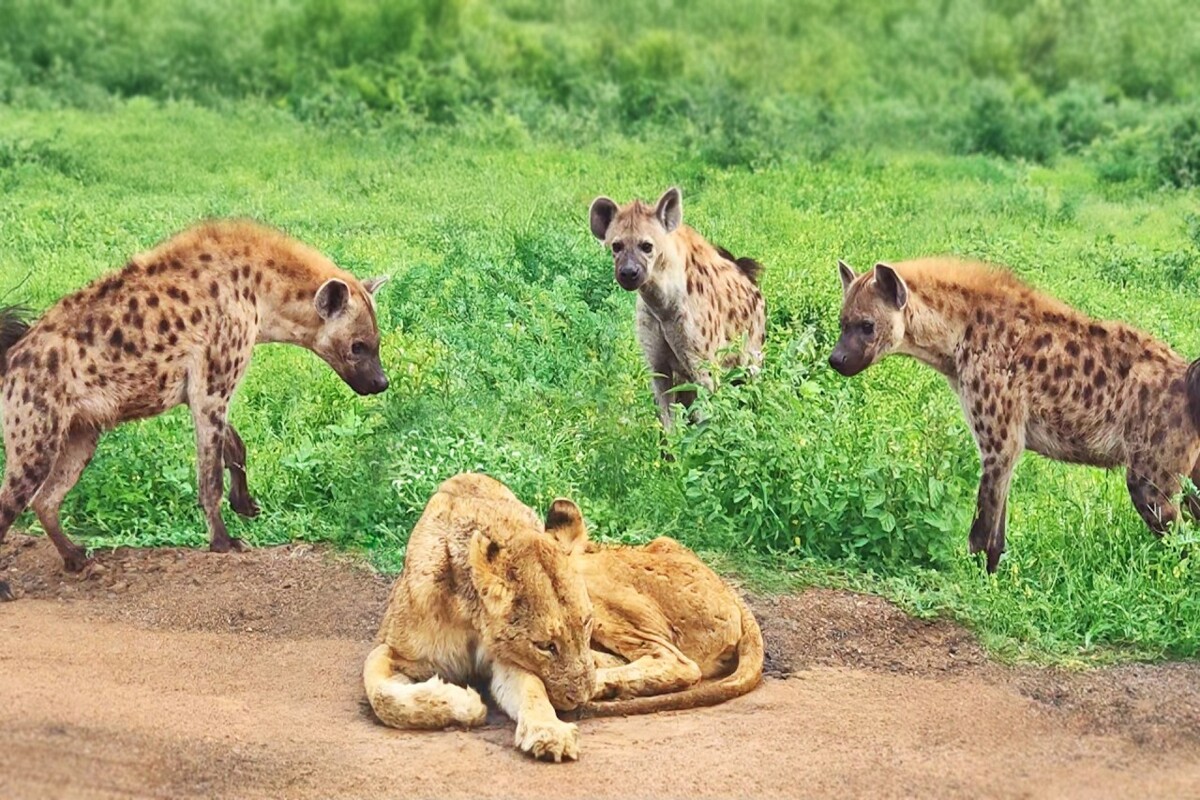
Hyenas Show Mercy on Old & Blind Lioness in Kruger

Old blind lioness surrounded by spotted hyenas in Kruger National Park

A lone lioness lay beside the road in Kruger National Park, looking nothing like the powerful predator people normally imagine when they hear the word “lion.”

She appeared extremely old and frail.

More troubling still, the lioness appeared to be blind.

Then a group of spotted hyenas came walking down the road.

For a lioness, this was an extremely dangerous situation.

Lions and spotted hyenas are among Africa’s most important large predators, and the two species compete directly for food. They can steal from each other’s kills, confront one another over carcasses, and sometimes kill one another. Animal Diversity Web describes this relationship as direct competition that can lead to violent encounters.

Yet the hyenas in this remarkable encounter did something unexpected.

They approached.

They investigated.

They came remarkably close.

And then they walked away.

There was no dramatic attack.

No chase.

No prolonged fight.

Instead, the hyenas appeared to recognize that the strange lioness lying before them was not behaving like a normal, dangerous adult lion.

The encounter was filmed by Steyn Jacobsohn on the S25 in Kruger National Park, South Africa, and published by Latest Sightings on February 10, 2025.

A Lioness Who Could Barely Respond

The sighting began with a normal lion sighting.

Steyn Jacobsohn and the other observers expected to find a lion.

What they discovered was much more unusual.

It was a lioness, but something was clearly wrong.

According to Steyn’s account, the lioness appeared to be blind, although he did not know what had caused her condition.

As she lifted her head, the impairment was apparent.

She did not respond normally to movement around her.

She seemed unable to identify what was approaching.

And she appeared physically weak.

The African lion is normally an exceptionally capable predator. Lions possess powerful forelimbs, large canine teeth and strong jaws, while lionesses are important hunters within prides.

But this lioness was in a very different condition.

Her usual defenses appeared severely reduced.

Then the Hyenas Appeared

The road was quiet.

Then hyenas came down the road.

At first, the animals did not seem to notice the lioness.

This was remarkable in itself.

A lion lying beside a road should normally attract immediate attention from another large predator.

But the hyenas initially passed behind her without appearing to realize exactly what was there.

The lioness also appeared unaware of them.

She turned her head at times, but there was no obvious aggressive response.

Neither species immediately understood the situation.

Then the hyenas picked up her scent.

Everything changed.

The Hyenas Turn Back

After passing behind the lioness, the hyenas detected her presence.

They began approaching.

For a moment, the encounter looked as though it could become extremely violent.

The hyenas were more numerous.

The lioness was alone.

And she was apparently unable to see properly.

Under normal circumstances, that combination could be disastrous for a solitary lion.

But the hyenas did not rush in.

They slowed down.

They approached cautiously.

That hesitation became one of the strangest aspects of the entire encounter.

Lions and Hyenas Are Ancient Competitors

To understand how unusual the scene was, it helps to understand the relationship between these two species.

The spotted hyena is not simply a scavenger waiting for lions to finish hunting.

Spotted hyenas are powerful predators in their own right.

Animal Diversity Web describes them as one of Africa’s top predators and notes that they can hunt a wide range of prey, including large mammals.

Lions and hyenas can therefore compete for exactly the same resources.

A lion may kill prey.

Hyenas may try to steal it.

Hyenas may make a kill.

Lions may attempt to take it.

The resulting encounters can become extremely aggressive.

The Lioness Is Normally the Dangerous One

Under normal conditions, a lioness would be a formidable opponent.

Lionesses are the primary hunters in many lion prides and frequently work together when targeting large prey.

Animal Diversity Web notes that African lions live in social groups and occupy habitats with abundant ungulate prey, while lions can also compete aggressively with other predators.

A healthy adult lioness therefore represents a serious threat to a hyena.

Even several hyenas have to consider the risks of approaching a lion.

That may explain some of the caution visible in the footage.

The hyenas did not know exactly what condition the lioness was in.

They approached carefully.

The Hyenas Move Closer

The hyenas continued toward her.

Their tails were raised.

Their attention was fixed on the lioness.

But something was missing.

There was no explosive attack.

Latest Sightings noted that the hyenas did not produce the intense whooping often associated with excitement and group activity in spotted hyenas during such encounters.

Instead, they appeared uncertain.

The lioness was not behaving as expected.

The Lioness Turns Her Head

The sounds of movement in the grass finally caught the lioness’s attention.

She turned toward the hyenas.

But there was no charge.

No attempt to run.

No obvious effort to attack.

She simply turned her head.

The hyenas continued to approach.

For the observers, this was an extraordinary sight.

A lioness was surrounded by one of her species’ most important competitors, yet she appeared almost incapable of responding.

A Soft Growl

Eventually, the lioness gave a low growl.

It was not the explosive roar of a powerful lion confronting a rival.

It was a much weaker warning.

The hyenas heard it.

But they still did not attack.

This is one of the moments that makes the footage so unusual.

The lioness was communicating that she was aware of the animals around her.

The hyenas were communicating through posture and movement.

Both species were assessing the situation.

The Hyenas Seem Confused

Latest Sightings described the hyenas as appearing confused by the lioness’s lack of reaction.

That interpretation is important because it avoids claiming that the hyenas necessarily felt “pity” in the human sense.

We cannot know what the animals were thinking.

What we can observe is that their behavior was unusually cautious.

They did not immediately attack.

They came closer.

They watched.

And they eventually moved on.

Did the Hyenas Show Mercy?

The video’s title calls it “mercy.”

That is a powerful description.

But scientifically, it is safer to describe the behavior as unusually tolerant or non-aggressive rather than claiming that the hyenas consciously felt compassion.

Animal behavior can be explained through many possibilities.

The hyenas may have been curious.

They may have recognized that the lioness posed little immediate threat.

They may have been uncertain about approaching an unusual animal.

They may have been responding to the absence of normal defensive behavior.

Or several factors may have influenced the encounter at once.

The footage cannot tell us exactly which explanation is correct.

Why Didn’t the Hyenas Attack?

There is no confirmed answer.

But the behavior is fascinating.

A healthy lion can be dangerous.

A sick or injured lion can be a very different proposition.

The hyenas may have assessed the situation and found little reason to take the risks associated with an attack.

Animal Diversity Web notes that spotted hyenas and lions compete directly and that their encounters can result in death.

Avoiding unnecessary injury is therefore an important consideration for any hyena.

A predator does not necessarily attack every vulnerable animal it encounters.

Predators Have to Manage Risk

Wild predators live in a world where injuries matter.

A broken leg can prevent hunting.

A damaged jaw can make feeding difficult.

A serious wound can become infected.

For a hyena, even a weakened lion may still have claws and teeth.

The safest strategy may sometimes be to investigate without committing to a physical confrontation.

That could help explain why these hyenas came close but stopped short of attacking.

The Lioness Was Not Acting Like a Normal Lion

One of the strongest clues was her behavior.

She did not rise.

She did not charge.

She did not chase the hyenas.

She barely reacted.

The hyenas may have been responding to that unusual behavior.

From their perspective, they were not facing the same kind of lion they would normally encounter.

Instead, they found an animal that appeared severely compromised.

The Mystery Behind Her Blindness

One of the most important details is that the cause of the lioness’s blindness was not established.

Steyn Jacobsohn said he did not know what had happened to her. Latest Sightings mentioned possible cataracts as one theory and also noted speculation about a previous spitting cobra encounter, but neither explanation was confirmed.

That uncertainty should remain part of the story.

It would be misleading to state that a snake caused her blindness.

Likewise, it would be misleading to state that she definitely had cataracts.

The footage only establishes that her eyesight appeared severely impaired.

What Could Cause Vision Problems in a Wild Lion?

Wild animals can experience vision problems for many reasons.

Age-related changes, injuries, infections and other diseases can affect eyesight.

Cataracts, for example, involve clouding of the eye’s lens and can impair vision.

But without veterinary examination, it is impossible to determine what caused this lioness’s condition.

That is why the original account wisely leaves the cause uncertain.

Old Age Changes Everything

Age can dramatically alter the survival prospects of a predator.

A young lion can hunt.

A healthy adult lioness can chase prey.

But an elderly animal may gradually lose physical condition.

Vision can deteriorate.

Teeth can wear down.

Muscle mass can decrease.

The ability to pursue prey can decline.

For a predator, these changes are especially serious because the animal depends on physical ability to obtain food.

A Lioness Without Her Pride

The lioness was also alone.

That matters enormously.

Lions are unusual among cats because they are highly social.

A lion pride can contain related females, their offspring and, depending on the pride structure, adult males.

Social living can provide protection, hunting opportunities and access to food.

Animal Diversity Web describes lions as social animals living in prides and notes that social relationships are an important part of their ecology.

A solitary lioness therefore lacks many of the advantages normally provided by a pride.

Why Being Alone Is Dangerous

A lone healthy lion can still be dangerous.

A lone weak lion is another matter.

Without companions, the lioness had fewer opportunities to share food or receive protection.

She also had no other lions immediately available to help drive away the hyenas.

That made her position extremely vulnerable.

The Hyenas Keep Their Distance

Despite the apparent weakness of the lioness, the hyenas did not crowd directly around her.

They generally remained a few metres away.

That distance is revealing.

It suggests that the hyenas were still treating the lioness as an animal that deserved caution.

A lion’s reputation as a dangerous competitor does not disappear simply because one individual appears weak.

The hyenas still had to assess her.

The Strange Silence

Another unusual feature of the encounter was the relative lack of vocal aggression.

Spotted hyenas are highly vocal animals.

They communicate through whoops, giggles, growls, calls and other sounds.

But according to Latest Sightings, the hyenas did not produce the expected whooping behavior as they approached the lioness.

That silence added to the strange atmosphere.

The road was quiet.

The lioness barely moved.

The hyenas approached carefully.

It was almost as though everyone was waiting for something to happen.

A Spotted Hyena Is a Powerful Predator

The spotted hyena is a remarkable predator in its own right.

Animal Diversity Web reports that females are generally larger than males and that spotted hyenas possess exceptionally powerful jaws relative to their body size.

Their ability to consume bones is legendary.

Their social organization is also sophisticated.

They live in clans and cooperate in hunting, defense and other activities.

That social power helps explain why lions and hyenas have such a complicated relationship.

Hyenas Are Not Simply Scavengers

The old image of hyenas as cowardly scavengers is inaccurate.

Spotted hyenas are capable hunters.

They can pursue prey over long distances and kill animals themselves.

Animal Diversity Web notes that spotted hyenas use keen senses to hunt live prey and can chase prey at speeds approaching 60 km/h.

They also scavenge extensively.

Their ecological flexibility is one reason they are so successful.

Lions and Hyenas Compete Constantly

Because both species can hunt and scavenge, competition is unavoidable.

Animal Diversity Web states that lions and spotted hyenas often compete for food and can scavenge each other’s kills. These encounters may become antagonistic and sometimes fatal.

That makes the behavior in this video even more unusual.

Instead of exploiting a vulnerable rival, the hyenas simply investigated and moved on.

A Rare Moment of Restraint

The word “restraint” should also be used carefully.

The hyenas may not have consciously decided to spare the lioness.

There is no way to know that from the footage.

But behaviorally, there was restraint.

The animals approached without escalating into a physical attack.

They had an opportunity to interact aggressively.

They did not take it.

That is the observable fact.

One Hyena Scent-Marks Nearby

The encounter was not completely passive.

One hyena eventually scent-marked nearby.

Scent marking is an important part of hyena communication.

Animal Diversity Web notes that spotted hyenas use scent marking and other forms of communication to interact with members of their social group and establish information about their surroundings.

So while the hyenas did not attack the lioness, they were still behaving like hyenas.

They were investigating and communicating in their normal environment.

The Lioness Lowers Her Head

After the hyenas had spent time near her, the lioness lowered her head again.

Her chin rested against the ground.

She appeared exhausted.

This was perhaps the saddest moment of the encounter.

The animal that would normally command respect across the savanna was now unable to defend herself effectively.

The hyenas eventually moved away.

The lioness remained.

Then the Hyenas Leave

The hyenas eventually continued down the road.

The encounter was over.

There was no dramatic chase.

No attack.

No kill.

Just a group of predators passing by a severely weakened competitor.

Latest Sightings described the behavior as unusually calm and suggested that the hyenas may have concluded that the lioness was no longer a meaningful threat or that attacking her was not worth the risk.

That interpretation remains a possibility rather than a proven explanation.

What Happened to the Lioness?

This is where the story becomes uncertain.

The video ends while the lioness is still alive.

There is no confirmed account in the original video description establishing exactly what happened to her afterward. Latest Sightings suggested that, given her condition, her chances of surviving much longer were poor.

But that is not the same as knowing her eventual fate.

We should not invent an ending that the footage does not provide.

Her story remains unfinished.

Nature Is Not Always a Quick Death

The encounter also highlights a difficult reality of life in the wild.

Predators do not always die during dramatic hunts.

Sometimes old age or illness gradually reduces an animal’s ability to survive.

An animal may become unable to hunt effectively.

It may lose weight.

It may become vulnerable to competitors.

Eventually, it may die from starvation, disease, predation or a combination of factors.

This can be a slow process.

Why the Encounter Feels So Emotional

The image of an old, apparently blind lioness surrounded by hyenas naturally triggers an emotional response in human viewers.

The lion is an iconic symbol of strength.

Seeing one in such a vulnerable condition creates a powerful contrast.

But the scientific story is equally fascinating.

The footage shows how a predator’s social position and physical condition can completely change an interaction with another predator.

The lioness was still a lion.

But her behavior and apparent condition changed the risk calculation for the hyenas.

The Lion Was Still Dangerous

Even in her weakened condition, the lioness remained potentially dangerous.

That is why the hyenas did not simply walk directly over to her.

They approached cautiously.

A single bite or swipe could still cause injury.

Wild predators do not necessarily know precisely how strong another animal is.

They have to assess it.

The hyenas appeared to do exactly that.

A Balance Between Curiosity and Caution

The behavior can perhaps be understood as a balance.

The hyenas were curious enough to investigate.

But they were cautious enough not to commit to an attack.

That combination is common in wildlife.

An animal may approach something unfamiliar while remaining ready to retreat.

The raised tails and careful movements visible in the encounter suggest that the hyenas were alert to the situation.

Why the Hyenas May Have Walked Away

Several explanations are possible.

The lioness may have appeared too weak to be worth attacking.

The hyenas may have been uncertain about her condition.

They may have been investigating rather than hunting.

They may have recognized the risks of physical contact.

Or they may simply have lost interest.

The footage cannot distinguish conclusively between these possibilities.

What we know is that the encounter ended peacefully.

The Importance of Not Humanizing Wildlife Too Much

The phrase “showed mercy” makes for a powerful headline.

But wildlife behavior is often more complicated than human morality.

Animals do not need to experience compassion in the same way humans do for their behavior to appear compassionate.

The hyenas may have been responding to risk, novelty, uncertainty or the absence of a threat.

That does not make the encounter less remarkable.

It makes it more scientifically interesting.

Kruger National Park: A World of Predator Competition

The encounter happened in Kruger National Park, one of Africa’s most famous protected areas.

The park supports large populations of lions and spotted hyenas along with leopards, wild dogs and numerous herbivore species. Its biodiversity statistics include both lions and spotted hyenas among its major large predators.

This makes Kruger an extraordinary place to observe predator competition.

The same landscape can support several large carnivores at once.

And when their territories and food sources overlap, encounters are inevitable.

The S25 and the Wildlife Around It

The sighting occurred on the S25, a road within Kruger National Park.

Safari roads often provide unusual opportunities to observe wildlife because animals sometimes use or cross them.

In this case, the road became the stage for a remarkable predator interaction.

The lioness rested beside it.

The hyenas approached along it.

And the observers were able to document behavior that would otherwise have remained unseen.

The Difference Between a Healthy Lion and a Vulnerable Lion

This encounter provides a striking comparison.

A healthy adult lioness can be a dangerous opponent.

A severely weakened lioness may be unable to respond effectively.

The same species can therefore occupy completely different positions in the predator hierarchy depending on age and physical condition.

That is one of the harsh realities of natural selection.

Strength is not permanent.

Health is not guaranteed.

And every predator eventually faces the effects of age.

What This Encounter Teaches Us About Hyenas

The encounter challenges several common misconceptions about hyenas.

They are not simply cowardly scavengers.

They are powerful predators.

They are intelligent and socially complex.

They compete directly with lions.

And they do not necessarily attack every vulnerable animal they encounter.

The spotted hyena is one of Africa’s most important large carnivores and plays a major ecological role through both hunting and scavenging.

What This Encounter Teaches Us About Lions

It also provides an important reminder about lions.

Even an apex predator is not invincible.

Age, injury, disease and isolation can dramatically change an animal’s ability to survive.

The lioness’s condition showed what can happen when a predator loses the physical abilities that normally allow it to hunt and defend itself.

The Most Unusual Part Was What Did Not Happen

There are plenty of dramatic wildlife videos showing lions and hyenas fighting.

This one is memorable for the opposite reason.

The fight never happened.

The hyenas came close.

The lioness growled.

The hyenas investigated.

Then they left.

Sometimes the absence of violence is itself the most remarkable part of a wildlife encounter.

A Powerful Ending Without a Battle

The final image is haunting.

The hyenas disappear down the road.

The old lioness remains behind.

Her head lowers again.

The landscape becomes quiet.

There is no triumphant predator.

No victorious prey.

No dramatic ending.

Only an aging wild animal facing an uncertain future.

And perhaps that is why the footage stays with viewers.

Watch the Original Video

Watch the complete encounter here:

Hyenas Show Mercy on Old & Blind Lioness — Latest Sightings

The video was published by Latest Sightings on February 10, 2025. The footage was submitted by Steyn Jacobsohn and recorded on the S25 in Kruger National Park.

More Wildlife Encounters From khxyz

If you enjoy unusual predator encounters, explore more wildlife stories from khxyz: