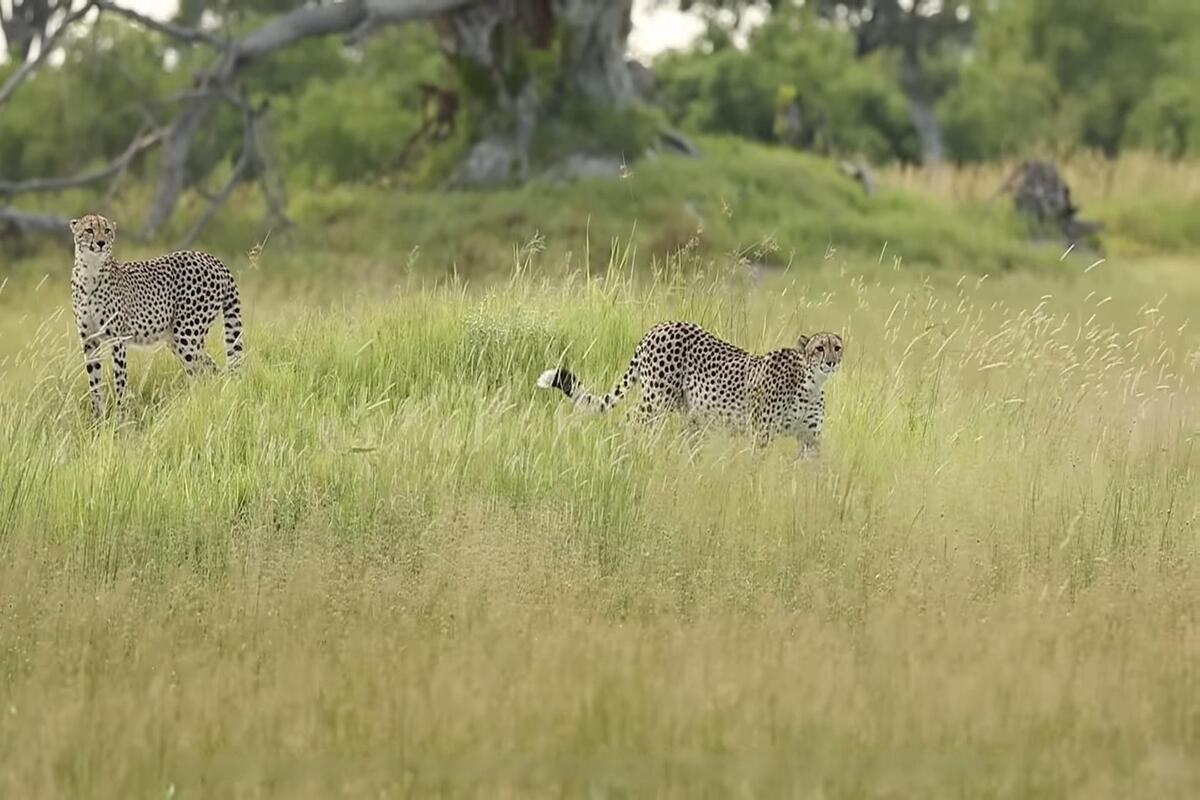
A mother cheetah was resting with her nearly grown cub in the Okavango Delta when something dangerous was watching them from a tree.
The leopard was almost impossible to see.
Hidden among the branches of a marula tree, it had already spotted the two cheetahs below. The mother was scanning the landscape, apparently unaware that another big cat was quietly watching from nearby.
Then the leopard moved.
The ambush was beginning.
But the leopard had made one mistake.
It had underestimated the mother.
Instead of immediately running away, the mother cheetah turned toward the threat and moved aggressively in its direction. What followed became an extraordinary standoff between two of Africa’s most famous cats.
The encounter was filmed by experienced guide Daryl Dell at andBeyond’s Xaranna Okavango Delta Camp in Botswana and published by Latest Sightings on February 19, 2025.
A Quiet Morning in the Okavango Delta
The encounter began during an early-morning safari.
Daryl Dell and his guests were searching for a mother cheetah and her older cub after having seen the pair the previous afternoon.
The Okavango Delta is one of Africa’s most remarkable wetland ecosystems, creating a mosaic of waterways, grasslands, woodland and seasonal floodplains.
It is also home to an extraordinary concentration of predators.
Cheetahs, leopards, lions, African wild dogs and spotted hyenas can all occur within the broader Okavango ecosystem.
That means a predator must constantly remain alert.
The mother cheetah appeared to understand that.
She climbed onto a termite mound and began scanning the surrounding landscape.
The Leopard Was Already Watching
Unknown to the cheetah, a leopard was sitting in a marula tree nearby.
The assistant guide spotted the leopard before the cheetahs did.
That gave the safari group a remarkable perspective.
They could see the danger.
The cheetahs could not.
The leopard is one of Africa’s most effective ambush predators. Animal Diversity Web describes leopards as solitary carnivores that commonly approach prey using a slow, crouching movement before launching a short attack.
Their spotted coats also provide excellent camouflage.
In this case, the leopard’s camouflage worked.
It remained still enough that the cheetahs did not immediately detect it.
The Cheetah Steps Off the Mound
Eventually, the mother apparently felt comfortable enough to leave the termite mound.
That was the moment the leopard had been waiting for.
The leopard climbed down from the tree and began moving through the vegetation.
The thick cover gave the leopard an enormous advantage.
It could approach without exposing itself.
The distance between the two predators quickly disappeared.
According to Latest Sightings, the leopard eventually came within roughly 20 metres of the cheetahs.
The mother and cub still had not fully recognized the danger.
A Leopard Gets Into Position
The leopard continued stalking.
It moved carefully through the vegetation, using cover to remain concealed.
This is classic leopard hunting behavior.
Unlike a cheetah, which often depends on speed and open ground, a leopard can use concealment to get remarkably close before attacking.
Animal Diversity Web describes leopards as ambush predators that can approach prey to within just a few metres before pouncing.
That makes dense Okavango vegetation particularly useful to a leopard.
The cheetah mother was about to discover exactly how close the danger had become.
The Cub Was the Vulnerable Target
The cub was no longer a tiny newborn.
Latest Sightings described it as a sub-adult.
That distinction matters.
The youngster was old enough to move around independently, but it was not yet fully independent from its mother.
And compared with an adult cheetah, a sub-adult was still a more vulnerable target.
The leopard had the size and strength advantage.
The mother therefore faced a dangerous choice.
Run?
Fight?
Or try to intimidate the leopard?
The Mother Climbs Another Mound
Something appeared to trigger another bout of caution in the mother.
She climbed a second mound to scan the surroundings.
This time, she was looking directly toward the leopard.
The leopard was extremely close.
Yet it remained almost perfectly still.
For several moments, neither animal moved.
It was one of those rare wildlife scenes where the smallest movement can completely change the outcome.
The safari guests could see the leopard.
The cheetah was looking toward the leopard.
But the predator remained difficult to distinguish from the surrounding vegetation.
Then the Leopard Moves
Eventually, the leopard shifted slightly.
That tiny movement was enough.
The camouflage was broken.
The mother cheetah detected the threat.
Suddenly, the situation was no longer an ambush.
The leopard had lost the element of surprise.
And the mother had a decision to make.
The Cheetah Does Something Unexpected
A cheetah’s most famous defense is speed.
If a larger predator approaches, running away is often the safest option.
Animal Diversity Web notes that most adult cheetahs flee from predators, while lions, hyenas and leopards are among the species known to kill cheetahs or cheetah cubs.
But this mother did something very different.
She moved toward the leopard.
Latest Sightings reported that instead of using her speed to escape, she became aggressive and moved directly toward the leopard while her cub remained behind her.
That changed everything.
A Mother Between Two Predators
The mother effectively positioned herself between the threat and her youngster.
It is important not to translate this into human emotions that cannot be directly measured.
But the observable behavior is clear.
The mother moved aggressively toward the leopard while the cub remained behind her.
That is consistent with defensive maternal behavior.
Animal Diversity Web records parental care and protection of young in cheetahs, and leopard research likewise documents strong maternal investment in offspring.
The mother was not simply fleeing.
She was confronting the immediate threat.
The Leopard Is Surprised
The leopard had approached expecting an opportunity.
Instead, it suddenly faced an adult cheetah moving toward it.
This was not the situation the leopard had prepared for.
The two cats began moving around each other.
The encounter became almost like a chase in reverse.
The leopard had been stalking the cheetahs.
Now the cheetah was pushing toward the leopard.
The hunter had suddenly become the animal being pressured.
Speed Versus Strength
This encounter highlights the enormous difference between the two species.
The cheetah is built primarily for speed.
The leopard is built for stealth, strength and versatility.
Cheetahs possess long legs, a flexible spine and specialized anatomy associated with high-speed pursuit.
Leopards, meanwhile, have powerful limbs and are exceptionally capable climbers.
Animal Diversity Web reports that leopards can run in short bursts at around 60 km/h and can tackle prey several times their own body mass.
A direct fight therefore carried significant risk for the smaller, more lightly built cheetah.
But the mother did not appear interested in fighting on the leopard’s terms.
She used movement and aggression to keep the leopard away from her cub.
The Cub Watches From Behind
Throughout the confrontation, the youngster remained behind its mother.
That was important.
The cub did not need to confront the leopard directly.
The mother was taking the lead.
The situation also demonstrates why remaining close to an experienced adult can be so valuable for a young predator.
Cheetah cubs face substantial mortality from other predators.
Animal Diversity Web identifies lions, hyenas and leopards among the predators known to kill cheetah cubs.
A mother therefore faces a difficult challenge: she must find food while also keeping vulnerable offspring alive in a landscape full of competitors.
Why Leopard Encounters Are So Dangerous
Leopards and cheetahs are not simply two unrelated predators that occasionally meet.
They can compete for prey and space.
Animal Diversity Web notes that leopards compete with other carnivores, including cheetahs, and are also known to scavenge from cheetahs.
That creates a complicated relationship.
A leopard can potentially kill a cheetah cub.
A leopard can also steal food from a cheetah.
And an encounter between adults can become dangerous for both animals.
For the mother in this video, keeping the leopard away from the cub was therefore critical.
The Leopard Retreats
The confrontation continued until the leopard began moving away.
Instead of pursuing the leopard as prey, the mother continued to pressure it.
The leopard eventually headed toward a nearby tree.
This is where the encounter becomes almost surreal.
A leopard is normally the cat associated with trees.
It is an excellent climber and frequently uses trees for resting, escaping competitors and storing food.
In this encounter, the leopard was effectively being pushed toward one of its most important natural refuges.
The Cheetah Escorts the Leopard
Latest Sightings described the remarkable ending by saying that the cheetah effectively “escorted” the leopard toward the nearest tree.
The wording captures the unusual reversal.
The leopard had started the encounter as the hidden predator.
It had approached the cheetahs under cover.
But once discovered, it ended up retreating toward a tree while the mother cheetah followed.
The cub remained safely behind.
The Leopard’s Tree Advantage
Once the leopard reached the tree, its physical advantages became important again.
Leopards are highly capable climbers.
Their muscular limbs, retractable claws and flexible bodies make trees useful refuges.
Animal Diversity Web describes leopards as partly arboreal and notes that they commonly use trees for feeding and other activities.
A cheetah cannot match a leopard’s climbing specialization.
So the tree provided the leopard with a natural escape route.
The confrontation was effectively over.
The Mother Had Achieved What She Needed
The most important result was not defeating the leopard.
It was keeping the leopard away from the cub.
The mother had successfully disrupted the ambush.
The leopard did not get the opportunity to attack the youngster.
The cub followed safely behind its mother.
Latest Sightings reported that the mother ultimately won the standoff and the cub remained safe.
In the language of wildlife survival, that was the important outcome.
Why Cheetah Mothers Face an Impossible Job
Raising cubs is one of the most difficult periods in a female cheetah’s life.
She has to hunt.
She has to find enough food.
She must avoid larger predators.
And she must protect offspring that are not yet capable of surviving independently.
This is particularly difficult because cheetahs are not built to defend themselves against every larger carnivore.
Their greatest weapon is speed.
But speed does not solve every problem.
If a cub is cornered, the mother may have to take a completely different approach.
The Importance of Maternal Protection
Cheetah mothers provide extensive care for their offspring.
Young cubs depend on their mother for food and protection while they develop.
Animal Diversity Web documents parental care in cheetahs and specifically identifies protection of young as part of their parental behavior.
The video provides a dramatic real-world example of why that protection matters.
A sub-adult may be capable of moving quickly.
But against a powerful leopard, speed alone may not always be enough.
Cheetah Cubs Face High Mortality
One of the harshest facts about cheetah biology is that cub survival is difficult.
Animal Diversity Web notes that cheetah cub mortality is particularly high and identifies several predators, including leopards, as threats.
This makes the encounter more significant.
The leopard was not simply another animal passing through.
It represented a genuine threat to the youngster.
The mother’s decision to confront it therefore occurred in a context where the survival of young cheetahs is already challenging.
A Leopard Is Also a Mother
There is another fascinating dimension to this encounter.
Leopards themselves invest heavily in their offspring.
Female leopards leave cubs concealed in dense vegetation, rock crevices or hollow trees while they hunt, and they frequently move den sites. These behaviors help reduce the risk of cubs being discovered by predators.
So the two animals involved are both mothers in their own species’ survival strategy.
One was protecting a sub-adult.
The other was acting as a solitary predator looking for an opportunity.
That is the complexity of wildlife.
Two Different Forms of Survival
The leopard relies heavily on:
- Camouflage
- Stealth
- Ambush
- Strength
- Climbing
The cheetah relies heavily on:
- Speed
- Acceleration
- Agility
- Excellent vision
- Rapid changes of direction
The encounter brought those different adaptations into direct conflict.
The leopard’s stealth created the initial advantage.
The cheetah’s awareness and aggression eventually changed the situation.
The Importance of the Termite Mound
The termite mounds were more than background scenery.
They gave the cheetah mother elevated positions from which she could scan the surroundings.
That was especially valuable in an environment where predators can hide in thick vegetation.
From higher ground, a cheetah can potentially gain a better view across the surrounding landscape.
In this encounter, the mother used a mound again just before detecting the leopard.
The Leopard’s Camouflage Nearly Worked
The leopard’s coat is another reason this encounter was so tense.
The rosette pattern breaks up the animal’s outline and can make it difficult to distinguish from shadows, branches and vegetation.
The leopard was sitting almost motionless in the marula tree before moving down and stalking through cover.
Its camouflage was so effective that even when the safari group knew where it was, it remained difficult to see.
That is exactly what an ambush predator needs.
One Small Movement Changed Everything
The entire ambush might have developed differently if the leopard had remained completely still.
But movement gave it away.
That tiny change allowed the cheetah to recognize the danger.
The moment the mother became aware of the leopard, the predator’s biggest advantage disappeared.
Stealth had become detection.
And detection allowed the cheetah to respond.
The Encounter Became a Standoff
Neither cat wanted unnecessary physical contact.
That is an important distinction.
A confrontation between two predators can be extremely costly.
An injury can make hunting difficult.
A damaged leg can be disastrous.
A deep bite can become infected.
For a cheetah, which depends heavily on physical performance, injury could have serious consequences.
For a leopard, the same is true.
The safest outcome for both animals was ultimately to create distance.
Why the Mother Did Not Simply Run
The most striking question from the video is why the mother did not immediately use her famous speed.
The footage does not allow us to know her exact internal motivation.
But the observed sequence is clear: after detecting the leopard, she moved toward it instead of immediately fleeing, while the cub remained behind her.
One reasonable biological interpretation is defensive behavior toward a vulnerable offspring.
But we should distinguish that interpretation from claims about human-like courage, sacrifice or conscious calculation.
What we can observe is extraordinary enough.
A Rare Big-Cat Encounter
Seeing a leopard and cheetah in the same area is already special.
Watching a leopard stalk a cheetah mother and sub-adult, followed by the mother confronting and driving the leopard away, is considerably rarer.
Latest Sightings described the sighting as an unusually rare encounter.
The safari guests were fortunate to witness a sequence that lasted long enough to show both the ambush and the reversal.
The Okavango Is Full of Predator Competition
The Okavango Delta supports a remarkable collection of carnivores.
Its seasonal floodwaters create islands, channels and grasslands where predators and prey constantly interact.
Cheetahs can take advantage of open areas.
Leopards can use woodland and vegetation.
Lions can operate in prides.
African wild dogs can pursue prey cooperatively.
Every predator has its own strategy.
But those strategies sometimes overlap.
That is when encounters like this become possible.
A Cub Safe Behind Its Mother
The final image is perhaps the most memorable.
The mother moves forward.
The leopard retreats.
The cub follows safely behind.
There is no dramatic kill.
No prolonged fight.
No obvious injury.
Instead, the encounter ends through intimidation, movement and distance.
That is often how wildlife conflicts are resolved.
The strongest animal does not necessarily win.
Sometimes the animal that successfully controls the distance wins the encounter.
What This Encounter Teaches Us
This rare confrontation provides several lessons about African predators.
Cheetahs are not helpless
Although they avoid many physical confrontations, cheetahs can respond aggressively when necessary.
Mothers protect vulnerable offspring
Cheetah mothers invest heavily in raising young, and predators such as leopards pose a genuine threat to cub survival.
Leopards depend on stealth
The leopard came remarkably close before its movement revealed its position.
Speed is not always the first defense
The mother did not immediately run.
She confronted the threat instead.
Trees give leopards an important advantage
Once the leopard reached a tree, its climbing ability gave it a natural refuge.
Avoiding injury matters
Neither predator needed a serious fight.
Creating distance was ultimately safer.
A Different Kind of Wildlife Victory
The title says the cheetah put everything on the line.
The footage certainly looks dramatic.
But the most useful way to understand the encounter is not as a human-style act of heroism.
It is as a rare example of defensive behavior between a mother and a vulnerable offspring under immediate predation risk.
The mother detected the threat.
She confronted it.
The leopard withdrew.
The cub remained safe.
Those observable facts tell a remarkable story on their own.
Watch the Original Video
Watch the complete encounter here:
Cheetah Puts Everything on the Line to Protect Cub from Leopard — Latest Sightings
The video was published by Latest Sightings on February 19, 2025, and features footage filmed by experienced guide Daryl Dell at andBeyond’s Xaranna Okavango Delta Camp in Botswana.
More Wildlife Encounters From khxyz
If you enjoy dramatic encounters involving big cats and vulnerable young animals, explore more wildlife stories from khxyz:
- Cheetah Mom and Cub Mobbed by 50+ Baboons
- Leopard Hides and Waits for Impalas
- Lion Catches Leopard Cub
- Lion Digs Inside Tree to Get to Leopard Cub
- Three Cheetahs vs Ostrich
 Add as Preferred Source